
If you have ever laid out ten cards and frozen, unsure which position to read first, the problem is not the cards but what you think a position is. Card meanings are easy to look up. Positions only ever come back as a label — “this one is the obstacle” — and nobody tells you where that label came from.
So this guide opens with a question and returns to it later. If a position changes what a card means, who decided the names of the positions? Once you know, choosing a spread changes, and building your own becomes possible.
Today's question
You learned the position names. Why does the spread still not read?
Positions are not inherited truth. They are a device for cutting one large question into pieces a card can answer. Decide what sub-question each position carries, and the card only has to answer that.
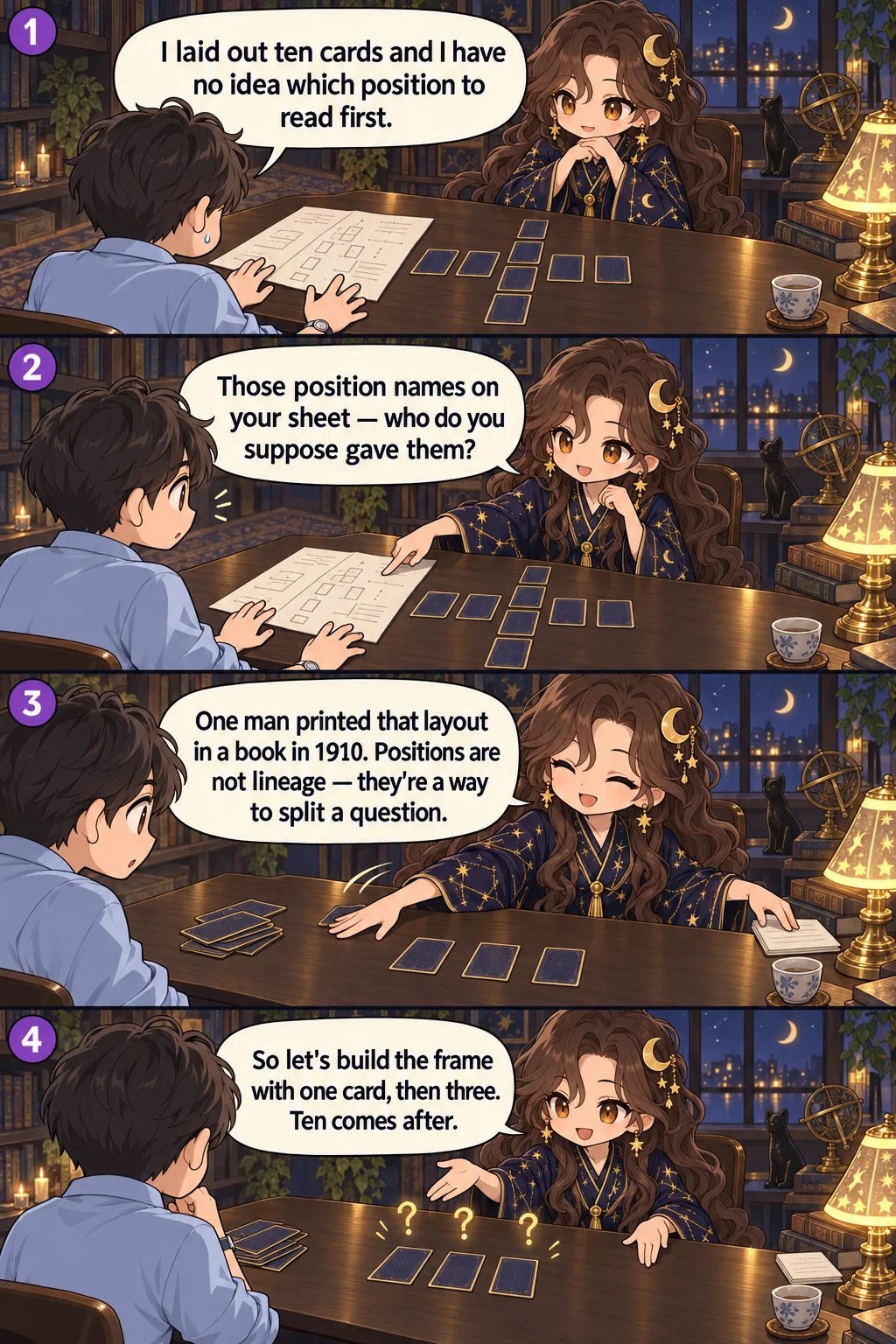
The short answer: a spread cuts the question down to size
“Will this year go well for me?” is hard to answer with one card, because the question is too large. Cut it into where I am standing / what I am blocking / the one step I could take next and each piece becomes something a single card can carry. That is precisely the work a spread does.
This is why treating a position as “the box that gives the card its meaning” keeps you stuck. Positions do not hand out meaning. Positions hand out questions.The card only answers the one it was given, and the reader’s job is to connect that question to what the image shows. If the structure of the seventy-eight is unfamiliar, what tarot is makes all of this easier first.
One card — the fewer the positions, the harder the question
It is the simplest spread and, for that reason, the one that demands the most from your question. With a single position there is nothing left to split, so the question itself has to already be card-sized.
Beginners get stuck most often on closed questions. “Will I succeed if I change jobs?” leaves the card nowhere to land. Closed questions open in three reliable ways.
| Closed question | How to open it | Open question |
|---|---|---|
| Will this job change work out? | Ask for a what | What am I not seeing about this move? |
| Does she like me? | Turn the gaze back | What am I holding onto in this relationship? |
| Should I buy now? | Ask for the criterion | What condition actually decides this? |
All three share one move: they stop asking about the future and ask about now. What cards do well is not prediction but showing your present situation from another angle, so pulling the question into the present makes it far easier to read. Draw one card a day and note at day’s end how it connected — nothing builds the habit of opening a question faster.
Three cards — what you assign to the three positions
Three-card spreads are common not because three is a good number but because three positions can carry three different sub-questions. Change the assignment and the same three cards tell an entirely different story.
| Assignment | What it is for | What the three ask together | What it does not answer |
|---|---|---|---|
| Past · Present · Future | Movement in time | Where this came from and where it is heading | What you should do about it |
| Situation · Action · Outcome | Making a decision | What follows if you do this | When that outcome arrives |
| Strength · Weakness · Advice | Self-assessment | What you hold and what you lack | How other people see you |
| Mind · Body · Relationships | Taking stock | Which layer is carrying too much right now | Anything medical or clinical |
There is one test for choosing. Is this a question about time, about choice, or about me? Curious how things moved, use the time axis. Curious what to do, use the action axis. Curious why you keep doing this, use the self-assessment axis. If all three feel urgent, the question has not been narrowed yet, and the fix is to split the question rather than draw more cards.
Watch a position change a reading
Put the same card in two positions and the principle shows itself. The Star in the present position reads as “there is something worth hoping for now.” The same card in the obstacle position reads as “hope is currently keeping you from moving.” The card did not change at all. What changed was the question the position asked.
This is why “is this a good card or a bad card?” usually has no answer. Without a position, good and bad are undecided. Whether to use reversals sits at the same level of choice, and that decision gets its own treatment in the reversed cards guide.
The Celtic Cross — ten sub-questions
The best-known layout. Six cards in the cross map the inside and outside of the situation; four in the right-hand staff cover you and the outcome. Read in numbered order, but pairing 1 with 10 first gets you the shape of the whole quickly.
| Position | Traditional name | The sub-question it carries |
|---|---|---|
| 1 The present | This covers him (verbatim) | What atmosphere surrounds the matter? |
| 2 The obstacle | This crosses him (verbatim) | What cuts across it? |
| 3 The aim | This crowns him (verbatim) | What is the best I am reaching for here? |
| 4 The foundation | What lies beneath | What was already at the root of this? |
| 5 What has passed | What lies behind | What just left but still lingers? |
| 6 What approaches | What lies before | What is about to enter? |
| 7 My stance | The querent | How am I holding myself toward this? |
| 8 The surroundings | The querent's house | What conditions are outside my control? |
| 9 Hopes and fears | Hopes or fears | What do I want and dread at once? |
| 10 Where it lands | What will come | If nothing changes, where does this arrive? |
The three marked verbatim are the 1910 first-edition phrases exactly as printed. The other seven vary by edition and textbook, so they are given here in the functional names now in common use. Do not try to read ten cards at once — draw the map of the situation with 1 through 6, then read yourself and the outcome with 7 through 10.
Where “ancient Celtic” came from
Time to answer the opening question. The Celtic Cross is first attested in print in A. E. Waite’s The Pictorial Key to the Tarot (1910). In that book, published alongside the Rider-Waite-Smith deck, Waite introduced the layout as “An Ancient Celtic Method of Divination.”
No source supports that ancient Celtic lineage. Writing on tarot history widely explains it as an attribution Waite gave the layout to lend it authority. Both Waite and the illustrator Smith belonged to the Hermetic Order of the Golden Dawn, and a tradition holds that Florence Farr worked a similar layout, though that account travels with the claim that her method differed from the version Waite printed — so “it came from the Golden Dawn” cannot be stated as fact either. What is verifiable stops at the 1910 printing.
What this changes in practice
If the ten positions began in one book a century ago rather than in a thousand-year tradition, then they are not commandments to obey but one well-made design. Well-made, so worth learning. A design, so yours to adapt.
Which means you can build your own
Hold onto the idea that a position is a sub-question and building one is straightforward. Three rules.
- Give each position a different question. If two positions ask effectively the same thing, the cards say the same thing twice and the reader manufactures a difference that is not there.
- Cut to an answerable size.A position called “the direction of my life” is more than one card can carry. “The choice I keep repeating” can be answered.
- Keep exactly one outcome position. With several, the reader picks whichever is more favourable when they conflict — and at that moment the spread stops splitting the question and starts finding the desired answer.
Yes-or-no questions are not decided by orientation
The formula “upright means yes, reversed means no” is widespread, and this guide does not use it. Handing the verdict to which way a card fell lets your shuffling habits decide, and it hides the thing the querent most needs: what actually tips the balance.
Spreading the closed question across three positions is far more useful. What is working in your favour / what is working against you / the one thing that would shift the weight. Laid out this way you get conditions instead of a verdict, and conditions can be acted on.
Choosing a spread
| If the question is | Use | Why |
|---|---|---|
| A focus for today | One card | One position forces one question |
| How the situation got here | Three cards | Three time slots make the movement visible |
| Choosing between two paths | Three cards, twice | Lay a row per option and compare |
| A long, tangled matter | Celtic Cross | Splits inside and outside, past and ahead, at once |
| Yes or no | Your own three | Turn the closed question into what tips it |
More cards do not make a reading more accurate. What grows is how finely the question gets split. Lay ten cards over a question that is not ready to be split and you land back where this guide started, unsure which position to read first. If you want to read this alongside Saju, settle first how the two layers overlap — the boundaries are in Saju × Tarot cross reading, and the cards themselves start in Major Arcana, part one.
In one sentence
A spread is not a device that gives cards meaning. It is a device that cuts one question into pieces a card can answer.
You can practice One-Card and Three-Card right now — one position with today’s card, three with this week’s draw. The Celtic Cross is not in the app; lay that one out with a physical deck.
Sources and production notes
The Celtic Cross first appears in A. E. Waite’s The Pictorial Key to the Tarot(1910), which introduces the layout as “An Ancient Celtic Method of Divination.” No earlier printed record was found within the range searched. The reading of “ancient Celtic” as a romantic attribution and the Florence Farr tradition are, however, secondary accounts common in tarot-history writing that could not be traced to primary scholarship — which is why the body presents them as prevailing views rather than settled fact. Our own tarot feature runs a daily single card and a weekly three in the Fortune tab, the same counts as the one-card and three-card practice above.
Three things are deliberately left unasserted. First, the origin of the Celtic Cross; the 1910 printing is the verifiable limit and anything earlier is unknown. Second, that any spread is more accurate than another; card count changes how finely a question is split, not accuracy. Third, a standard for the position names — only positions 1 through 3 above are the 1910 wording verbatim, and positions 4 through 10 are given in common functional names because the original text could not be obtained. Editions, textbooks and translations differ.
While checking this, the earlier version of this page turned out to assert two things: that the Celtic Cross originated in the late-nineteenth-century Golden Dawn, and that yes-or-no questions can be decided by card orientation. The first is corrected against the citation above; the second is replaced with a three-position layout that asks for conditions. This article introduces how a traditional symbolic system is used and does not offer scientifically validated prediction.
Mystic Universe Editorial
Authorship & review
This article introduces how tarot spreads are used. It is not scientifically validated prediction, and the Celtic Cross citation and the limits of the position names are stated in the sources section.
Frequently Asked Questions
Q.What spread should a beginner start with?▾
One card. With a single position the card work is easy but the question has to be built well, and that skill underpins every other spread. Draw one a day and note at day's end how it connected — nothing develops the habit of opening a question faster. Expand to three cards once that feels natural.
Q.Is the Celtic Cross really a Celtic tradition?▾
What is verifiable stops at the 1910 printing of A. E. Waite's The Pictorial Key to the Tarot. Waite introduced the layout as an ancient Celtic method of divination, but no source supports that lineage and researchers read it as a romantic attribution meant to lend authority. A Golden Dawn origin is also claimed, though Florence Farr's method is held to differ from the version Waite printed, so it cannot be stated as fact.
Q.Can I build my own spread?▾
Yes, because positions are a design for splitting a question rather than an inherited rule. Keep three things: give each position a different question, cut each to a size one card can answer, and keep exactly one outcome position. With several outcome positions the reader picks the favourable one whenever they conflict.
Q.Can I use one card for a yes-or-no question?▾
Deciding by orientation is not recommended. Treating upright as yes and reversed as no lets your shuffling habits settle the answer and hides the conditions that actually tip the question. Spread it across three positions instead: what is working in your favour, what is working against you, and the one thing that would shift the weight. You get actionable conditions rather than a verdict.
Q.If the same card reads differently by position, isn't that arbitrary?▾
It is not arbitrary, because the position was fixed first. The Star in the present position means there is something worth hoping for; in the obstacle position it means hope is holding you still. Both readings answer the question that position asked. It only becomes arbitrary when you read without assigning positions at all.
Related Articles
Start with one card today?
The Fortune tab draws one card for today and three for the week.
Draw Today's CardThis content is for entertainment purposes only and does not replace professional advice.