

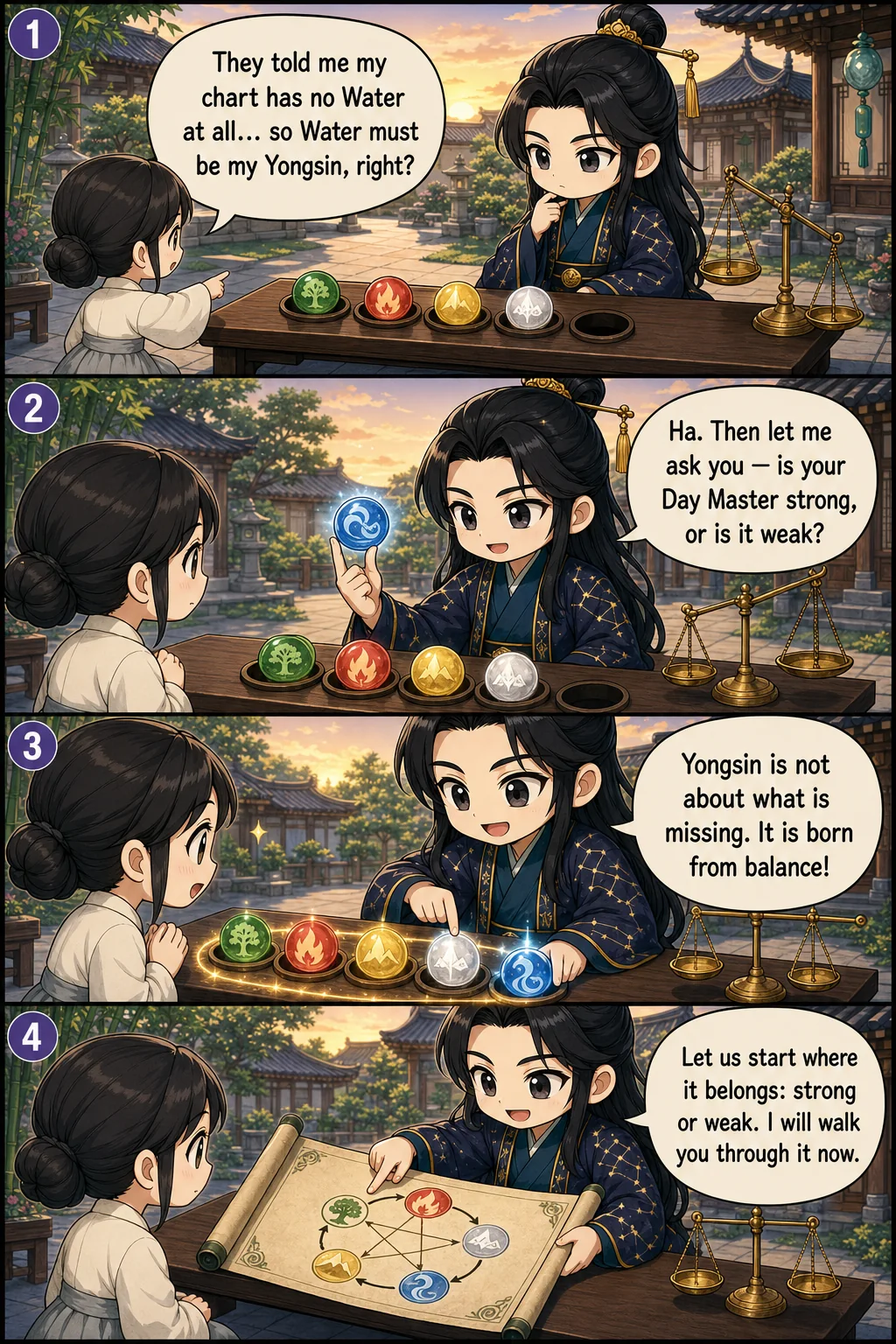
If you think your Yongsin is simply the element your chart lacks, you’re halfway wrong. The real first step is not counting elements but judging whether your Day Master is strong or weak — and once you know that order, you can finally see why readings of the same chart split apart.
Many people walk out of a Saju reading having heard “your Yongsin is Water,” yet never learn what that element actually does or why it was chosen. Yongsin (用神) is the element that restores balance to your natal chart and gives your Day Master (Ilgan, the Heavenly Stem that represents you) what it needs most. The word appears constantly, but the principle behind it rarely gets explained.
So this guide opens with one question and holds it until the end. Why can blindly filling in a missing element actually become poison rather than medicine? We will answer that in the closing section. Before then, we walk through what Yongsin really is, why day-master strength must come first, and what distinct question each of the five Yongsin methods answers.
5
Types of Yongsin
1st
Judge strength first
5
Elements to apply daily
What Yongsin Is — Your Chart’s Balancing Device
Here is the core, up front: Yongsin is not a “lucky star” or a “good energy.” It is the counterweight that levels the whole chart. When the Five Elements tip heavily to one side, the element that lightens the overloaded side or props up the empty side back toward level — that is your Yongsin. So finding it is not about hunting for a “missing ingredient.” It is about reading which way the scale is currently tipping.

Traditional Korean fortune study treats the natal chart, your inborn format (gyeokguk), as a given condition, and reads Yongsin as the acquired realm of use (用) within that condition. If the format is a bowl you cannot swap, Yongsin is the question of how you fill and use it. Even the practice of gaeun (opening fortune) — what to keep close and what to keep at a distance — is an attempt to pull this counterweight back toward your life. In that sense Yongsin is less fatalism and more a compass for handling your own energy. If the way the Five Elements feed and control each other feels unfamiliar, skim the Five Elements guidefirst and the markings on this scale grow much clearer.
In One Sentence
Yongsin is not a “benefic” — it is a counterweight. The task is not to pick a good element, but to first read which way your chart is tipping and then support the opposite side. That is the essence of Yongsin.
The Five Types of Yongsin — Each Answers a Different Question
There is no single way to find a Yongsin. The traditional interpretive system uses five branches, each answering a different question. A real reading usually layers two or three of them, and once you know what each method asks, it becomes obvious why two readers can name different Yongsin for the same chart. The table below compares the question each of the five methods puts to your chart.
| Type | The Question It Asks | Core Idea | Classical Basis |
|---|---|---|---|
| Eokbu (抑扶) | Is the Day Master strong or weak? | Drain if it overflows, support if it lacks | Jeokcheonsu (滴天髓) |
| Johu (調候) | Is the birth season cold or hot? | Correcting cold / warm / dry / damp | Gungtongbogam (窮通寶鑑) |
| Gyeokguk (格局) | What structural format is the chart? | Set the use that fits the month-format | Japyeong Jinjeon (子平眞詮) |
| Tonggwan (通關) | Do two forces collide head-on? | A bridge between opposing elements | Generative-cycle theory |
| Byeongyak (病藥) | Is there a disease breaking balance? | The medicine for the disease is the Yongsin | Disease-and-medicine theory |
The most widely used is Eokbu Yongsin. Based on the Day Master’s strength, it drains the excess when power overflows and adds support when power falls short. The language that decides what adds and what removes power is the Ten Gods: Resource and Companion strengthen the Day Master, while Output, Wealth, and Officer spend or restrain it. If the roles of the Ten Gods blur together, reading the Ten Gods guidealongside this makes the Eokbu calculation concrete. The classical root of Eokbu reaches back to the ideal of balance (中和) in the Jeokcheonsu.
Johu Yongsin works on a different axis. Instead of strength, it reads the temperature and humidity of the birth season. A chart born in deep winter wants warm Fire and Wood; a chart born in high summer wants cool Water and Metal. The Gungtongbogam is the classic that organized these seasonal corrections. Gyeokguk Yongsinfirst defines the chart’s structure around the month-branch and finds the use that fits that format — the Japyeong Jinjeon systematized this format theory. Add Tonggwan Yongsin, which mediates opposing forces, and Byeongyak Yongsin, which names the disease harming balance and prescribes its medicine, and all five branches are complete.
The Right Order — Day-Master Strength Comes First
Even knowing all five branches, skipping the order flips the Yongsin to its exact opposite. The first task is not counting elements but judging whether the Day Master is strong or weak. When the Resource and Companion forces that support the Day Master dominate, the chart is strong; when the Output, Wealth, and Officer forces that spend it dominate, the chart is weak. Misjudge strength, and you read a “drain this” chart as a “fill this” chart — and the Yongsin you then set becomes poison instead of medicine.
| Aspect | Strong (身强) — powerful Day Master | Weak (身弱) — depleted Day Master |
|---|---|---|
| Force makeup | Resource and Companion dominate | Output, Wealth, Officer dominate |
| What it needs | Drain the excess power | Add the missing power |
| Yongsin | Output, Wealth, Officer | Resource, Companion |
| Gisin (avoid) | Resource, Companion | Output, Wealth, Officer |
| Temperament note | Strong drive, watch stubbornness | Caring, watch wavering resolve |
The key is that strength is not counted by “number of characters.” Among the eight characters, the month-branch (Wolji) carries the heaviest weight, and you must fold in whether roots surface in the Heavenly Stems (transparency) and how combinations and clashes move the forces. That is why the same chart can be judged strong by one reader and weak by another. To study the criteria for this strength judgment more closely, read the strong-vs-weak guidefirst — it is the shortcut into Yongsin study.
Worked Example — Counting a Gap-Wood Day Master
Say a Gap-Wood (甲木) Day Master is born in spring with Wood and Water rooted in layers — the Day Master already overflows (strong). Here the Yongsin is not more Water but Metal to prune the excess Wood, or Fire and Earth to drain its force. Reverse it: the same Gap-Wood standing alone in autumn, pressed by Metal and Earth (weak), only then makes Water and Companion the Yongsin. It is the direction of the tilt, not the count of elements, that sets the Yongsin.
Three Things People Get Wrong
What makes Yongsin hard is less the concept than the myths around it. Fix these three common slips and you will not lose your way on any chart.
1. Yongsin is always a “good” element?
Yongsin is not a “good element” but “the element this chart needs now.” The same Water can be the life-giving Yongsin in one chart and the balance-breaking Gisin in another. Elements carry no built-in good or evil; their role flips with the direction of the scale.
2. Just fill the least-present element?
The mechanical rule that “the scarcest element is the Yongsin” is the most common trap. Having no Water does not make Water your Yongsin. If the Day Master is already strong and Water acts as a Resource that grows it even more, that Water becomes a Gisin that tips the scale further.
3. You can name a Yongsin without judging strength?
Skip the strength judgment and Eokbu Yongsin simply does not hold. You must first set the direction — strong or weak — before deciding whether to drain or to fill. Flip the order and you flip the conclusion. Judging strength is not optional; it is the premise.
The Principle That Remains
Elements carry no inherent fortune; do not mechanically plug in the scarcest element; and always judge strong-vs-weak before naming a Yongsin — hold just these three and most Yongsin readings fall back into place.
Applying Yongsin by Element — Translating It Into Daily Life
Once you know your Yongsin, keeping it close in daily life is the heart of gaeun. Adding your Yongsin element through the grain of your work, the colors you favor, the direction of the space you occupy, and daily habits can shape an energy flow that suits you. The cheat sheet below is arranged so you find the one row for your Yongsin element and go. Save it, and just read your own row when you need it.
| Yongsin | Fitting Fields | Colors | Direction | Supporting Habits |
|---|---|---|---|---|
| Wood (木) | Education, publishing, environment | Blue, green | East | Forest walks, growing plants |
| Fire (火) | Art, broadcast, marketing, beauty | Red, orange | South | Brighter lighting, red accents |
| Earth (土) | Real estate, admin, food, brokerage | Yellow, brown | Center | Soil and ceramics, pottery |
| Metal (金) | Law, finance, IT, engineering | White, silver | West | Metal objects, tidy spaces |
| Water (水) | Trade, logistics, marine, hospitality | Black, navy | North | Near water, swimming, aquariums |
Aligning your sleeping or desk direction with your Yongsin direction, and favoring your Yongsin colors in clothing and small objects, are good moves. The reverse principle is to gradually reduce your Gisin element’s colors and settings. Still, this is no life-changing magic — it is a set of small habits that lend a hand to the balance of your energy. To design element-by-element gaeun more concretely, the gaeun guidelets you connect color, direction, and habit one by one.
Yongsin vs. Gisin and Huisin — Two Faces of Luck
Where there is a Yongsin, there is always a Gisin (忌神) on the opposite side — the element that blocks the Yongsin or breaks the chart’s balance further. The element that helps the Yongsin from beside it is called the Huisin (喜神). Seeing all three together explains why some years in the Great Luck and Yearly Luck cycles feel smooth and others feel heavy.
| Domain | Yongsin Luck | Gisin Luck |
|---|---|---|
| Flow of work | Skill shows, opportunity grows | Collisions, losses, fatigue rise |
| People | Benefactors and good ties arrive | Energy-draining ties increase |
| Environment | Yongsin direction and color add energy | Gisin direction and color drain it |
| Stance | A season to push and leap | A season to slow and consolidate |
Still, this theory is a reference tool, not determinism. A Yongsin year does not resolve everything on its own, and a Gisin year is not automatically bad. The whole flow of the chart, the relations among the other Ten Gods, and personal effort all act together. For how Yongsin and Gisin unfold as actual periods, read on in the Great Luck and Yearly Luck guideand you will develop a feel for when to push and when to consolidate.
Closing — Balance Before Filling
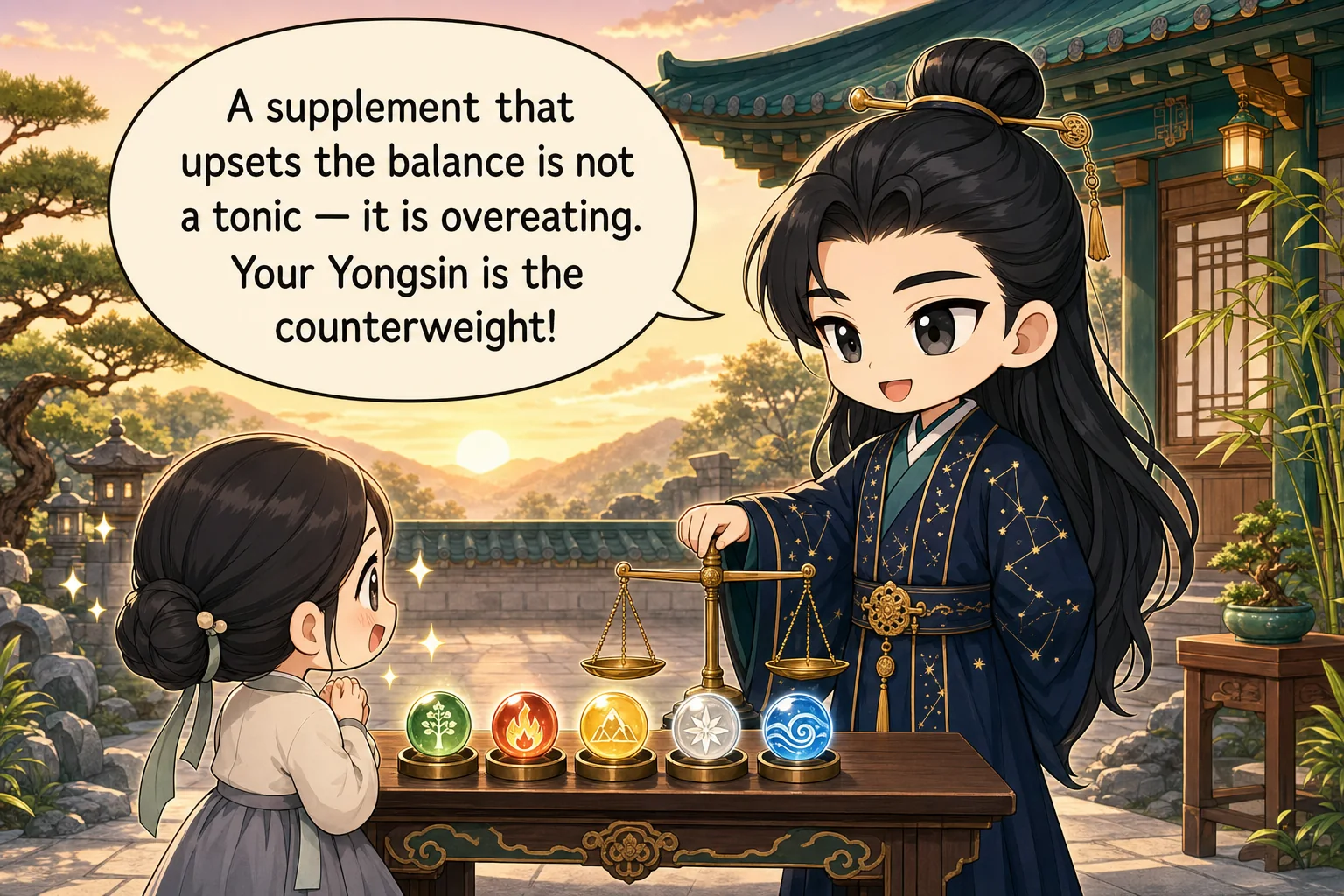
Now back to the opening question. Why can blindly filling a missing element become poison rather than medicine? The answer is clear. Pour an element into a chart already tipped to one side simply “because it is absent,” and a supplement that shakes the balance is not a tonic but overeating. Yongsin is never about filling a missing ingredient. It is about reading which way the scale tips first, and then supporting the opposite side.
So the order of Yongsin study is always the same. First set the direction of the scale with strong-vs-weak; then name the needed element through the five branches of Eokbu, Johu, Gyeokguk, Tonggwan, and Byeongyak; and last, translate it into life through color, direction, and habit. Hold that order and “why the same chart splits into different readings” stops being a mystery. If you are curious about your own chart’s strength and its Yongsin and Gisin, check your Yongsin element in a free Saju analysis and apply today’s order for yourself.
References · Editorial Note
This guide organizes the traditional Yongsin doctrine along three axes — Eokbu (Jeokcheonsu, 滴天髓), Johu (Gungtongbogam, 窮通寶鑑), and Gyeokguk (Japyeong Jinjeon, 子平眞詮) — drawing also on the myeongni entry of the Encyclopedia of Korean Culture (Academy of Korean Studies) and on secondary syntheses in the lineage of comparative studies of the Jeokcheonsu, Japyeong Jinjeon, and Gungtongbogam Yongsin theories. How strength and Yongsin are handled varies by school, and we do not impersonate any real fortune-teller or licensed credential. This content is for reference and entertainment and does not replace medical, legal, financial, or other important life decisions.
Related Guides
- Strong vs. Weak Guide — step one of finding Yongsin: judging Day-Master strength
- Five Elements Guide — the base principle of how Wood, Fire, Earth, Metal, and Water feed and control
- Ten Gods Guide — reading the Resource, Companion, Output, Wealth, and Officer that decide Eokbu
- Great Luck & Yearly Luck Guide — how Yongsin and Gisin luck unfold as real periods
- Gaeun Guide — the deep dive on translating your Yongsin element into color, direction, and habit
Mystic Universe Editorial
Authorship & review
This guide organizes the traditional Yongsin doctrine along three axes — Eokbu (Jeokcheonsu), Johu (Gungtongbogam), and Gyeokguk (Japyeong Jinjeon) — drawing on the myeongni entry of the Encyclopedia of Korean Culture and comparative Yongsin studies. Handling of strength and Yongsin varies by school; this is a pen-name editorial review that impersonates no real fortune-teller or credential.
Frequently Asked Questions
Q.How do I find my Yongsin?▾
Using the most common Eokbu method, step one is not counting elements but judging whether your Day Master (Ilgan) is strong or weak. If strong, your Yongsin comes from Output, Wealth, or Officer elements; if weak, from Resource or Companion elements. The birth season's temperature and humidity (Johu) also matter, and an accurate reading folds in the month-branch, transparency, and combinations and clashes.
Q.What is the difference between Yongsin and Gisin?▾
Yongsin (用神) is the element your chart needs to restore balance, while Gisin (忌神) is the element that blocks or worsens that balance. The same element can be a Yongsin in one chart and a Gisin in another, depending on which way the chart tips. When Yongsin energy strengthens, opportunities grow; when Gisin energy strengthens, it is wiser to slow down and consolidate.
Q.Can a chart have no Yongsin?▾
In principle every chart has a Yongsin. If the Five Elements are already well balanced, the chart is read as stable and not heavily dependent on any single element. In special cases like Jong-gyeok (Following Format), where the Day Master is overwhelmingly weak and does not resist the dominant trend, the strongest force itself becomes the Yongsin rather than an element that opposes the flow.
Q.If Eokbu and Johu Yongsin disagree, which do I follow?▾
They are not rival right-or-wrong answers but tools for different questions. A real reading weighs both, yet in charts with extreme seasonal bias (deep winter or high summer), correcting Johu first matters — without it, even a well-matched Eokbu Yongsin brings large swings. When the season is mild, strength (Eokbu) becomes the main axis. The key is not discarding one but setting the priority to fit the situation.
Related Articles
Curious about your Day Master?
Enter your birth details and AI will show your Day Master and Five Elements analysis.
Check My Saju for FreeThis content is for entertainment purposes only and does not replace professional advice.