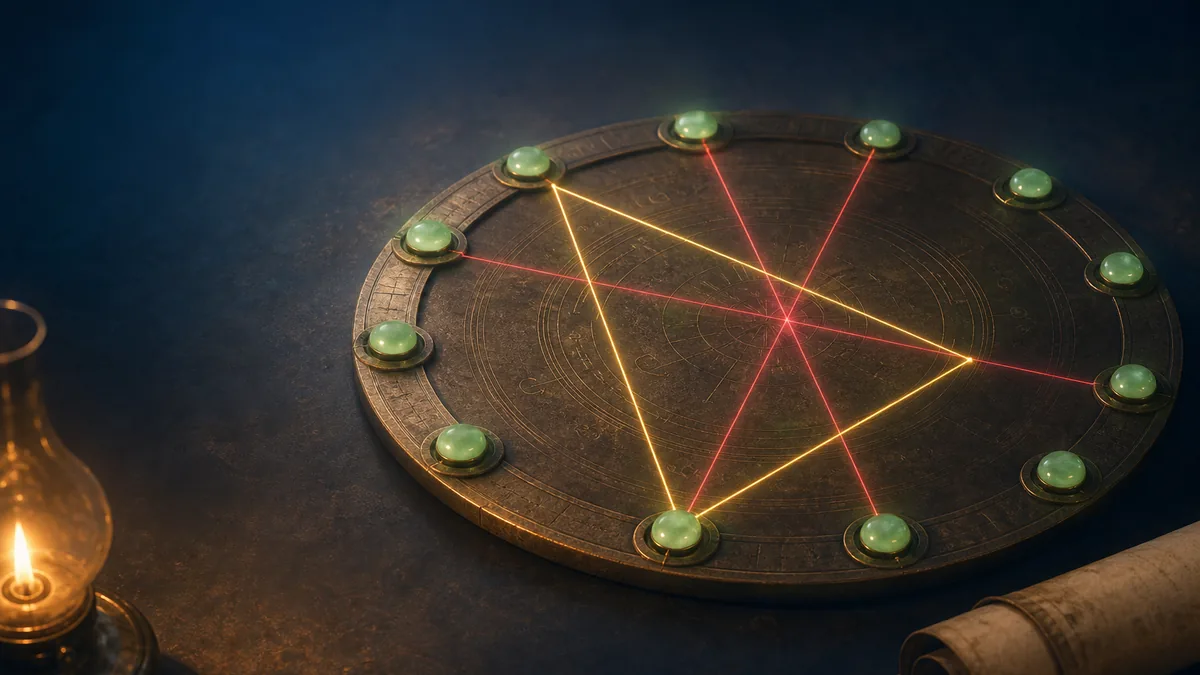
Five Stem combinations, six Branch harmonies, four trines, six clashes… you memorize the table and it fades by the next day. Most people who read charts never memorized it. They did not have to.
This guide asks one question: why those particular groupings? Ja (子) and O (午) clash, yet In-O-Sul forms a trine — why? The answer comes at the end. First, draw a circle.
Today's question
Do you have to memorize combinations to use them?
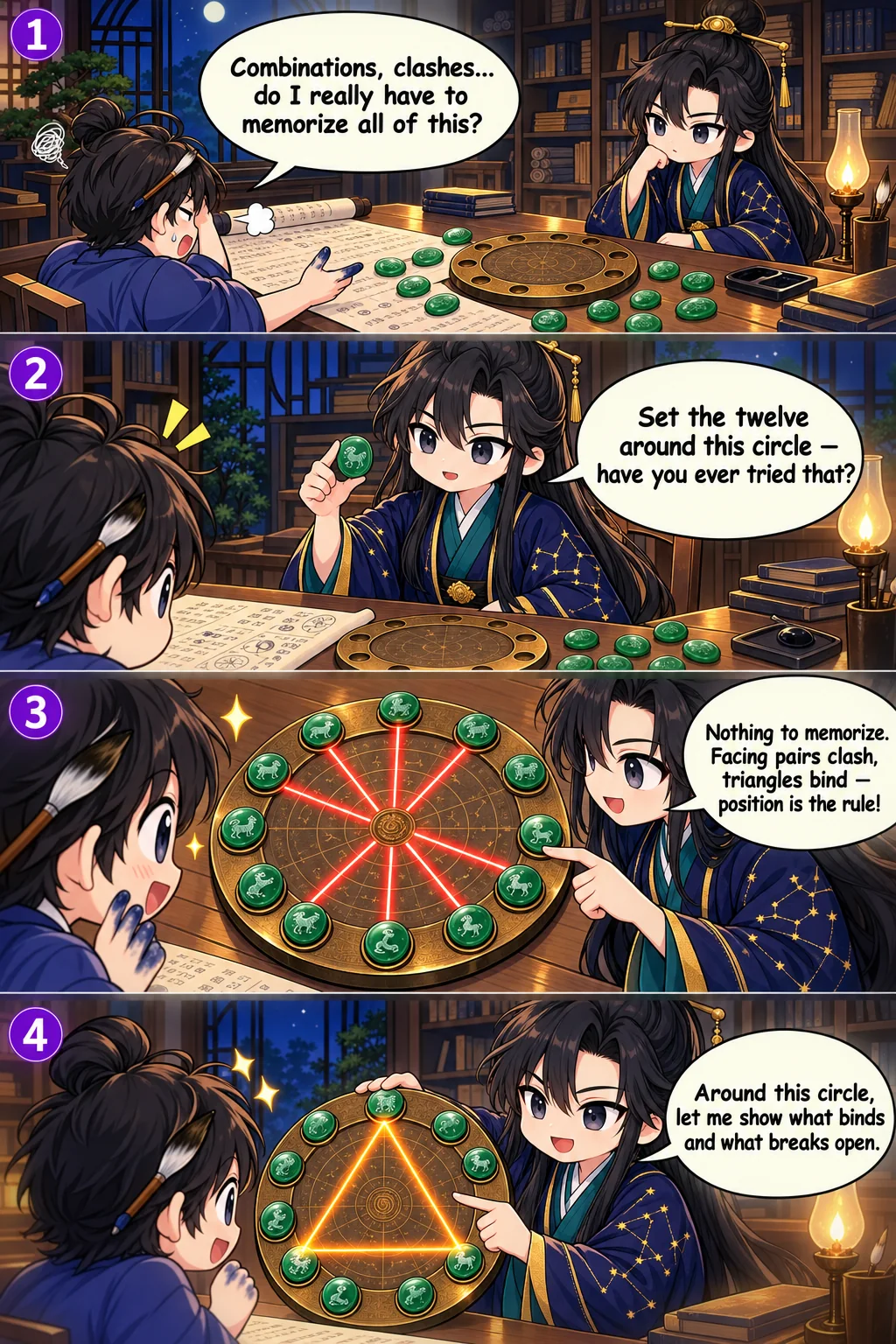
Lay the twelve Branches around a circle in order and the relations stop being a list. They become something you read off a position. Drawing lasts far longer than memorizing.
One Circle Is All You Need
The conclusion first: place the twelve Branches clockwise around a circle. Put Ja (子) at twelve o'clock and step thirty degrees at a time through Chuk, In, Myo and the rest. That single drawing is the whole of this guide. Every Branch relation below — clash, trine, directional set, harmony — falls out of a position on this circle. (Stem combinations and the Hyeong-Pa-Hae group sit outside the circle; both come later.)
Start with clash (沖). You can see six dashed lines crossing the circle. A clash is simply a pair that sits exactly opposite. Ja-O, Chuk-Mi, In-Sin, Myo-Yu, Jin-Sul, Sa-Hae — all six are diameters. Nothing was memorized; it was read off the picture.
Clash — the Facing Seat
Clash is often taught as purely unlucky, but on the circle its character reads differently. Facing means the farthest possible distance and, at the same time, looking straight at each other. So a clash breaks and opens at once. It is read as the force that shakes a stuck position into motion.
Ja (子) ↔ O (午)
Water and fire stand face to face
Chuk (丑) ↔ Mi (未)
Two earths pulling in opposite directions
In (寅) ↔ Sin (申)
The force that extends against the force that gathers
Myo (卯) ↔ Yu (酉)
Growing grain against grain being trimmed
Jin (辰) ↔ Sul (戌)
Damp earth against dry earth
Sa (巳) ↔ Hae (亥)
Spreading fire against collecting water
Trine — What Thirds of the Circle Produce
On the same circle, look for equilateral triangles — connect every fourth position. The four triangles you get are exactly the trines.
A trine is read as three Branches merging into a single element. Which element it becomes is decided by the vertex where that energy peaks, the peak Branch. Sin-Ja-Jin contains Ja (子) and becomes Water; Hae-Myo-Mi contains Myo (卯) and becomes Wood.
Peak Ja (子) · becomes Water
Sin-Ja-Jin (申子辰)
A current that gathers and seeps
Peak Myo (卯) · becomes Wood
Hae-Myo-Mi (亥卯未)
Growth that reaches outward
Peak O (午) · becomes Fire
In-O-Sul (寅午戌)
Heat that spreads and reveals
Peak Yu (酉) · becomes Metal
Sa-Yu-Chuk (巳酉丑)
Harvest that hardens and refines
When only two of the three are present it is read as a half-trine. The half that contains the peak Branch is generally treated as the stronger one.
Directional Sets and Harmonies — Neighbours, and a Mirror
A directional set is simpler still: three neighbouring characters on the circle. In-Myo-Jin is spring and east, Sa-O-Mi is summer and south. Season and direction are the same mapping, so three adjacent Branches naturally read as one block.
The six harmonies look different. Ja-Chuk, In-Hae, Myo-Sul, Jin-Yu, Sa-Sin, O-Mi — these are neither opposite pairs nor triangles. But draw them on the circle and a rule appears: fold the circle along the axis running between Ja (子) and Chuk (丑) and all six pairs land on each other.
This circle is a modern visualization
Worth stating plainly: the classics did not say "draw a circle and measure angles." This drawing takes the directional and seasonal mapping of the twelve Branches — which was already fixed — and lays it out so a reader today can see it at once. Once laid out, though, the angular relations do hold: clashes face each other, trines divide the circle in three, and the six harmonies meet across a mirror axis.
Stem Combinations — Five Pairs and Transformation
Everything above concerned Branches. The Stems have combinations too — five pairs. When one forms, a new element is said to arise, which is called transformation. Whether a transformation actually completes depends on conditions, and schools disagree about which conditions those are.
Gap-Gi (甲己) becomes Earth
Eul-Gyeong (乙庚) becomes Metal
Byeong-Sin (丙辛) becomes Water
Jeong-Im (丁壬) becomes Wood
Mu-Gye (戊癸) becomes Fire
Stem combinations do not form only at the Day Master. They form wherever two of the four Stems are both present — the pillars do not have to be adjacent (closer placement is read as a stronger effect, not a requirement). A combination touching the Day Master simply carries more weight in interpretation, because that is the seat that stands for the self.
The Remaining Three — Hyeong, Pa, Hae
Of the five relations named together, Hyeong, Pa and Hae do not resolve cleanly into circle geometry. They have more combinations and more interpretive disagreement. Here is what each one points at; the combination-by-combination treatment lives in its own guide.
Hyeong (刑)
Grinding each other
Characters sitting close and wearing down each other's edges. The example usually given is In-Sa-Sin (寅巳申) appearing together: the three push and pull until nothing moves smoothly.
Pa (破)
Coming apart
Something that was joined slips out of alignment and breaks. Ja-Yu (子酉) is read this way — a flow that had been running develops a crack, and the plan has to be redrawn.
Hae (害)
Getting in the way
A third character interferes with a bond between two others. Chuk-O (丑午) belongs here: nothing collides directly, yet things keep missing each other and resentment accumulates.
The full combination list for those three is in the Hyeong, Pa, Hae deep dive. If the generating and controlling cycles themselves are unclear, start with the Five Elements guide; if you want to revisit what Stems and Branches are, the Stems and Branches basics comes first.
One Page Summary
| Relation | Position on the circle | In one line |
|---|---|---|
| Clash | Exactly opposite (6 pairs) | Collides and opens |
| Trine | Equilateral triangle, thirds (4 sets) | Merges into the peak element |
| Directional set | Three neighbours (4 sets) | Bound by season and direction |
| Harmony | Mirror across the Ja-Chuk axis (6 pairs) | Bound as a pair |
| Stem combination | Five Stem pairs (off the circle) | Binds and becomes a new element |
What I Verified While Making This
Once the circle framing was chosen, the first job was checking whether the symmetry actually holds for every pair. Clashes and trines fell into place immediately: every clash pair differed by exactly 180 degrees, and all four trines came out at 120 degrees per step.
The harmonies were the sticking point. They are neither opposite nor triangular, and the draft was going to call them "the one exception." Then I added the two angles of each pair together: Ja-Chuk 30, In-Hae 390, Myo-Sul 390 — all of them 30 degrees once a full turn is subtracted. A constant angular sum means mirror symmetry about a single axis. They were not an exception but the same rule wearing another face, which is why the claim that position is the rule could be extended to the harmonies as well.
180°
Clash — facing angle
120°
Trine — step between points
30°
Harmony — constant angular sum
In one sentence
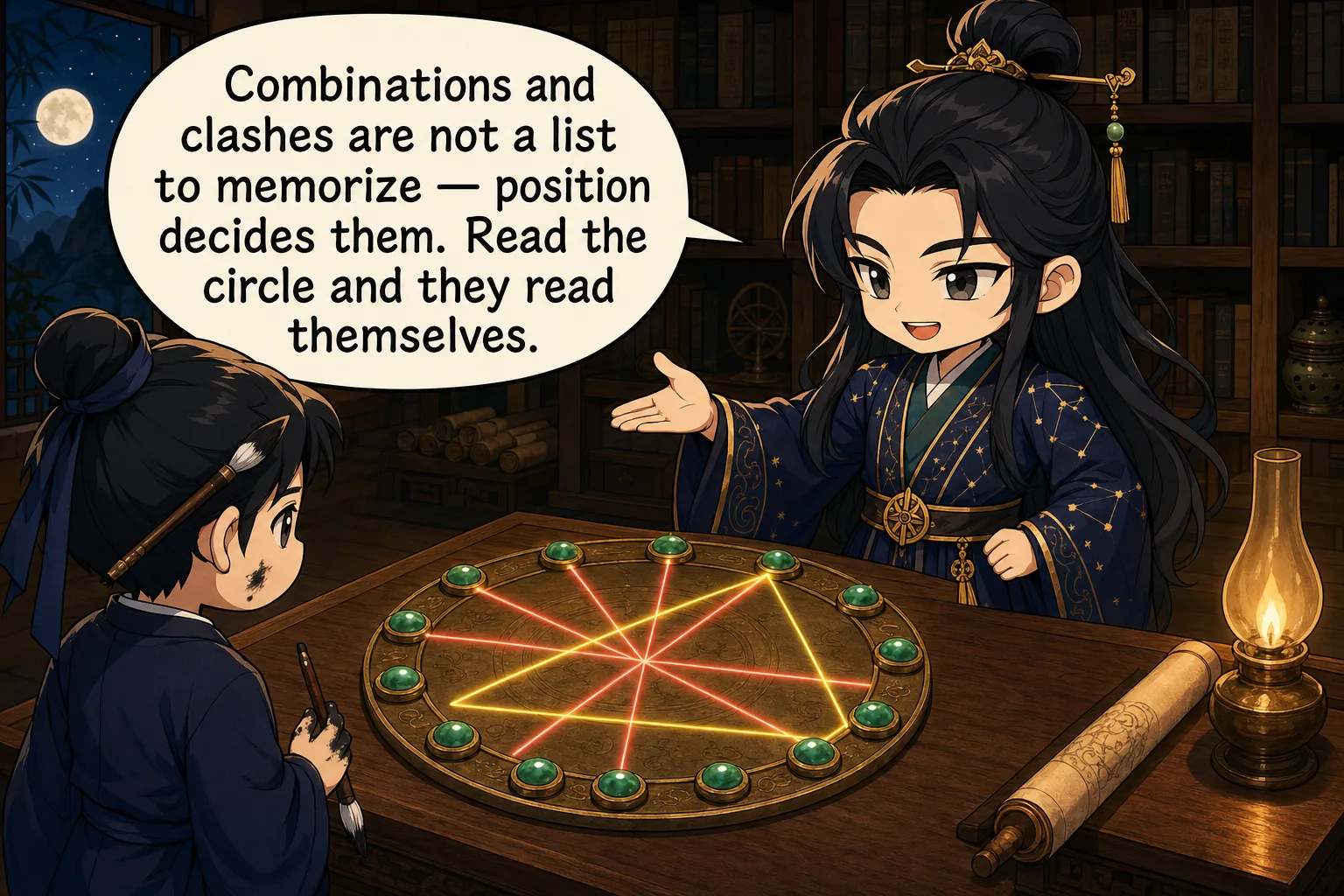
Combinations and clashes are not a list to memorize but a rule set by where the twelve characters sit on a circle. Ja and O clash because they face each other; In-O-Sul is a trine because it cuts the circle into thirds.
Find Them in Your Own Chart
What you need now is your own eight characters. Open your chart in the Mystic Universe Saju reading and the Stems and Branches of all four pillars are laid out. With the circle in mind, look for facing pairs and for characters clustered at the thirds.
Reading combinations between two people is a different matter — how meaning shifts by seat is covered separately in the Saju compatibility guide.
Two questions worth asking of the result. First, if there is a facing pair in your chart, which pillar does it sit on? Second, if a trine or directional set has merged into one element, is that element already abundant in your chart or scarce?
Sources and Editorial Note
The five Stem combinations and their transformation elements come down through the Yuanhai Ziping lineage, which organized the Day Master-centered system. That text is transmitted as a compilation by Xu Dasheng of the Southern Song, but authorship and compilation are disputed, so this guide names no single founder.
Two peer-reviewed Korean papers indexed in KCI informed the modern side. Lee Jae-seung, "A Study on Differences in Combining Force of Earthly Branches by Combination and Clash in Myeongri" (Humanities and Social Sciences 21, 12-6, 2021) treats variation in combining force, which is why the relative strength of a half-trine is written here as "is read as" rather than stated flatly. "A Study on the Application of the Heavenly Stem Combination and Clash Theory" classifies the conditions under which transformation does or does not complete, which is the basis for saying transformation depends on conditions.
The circular diagram takes the already-fixed directional and seasonal mappingof the twelve Branches and plots it as coordinates. While writing, I placed the twelve at thirty-degree intervals and computed the angular differences of the six clash pairs, the spacing of the four trines, and the angular sums of the six harmony pairs, checking each against the received lists. The coordinates in the diagram are computed from those angles rather than placed by hand. Points where schools disagree — the conditions for transformation, the relative strength of a half-trine — are written as "is read as" rather than stated flatly.
This article introduces an interpretive tradition rooted in classical philosophy. It does not predict or guarantee any specific event or outcome.
Frequently Asked Questions
Q.Does a clash mean a bad chart?▾
No. A clash names a quality of relation — divergence, and with it opening. On the circle a clash pair sits exactly opposite, which is both the farthest distance and a direct facing. It is also read as the force that shakes a stuck position into motion.
Q.Is a combination always good?▾
No. A combination binds, which can be comfortable but can also lock a character out of its role. Counting combinations to score a chart is not how they are read.
Q.What if only two of a trine are present?▾
It is read as a half-trine. A trine is an equilateral triangle across the circle, and here only two of its three seats are filled. The half containing the peak Branch, the middle character of the triangle, is generally treated as stronger.
Q.Why are Hyeong, Pa and Hae not covered in depth here?▾
Those three do not resolve cleanly into circle geometry, they have far more combinations, and interpretations diverge. This guide defines what each one points at and hands the combination-by-combination treatment to the dedicated deep dive.
Related Articles
Curious about your Day Master?
Enter your birth details and AI will show your Day Master and Five Elements analysis.
Check My Saju for FreeThis content is for entertainment purposes only and does not replace professional advice.