
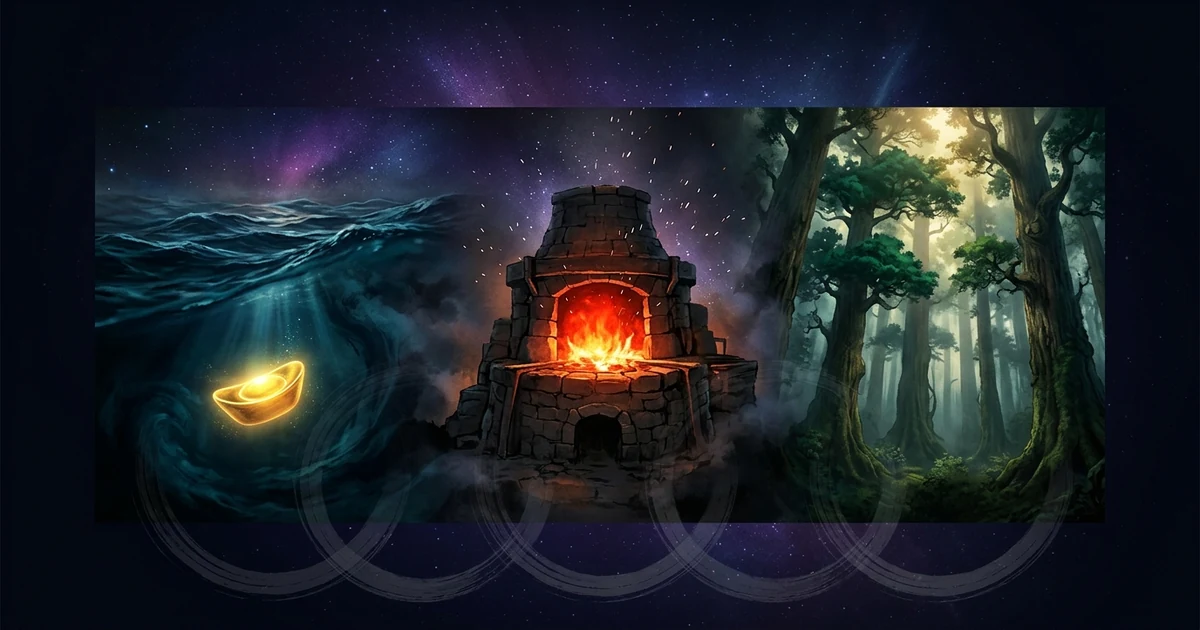
The stem of Gapja (甲子) is Gap, which is Wood. Its branch, Ja, is Water. Yet the Naeum name attached to Gapja is Haejunggeum — Gold in the Sea.
Not wood, not water, but metal. It matches neither of the two characters on the surface. So why does a wood pillar carry a name made of gold?
What this article answers
Naeum is a structure, not decoration
The thirty poetic names are not nicknames added for flavour. They divide sixty places exactly and distribute the five elements without a single one out of place.

The short answer: Naeum is a second map
Ordinary five-element reading takes the characters one at a time: Gap is Wood, Ja is Water, and so on. Naeum does something else. It binds the stem and branch into a pair and assigns that pair an element by a different rule.
So Naeum is not a correction to the elements you already have. It is a second map laid over the same characters. The two do not compete; each shows something the other does not.
In one line
Naeum does not correct a chart's elements. It is a second layer laid over the very same characters.
Why the names came from sound
The word Naeum (納音) means to draw in a sound. Old East Asia recognised five tones — gung, sang, gak, chi and u — and mapped those five tones onto the five elements. Naeum asks each of the sixty pillars for its tone and names it by the element that tone belongs to.
That is why the names read like pictures. Gold in the Sea, Fire in the Furnace, Fire of Thunder — they tell you not only which element but which kind of it. The names carry a grain that five bare element words cannot.
Why sixty places have only thirty names
The sexagenary cycle has sixty entries, yet Naeum has thirty names. That is because one name covers two consecutive pillars. Gapja and Eulchuk share Gold in the Sea; Byeongin and Jeongmyo share Fire in the Furnace.
You would expect exceptions. There are none. Counting every row, each of the thirty names takes exactly two pillars, with no place left out and none claimed twice.
| Structure | What it means | Confirmed value |
|---|---|---|
| Sixty places, thirty names | Each name covers exactly two pillars | No gaps and no overlaps |
| The elements split evenly | By pillar: 12 Metal, 12 Fire, 12 Wood, 12 Earth, 12 Water | By name, six of each element |
| The order repeats at the halfway point | The element order of the first 15 pairs repeats in the last 15 | Metal Fire Wood Earth Metal Fire Water Earth Metal Wood Water Earth Fire Wood Water |
The elements divide without a remainder
The evenness is the more striking part. Counting the sixty pillars by element gives 12 Metal, 12 Fire, 12 Wood, 12 Earth and 12 Water. Counting by name gives exactly six of each.
That is not a distribution that happened to come out close. It is built that way. In Naeum no element is rarer or more common than another. For the elements themselves, see the Five Elements guide.
The order repeats every thirty pillars
Follow the sequence and something else appears. The element order made by the first fifteen pairs repeats exactly in the last fifteen. Metal, Fire, Wood, Earth, Metal, Fire, Water, Earth, Metal, Wood, Water, Earth, Fire, Wood, Water — that run of fifteen, twice, is the whole of Naeum.
In Naeum terms the sexagenary cycle is really two halves. All thirty names differ, but the elemental skeleton overlaps between them.
Disagreement is not the exception
Back to the opening question. Gapja's stem is Wood while its Naeum is Metal. How common is that kind of disagreement? We compared all sixty pillars.
| Kind of disagreement | Pillars | Share |
|---|---|---|
| Differs from the stem's element | 44 of 60 | 73% |
| Differs from the branch's element | 48 of 60 | 80% |
| Differs from both | 33 of 60 | 55% |
What you get from this
More than half the pillars have a Naeum that matches neither visible character. Gapja being Metal is not a strange exception — it is closer to the default. There is no reason to read the mismatch as an error.
So what is Naeum actually for
It is a layer you read on top. Weigh the balance of a chart with the ordinary reading, character by character, then lay Naeum over it for grain. Two Metal pillars are not the same picture when one is Gold of the Sword Edge and the other Gold Foil.
Below are the six names that belong to Metal. By element they are identical; the pictures they carry are not.
| One element, six names | What the name pictures | Its grain |
|---|---|---|
| Gold in the Sea | Metal sunk beneath water | Not yet brought up |
| Gold of the Sword Edge | Metal forged to an edge | Its use already decided |
| Gold of White Wax | Soft white pewter-like metal | Reshaped easily |
| Gold in the Sand | Metal mixed through sand | Has to be sifted out |
| Gold Foil | Metal beaten thin | Covers widely, never thickly |
| Gold of the Hairpin | Metal worn as ornament | Carried on the body |
In the five-element vocabulary all six collapse into the single word "Metal." The names preserve the differences inside that one word. This is where Naeum earns its place as a second layer.
The order matters. Naeum does not replace the ordinary element reading. The two layers are useful only while each stays in its own place.
Myth one: Naeum is the real element
Gapja is Gold in the Sea, therefore a Gapja day pillar runs strong in Metal — you see this reading often. But then where does Gap's Wood go? The two layers are not rivals, and the moment one is used to displace the other, both stop working.
Myth two: the image is the personality
"Gold in the Sea, so deep and cautious." "Fire of Thunder, so quick-tempered." The names are metaphors, not rules for judging character. Pinning a metaphor directly onto a person is describing them with nothing behind it.
Finding your own Naeum
All thirty are below, in sexagenary order. Find your day pillar and that row is your Naeum. If you do not know your day pillar yet, check the 60 Ilju guide first.
| Pillar pair | Naeum | Meaning | Element |
|---|---|---|---|
| Gapja / Eulchuk | Haejunggeum 海中金 | Gold in the Sea | Metal |
| Byeongin / Jeongmyo | Nojunghwa 爐中火 | Fire in the Furnace | Fire |
| Mujin / Gisa | Daerimmok 大林木 | Wood of the Great Forest | Wood |
| Gyeongo / Sinmi | Nobangto 路傍土 | Earth by the Road | Earth |
| Imsin / Gyeyu | Geombonggeum 劍鋒金 | Gold of the Sword Edge | Metal |
| Gapsul / Eulhae | Sanduhwa 山頭火 | Fire on the Mountain | Fire |
| Byeongja / Jeongchuk | Ganhasu 澗下水 | Water in the Stream | Water |
| Muin / Gimyo | Seongduto 城頭土 | Earth on the City Wall | Earth |
| Gyeongjin / Sinsa | Baengnapgeum 白鑞金 | Gold of White Wax | Metal |
| Imo / Gyemi | Yangnyumok 楊柳木 | Wood of the Willow | Wood |
| Gapsin / Eulyu | Cheonjungsu 泉中水 | Water from the Spring | Water |
| Byeongsul / Jeonghae | Oksangto 屋上土 | Earth on the Roof | Earth |
| Muja / Gichuk | Byeongnyeokhwa 霹靂火 | Fire of Thunder | Fire |
| Gyeongin / Sinmyo | Songbaengmok 松柏木 | Wood of the Pine | Wood |
| Imjin / Gyesa | Jangnyusu 長流水 | Water of the Long River | Water |
| Gapo / Eulmi | Sajunggeum 沙中金 | Gold in the Sand | Metal |
| Byeongsin / Jeongyu | Sanhahwa 山下火 | Fire below the Mountain | Fire |
| Musul / Gihae | Pyeongjimok 平地木 | Wood on the Plain | Wood |
| Gyeongja / Sinchuk | Byeoksangto 壁上土 | Earth on the Wall | Earth |
| Imin / Gyemyo | Geumbakgeum 金箔金 | Gold Foil | Metal |
| Gapjin / Eulsa | Bokdeunghwa 覆燈火 | Fire of the Covered Lamp | Fire |
| Byeongo / Jeongmi | Cheonhasu 天河水 | Water from the Sky | Water |
| Musin / Giyu | Daeyeokto 大驛土 | Earth of the Great Road | Earth |
| Gyeongsul / Sinhae | Chacheongeum 釵釧金 | Gold of the Hairpin | Metal |
| Imja / Gyechuk | Sangjamok 桑柘木 | Wood of the Mulberry | Wood |
| Gapin / Eulmyo | Daegyesu 大溪水 | Water of the Great Creek | Water |
| Byeongjin / Jeongsa | Sajungto 沙中土 | Earth in the Sand | Earth |
| Muo / Gimi | Cheonsanghwa 天上火 | Fire in the Sky | Fire |
| Gyeongsin / Sinyu | Seongnyumok 石榴木 | Wood of the Pomegranate | Wood |
| Imsul / Gyehae | Daehaesu 大海水 | Water of the Great Sea | Water |
Once you find it, do one more thing: compare that pillar's stem and branch elements against its Naeum element. If they differ, that is nothing to worry about — as shown above, differing is the majority case.
In one sentence
Conclusion
Naeum does not correct a chart's elements. It is a second map laid over the same characters.

You can see the Naeum of all four of your pillars straight from your result screen.
What we checked
The table and every figure come from pulling all sixty rows of this service's Naeum data and counting them directly. That each of the thirty names covers two pillars, that the elements split twelve apiece, that the order repeats at the halfway point, and how many pillars disagree with their surface element — all verified that way.
The name Naeum comes from mapping the five tones onto the five elements, and the Ming-era Sanming Tonghui (三命通會) is cited as the standard source that treats it. We did not compare the original text directly; we only confirmed the source exists through secondary material.
What we did not settle: how this assignment was derived, which some sources explain through the gyeokpal cycle or the Great Expansion number — we could not verify the original, so we do not present a formula. Which pillar's Naeum matters most is recorded only as a widely held view. Naeum-based compatibility is left out entirely because we could not verify its basis. If a term trips you up, keep the Saju glossary open.
Mystic Universe Editorial
Authorship & review
The thirty rows and every figure were verified by pulling all sixty rows of this service's Naeum data and counting them directly: that each name covers two pillars, that the elements split twelve apiece, that the order repeats at the halfway point, and how many pillars disagree with their stem and branch. How the assignment was derived, which some sources explain through the gyeokpal cycle or the Great Expansion number, is not presented as a formula because we could not verify the original text; the Sanming Tonghui is confirmed only as a cited source through secondary material. Naeum-based compatibility is left out for lack of a verifiable basis. This article does not decide personality, career, or wealth from the imagery of a Naeum name.
Frequently Asked Questions
Q.What is Naeum Ohang in Saju?▾
It is a system that binds a heavenly stem and an earthly branch into a pair and assigns that pair an element by a separate rule, rather than reading each character on its own. The word Naeum means 'to draw in a sound', from mapping the five old tones onto the five elements. Thirty poetic names cover the sixty Jiazi, each name taking two consecutive pillars.
Q.How is Naeum Ohang different from the regular Five Elements?▾
The regular reading classifies each stem or branch on its own. Naeum pairs two characters and assigns separately, so the two often disagree: of sixty pillars, 44 differ from the stem's element, 48 differ from the branch's, and 33 differ from both. Naeum does not replace the ordinary reading; it is a layer laid over it.
Q.Which pillar's Naeum matters most?▾
The day pillar's Naeum is the commonly cited answer. We could not verify that in an original source, so we record it only as a widely held view. Reading all four pillars' Naeum together, without treating any single one as the conclusion, is the safer approach.
Q.Gapja is Wood, so why is its Naeum Metal?▾
Because Naeum assigns by pair under a different rule instead of reading characters individually. Gapja has a Wood stem and a Water branch, yet its Naeum is Gold in the Sea. That kind of mismatch is the majority, not an exception: 33 of 60 pillars differ from both visible characters.
Q.Can Naeum be used for compatibility readings?▾
This article does not cover it. There are methods that read compatibility from the generating and controlling cycles between Naeum names, but we could not verify the basis for those judgments. Presenting an unverified method invites it to be used as-is, so we left it out.
Related Articles
Curious about your Day Master?
Enter your birth details and AI will show your Day Master and Five Elements analysis.
Check My Saju for FreeThis content is for entertainment purposes only and does not replace professional advice.