
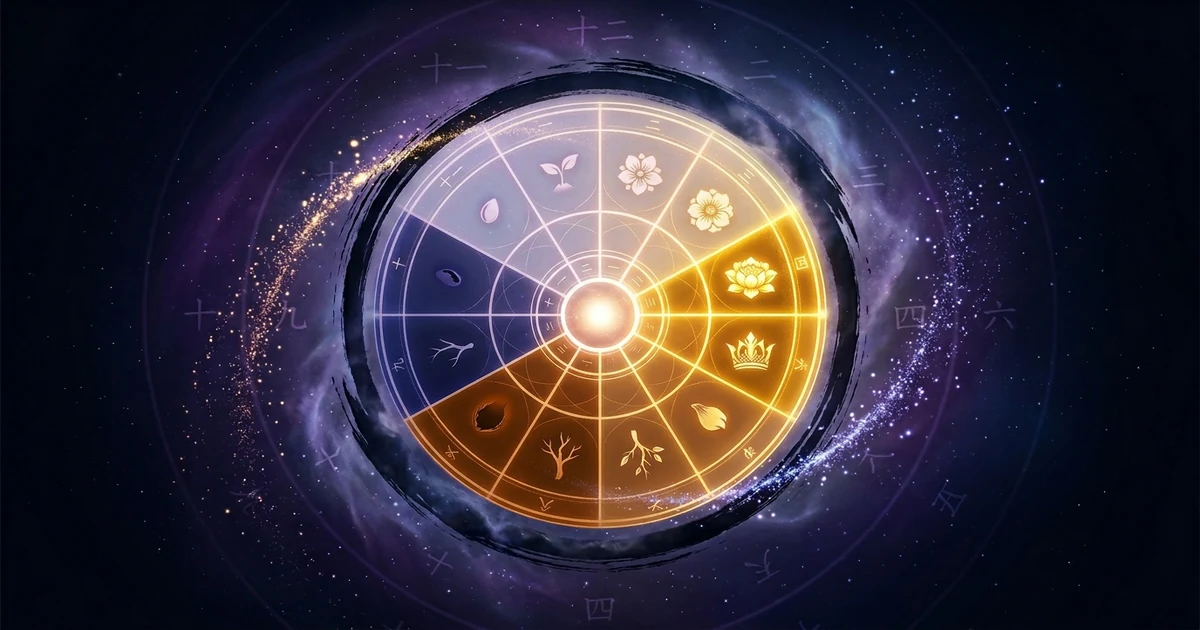
“Does a Mokyok luck cycle mean relationship trouble?” “Does Jewang make this a good chart?” Those questions treat the Twelve Life Stages as a scorecard. Sibi Unseong is first a set of coordinates showing which phase a Day Master meets at an Earthly Branch. It is not a verdict that fixes an event or grades a person.
This guide moves past memorizing twelve names. It shows the calculation rule, how four labels appear in one natal chart, what the often-searched Mokyok, Gwandae, Myo, and Tae stages mean, and how to turn a luck-cycle label into a useful question instead of a prediction.
Correct the premise first
Is Jewang the top score while Death, Tomb, and Cut are bad scores?
No. The names locate a current as it emerges, expands, contracts, stores, and prepares to begin again. They do not rank lives.

Quick answer: what Sibi Unseong measures
One-line takeaway
The Twelve Life Stages are not a ranking of people; they mark the phase a Day Master meets at each Branch.
A Saju natal charthas four pillars—Year, Month, Day, and Hour—and one Earthly Branch beneath each pillar. The same Day Master is compared with those four Branches, so one person can carry four different stage labels.
The system borrows the imagery of a life cycle to make changes of phase easier to remember. That imagery does not forecast literal lifespan, disease, death, or success. Sa (Death), Myo (Tomb), and Jeol (Cut) name symbolic transitions; they are not diagnoses or event predictions.
The twelve phases, from Birth to Nurture
The sequence is Birth, Bath, Crown, Prosperity, Peak, Decline, Illness, Death, Tomb, Cut, Embryo, and Nurture. Nurture leads back to Birth, so picture a wheel rather than a ladder with a winner at the top.
- 01Jangseong (長生) · Birthemergence
A new current appears and begins to grow.
- 02Mokyok (沐浴) · Bathexposure
An old covering is washed away while the current adjusts to change.
- 03Gwandae (冠帶) · Crownrole
Form, presentation, and the skills needed for an outward role develop.
- 04Geonrok (建祿) · Prosperityestablishment
The current gains footing and works through steady execution.
- 05Jewang (帝旺) · Peakmaximum expansion
Energy spreads widely, making direction and restraint as important as force.
- 06Soe (衰) · Declineadjustment
The emphasis moves from expansion toward selection and preservation.
- 07Byeong (病) · Illnessmaintenance
Momentum slows so repair, care, and sustainable pacing can come forward.
- 08Sa (死) · Deathhandover
One mode of movement stops and yields space to the next phase.
- 09Myo (墓) · Tombstorage
What spread outward is gathered, condensed, and kept.
- 10Jeol (絶) · Cutreset
A previous connection ends, opening an interval before renewal.
- 11Tae (胎) · Embryoincubation
A possibility that is not yet visible begins to take shape within.
- 12Yang (養) · Nurtureprotection
The next beginning is protected and fed before it emerges.
Birth, Prosperity, and Peak are not automatically comfortable. Expansion can overshoot or exhaust its resources. Decline, Illness, Death, Tomb, and Cut are not failure stamps either. Adjustment, maintenance, closure, storage, and reset are necessary parts of any sustainable cycle.
How to find your stages: Day Master × four Branches
The reference point is the Day Master, the Heavenly Stem of the Day Pillar. If it is Gap (甲), compare Gap with the Year, Month, Day, and Hour Branches one at a time. If those chart positions are new to you, start with the Heavenly Stems and Earthly Branches guide.
- Find the Heavenly Stem of your Day Pillar.
- Write down the Year, Month, Day, and Hour Branches.
- Locate the Birth Branch for that Day Master.
- Move forward for a Yang stem and in reverse for a Yin stem.
| Day Master | Birth Branch | Direction | Peak Branch |
|---|---|---|---|
| Gap (甲) | Hae (亥) | forward | Myo (卯) |
| Eul (乙) | O (午) | reverse | In (寅) |
| Byeong (丙) | In (寅) | forward | O (午) |
| Jeong (丁) | Yu (酉) | reverse | Sa (巳) |
| Mu (戊) | In (寅) | forward | O (午) |
| Gi (己) | Yu (酉) | reverse | Sa (巳) |
| Gyeong (庚) | Sa (巳) | forward | Yu (酉) |
| Sin (辛) | Ja (子) | reverse | Sin (申) |
| Im (壬) | Sin (申) | forward | Ja (子) |
| Gye (癸) | Myo (卯) | reverse | Hae (亥) |
This table reproduces the starting points and Yin–Yang direction used by the Mystic Universe calculation engine. Lineages and tools can differ in how broadly they apply reverse progression or translate individual stage names. When two calculators disagree, check their underlying table before deciding that one label was calculated incorrectly.
Mokyok, Gwandae, Myo, and Tae in plain language
These four stages attract especially rigid claims in search results. A safer and more useful method is to translate each symbol into an observation question.
Mokyok (Bath) — exposure and transition
Washing removes a familiar covering. The phase can sensitize you to change and outside reactions, but it does not automatically mean an affair, breakup, or scandal.
Ask: What is changing, and which boundaries need to be redrawn?
Gwandae (Crown) — role and form
Putting on formal clothing evokes learning how to carry a visible role. It can describe preparation and presentation, not a guaranteed promotion or social rank.
Ask: Which rules, skills, and forms support the role ahead?
Myo (Tomb) — storage and condensation
What had spread outward is gathered and kept. Do not turn the image into prison, hospitalization, or funeral predictions.
Ask: What should be completed, archived, or matured in reserve?
Tae (Embryo) — an unseen seed
A new current begins to form inside. Tae signals incubation, not a guaranteed outcome and not necessarily literal pregnancy.
Ask: Which possibility needs protection before it is made public?
Is Jewang the best stage?
Jewang marks maximum expansion within the sequence. It does not mean “the best person” or “the best outcome.” When resources and direction support expansion, Peak can describe forceful execution. When a chart is already overloaded, the same tendency can become pressure, overreach, or waste. There are also moments when the selection of Decline or the storage of Tomb is exactly the work that matters.
Replace the ranking question
Instead of “How strong is this score?” ask “Is this current emerging, expanding, adjusting, storing, or preparing?”
Can one stage determine Day-Master strength?
No. A stage is a supporting coordinate between one Day Master and one Branch, not a total strength score for the chart. A strength assessment must also examine seasonal command, roots, visible Heavenly Stems, and the generating and controlling flow among the Five Phases.
Even two Peak labels can function differently depending on their pillar and surrounding relationships. The Day-Branch stage is not a universal shortcut that overrides the other three pillars. For another Day-Master- centered relationship system, continue with the Ten Gods guide.
How to read a stage in luck cycles
A luck-cycle Branch can be compared with the natal Day Master using the same table. The result is still a prompt for observation, not an event guarantee. “Mokyok decade means divorce” and “Peak decade means success” both skip the natal chart and the actual Stem–Branch interactions.
- Bath: What is becoming exposed, and what needs a new boundary?
- Crown: Which role asks for new rules, presentation, or training?
- Peak: Where should force be directed, and where is restraint needed?
- Tomb: What should be completed, stored, or handed forward?
- Embryo/Nurture: Which small possibility needs time and protection?
Timing work combines the natal chart with the incoming Stem and Branch. The Daeun and annual luck guide explains how ten-year and yearly layers overlap.
A four-label example for a Gap Wood Day Master
Suppose a sample chart has a Gap (甲) Day Master with Ja (子) in the Year, In (寅) in the Month, O (午) in the Day, and Sul (戌) in the Hour. Gap Wood begins at Hae (亥) and moves forward, producing these labels:
- Year Branch Ja — Bath: Where does the outer environment ask for adaptation?
- Month Branch In — Prosperity: What can be built through steady daily execution?
- Day Branch O — Death: What familiar mode needs to stop or be handed over?
- Hour Branch Sul — Nurture: What long-range possibility needs protection?
These are four coordinates, not four fixed predictions. Season, roots, visible Stems, and Branch relationships must still be added before the chart becomes a coherent reading. Keep the Saju glossary nearby if the Korean names are unfamiliar.
Remember it in one sentence
Conclusion
The Twelve Life Stages are not a ranking of people; they mark the phase a Day Master meets at each Branch.

Open your chart and check the stage shown beneath each of the four pillars. Use each label as one coordinate, not a verdict on your whole chart.
Sources and editorial boundaries
The stage order and Day-Master starting points were checked against the Twelve Life Stage tradition transmitted through the Yuanhai Zipingand Ziping Zhenquan lineages, then cross-checked with the actual Mystic Universe calculator. Classical life-cycle imagery is used only to explain the names; it is not evidence for predictions about health, lifespan, profession, wealth, or relationships.
Schools and calculators can differ in their treatment of Yin-stem reverse progression and in English translations. This article exposes the table used by this service without claiming it is the only universal convention. Common search claims—“Peak is always best,” “the Day-Branch stage matters most,” or “Bath predicts romance trouble”—were removed after checking the calculation rule and whole-chart reading principles.
Mystic Universe Editorial
Authorship & review
This article explains Sibi Unseong as a traditional relational coordinate. It does not predict lifespan, illness, death, profession, wealth, or relationship events.
Frequently Asked Questions
Q.What are the Twelve Life Stages, and how are they calculated?▾
They are twelve coordinates, from Birth to Nurture, for the phase a Day Master meets at an Earthly Branch. Compare the Day Master with each of the four Branches; Yang stems move forward and Yin stems move in reverse.
Q.Is Peak good while Death, Tomb, and Cut are bad?▾
No. Peak describes broad expansion, while Death, Tomb, and Cut describe stopping, storage, and reset. None is a grade for a person or a life; context determines which phase-work is useful.
Q.Does a Mokyok luck cycle predict relationship or change problems?▾
Bath symbolizes exposure and transition, not a guaranteed breakup, affair, or scandal. Read it with the natal chart and ask what is changing, becoming visible, or calling for new boundaries.
Q.What do Gwandae, Myo, and Tae mean?▾
Crown evokes preparation for a visible role, Tomb gathers and stores, and Embryo protects a possibility taking shape. They should not be converted directly into promotion, hospitalization, or pregnancy predictions.
Q.Is the Day-Branch stage the most important one?▾
The Day-Branch label does not override the Year, Month, and Hour labels or the whole chart. Check all four stages together with season, roots, visible stems, Five-Phase flow, and Branch interactions.
Related Articles
Curious about your Day Master?
Enter your birth details and AI will show your Day Master and Five Elements analysis.
Check My Saju for FreeThis content is for entertainment purposes only and does not replace professional advice.