
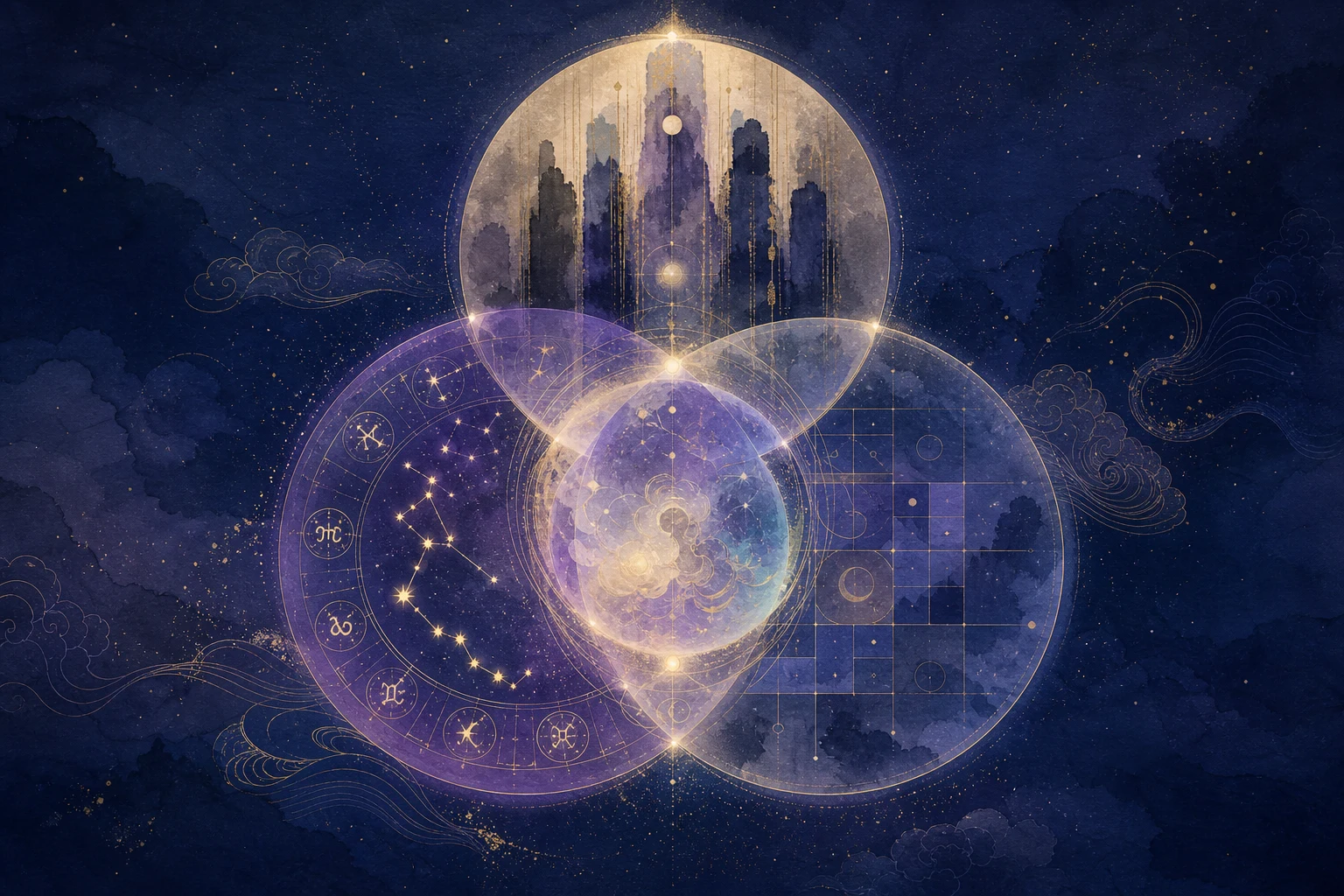
When Three Languages Illuminate the Same Self
Modern self-understanding content often brings three languages into the same room: Saju, which reads the year, month, day, and hour of birth; Western astrology, which reads zodiac signs and the birth chart; and MBTI, which explains everyday preference patterns. All three ask "What kind of person am I?" but each one shines light on a slightly different scene.
Saju reads the structure of time and the balance of the Five Elements. Astrology shows where and how your energy becomes visible. MBTI translates how you take in information, decide, recharge, and relate into everyday language. Rather than forcing them into one answer key, it is easier to layer them likethree different lights. What overlaps may be close to your center. What differs may be a face that appears only in certain situations.
Today's question
What if several personality descriptions all feel partly true?
That does not always mean one system is wrong. It may mean each system is looking at a different layer. This guide keeps the three languages separate, then shows where they can be read together.
4
Four pillars in Saju
12
Zodiac signs and houses
16
MBTI personality types

A Helpful Way to Read This Guide
This article is not trying to prove which system is "more correct." Based on Mystic Universe's Saju knowledge data, astrology blog data, and MBTI knowledge data, it places the three systems side by side to show which scenes each lens illuminates well and where each one should be read carefully. If Saju terms are new to you, start with What Is Saju? and the Five Elements guide.


AI-generated inline illustration
Created by Mystic Universe to compare the three lenses at a glance.
Each Lens Illuminates a Different Scene
All three systems talk about personality, but they begin from different places. Saju starts from the Yin-Yang and Five Element layout of birth time. Astrology starts from symbolic planetary positions. MBTI starts from psychological preference. The same person might be described as "strong Water energy" in Saju, "Pisces-like sensitivity" in astrology, and "INFP inner orientation" in MBTI. The words differ, yet they may all point toward emotional depth, imagination, and inner focus.
How to read this guide
Instead of treating the three systems as a single comparison chart, read them in this order.
Use Saju to read your raw material
Read the Five Element balance, Ten Gods, and luck-cycle movement of your birth time to see the structure you started with.
Where is my energy concentrated, and what is missing?
Use astrology to read the scene of expression
Use the Sun, Moon, planets, and houses to notice where that energy becomes visible in life.
In what scene does my self-expression become clearer?
Use MBTI to check everyday habits
Translate repeated choices in recharging, information, decisions, and rhythm into everyday language.
How do I collide, connect, decide, and recover?
What Saju Sees Well — Time and Balance
The heart of Saju is the structure created by time. Your birth year, month, day, and hour form four pillars. Each pillar has a Heavenly Stem and an Earthly Branch, and the eight characters distribute Wood, Fire, Earth, Metal, and Water. The first question is not simply "What is my personality?" but "How does my energy flow, and where is it too strong or too thin?"
For example, someone with strong Fire may express quickly, brighten the room, and move first. Depending on the whole chart, that Fire can become creativity, impatience, leadership, or performance. Someone with strong Water may think deeply and feel subtly, but when balance is off, the same Water can become hesitation or worry. That is why Saju depends on the whole chart, not one isolated sign.
Saju also reads time as movement. Through Great Luck and yearly luck, a person can act very differently as ten-year and one-year energies arrive. Saju is strong because it does not stop at "this is who I am." It asks: what kind of energy is pressing on me now, and how is it changing the way my traits show up?
What Astrology Sees Well — Expression and Life Stage
Many people think of astrology as "I am a Leo" or "I am a Pisces," but an actual chart is much richer. The Sun shows identity and will. The Moon shows emotion and instinct. The Ascendant shows first impressions and how you meet the world. The 12 houses then describe where those energies tend to act.
A strong 10th house can make career, reputation, and public role a central stage. A strong 4th house can make home, family, roots, and inner safety a major life theme. If Saju is especially good at reading elemental balance and timing, astrology is especially vivid at showing the scene in which your self-expression becomes visible.
Grouping the 12 signs into four moods
Instead of memorizing each sign one by one, feel the rhythm first. From there, the bridge to Saju language becomes softer.
The fire rhythm that moves first
This rhythm starts, shows itself, and reaches toward a wider world.
In Saju language, it can sit near Fire, Siksang, and Bi-geop cues that push expression and momentum.
The earth rhythm that holds reality
This rhythm refines life through stability, senses, responsibility, and steady craft.
It pairs naturally with Wealth, Officer, and Earth-element cues that build results and structure.
The air rhythm that connects ideas
This rhythm spreads through words, relationships, ideas, and networks.
It is easy to compare with Siksang, Resource, and Indirect Resource patterns of language and learning.
The water rhythm that carries feeling
This rhythm notices memory, protection, immersion, and intuition before they become visible.
Read through Water, Resource, and Indirect Resource cues, it softens into empathy and imagination.
This Is a Mood Translation, Not a Conversion Table
The grouping above is a bridge for understanding. It does not mean Aries equals one Ten God, or Pisces equals the Water element. Astrology is symbolic language; Saju reads elements, Ten Gods, pillars, and timing. Good comparison keeps the grammar of each system intact.
What MBTI Sees Well — Communication and Choice Habits
MBTI explains four preference axes. E/I asks where you gain energy. S/N asks how you take in information. T/F asks what you use as the main basis for decision-making. J/P asks whether you prefer structure or open options. That is why MBTI is especially intuitive for daily conversations and relationship friction.
A Thinking type may hear a problem and immediately search for a solution. A Feeling type may first want the emotion to be understood. A Judging type feels safe when plans and promises are clear. A Perceiving type breathes better when there is room to adjust. These differences are hard to explain quickly through elemental balance or houses alone. MBTI is useful because it translates the concrete ways people collide and connect into everyday language.
| MBTI axis | Everyday question | When paired with Saju / astrology |
|---|---|---|
| E / I | Do I recharge with people, or by processing alone? | Compare with Siksang / Bi-geop expressiveness and the Ascendant's outward response style |
| S / N | Do I look first at facts and experience, or meaning and possibility? | Pair with Resource / Siksang learning style, Mercury, and 9th-house thinking |
| T / F | Do I decide through logic and outcomes, or people and values? | Read alongside Officer / Wealth realism, Venus, and Moon relationship tone |
| J / P | Do I feel calmer with a plan, or with options open? | Compare with Earth / Officer structure and fixed, mutable, or cardinal rhythms |
When the Three Lenses Overlap
When all three lenses point in the same direction, that trait may be a stable core. Suppose a chart has strong Fire and expressive Siksang, astrology emphasizes Leo or the 5th house, and MBTI is ENFP or ESFP. In that case, "coming alive in front of people" may be more than a mood. It can be a real talent.
Or suppose Saju shows strong Water and Resource energy, astrology emphasizes Pisces or the 12th house, and MBTI is INFP or INFJ. Then deep empathy, imagination, and quiet immersion are likely central. Instead of asking, "Why do loud environments drain me so fast?" the better question becomes: "How can I use this sensitivity in creation, counseling, research, or planning?"
When the Three Lenses Do Not Match
Someone may look calm and structured in Saju through strong Metal or Earth, while their MBTI comes out as a lively ENFP. Another person may show Sagittarius-like freedom in astrology but live day to day with a very planned J-type rhythm. This does not mean one system is wrong. It means the systems are looking at different layers.
Saju reads the raw material of your birth chart and the timing that activates it. MBTI reads the psychological habits you currently use most often. Astrology reads symbolic scenes of self-expression. The mismatch is often the most useful part because it shows where your natural material and your chosen habits operate differently.
Good Self-Understanding Does Not Freeze You
If you use these systems as "I am INFP, so I cannot do that," "I am in Samjae, so nothing will work," or "My sign is like this, so I am stuck," they stop helping. A good reading is not a cage. It is a map for choosing with less harm and more awareness.
A Five-Step Way to Apply the Three Lenses
When reading the three systems together, do not rush to one final label. Split the questions. The order below keeps the information from tangling and turns it into actual self-understanding.
- Use Saju to identify your raw material. Check your Day Master, Five Element balance, and strongest Ten Gods. The Day Master guide is a good starting point.
- Use astrology to find the scene of expression. Look beyond Sun sign to the Moon, Ascendant, and emphasized houses.
- Use MBTI to read daily habits. Notice how you recharge, take in information, decide, and handle promises.
- Mark repeated keywords. Expression, stability, empathy, analysis, freedom, responsibility: repeated words matter.
- Turn mismatch into questions.Instead of "Why are they different?" ask, "In what situation does this side of me appear?"
How to Use This in Relationships
In relationships, the roles of the three lenses become even clearer. Saju reads structural interaction such as element balance and combinations, clashes, punishments, breaks, and harms. Astrology shows what emotional scenes and needs two people activate in each other. MBTI explains where the daily conversation actually breaks down.
For example, one person may answer a problem with a solution first (T), while the other wants emotional validation first (F). Saju compatibility alone will not resolve that conversation. But MBTI alone may miss why a certain year makes the relationship suddenly more sensitive. For deeper reading, it is better to combine the structure of Saju compatibility with the communication habits MBTI reveals.
Questions to carry into the app
After reading, first check which element is strongest in your Saju and whether that energy points in the same direction as your MBTI. Then compare people saved in your archive, such as family, friends, or a partner, and the article naturally turns into a relationship question: why do we hear the same words differently?
Bottom Line — Layer the Lenses, But Stay the Author
Saju, astrology, and MBTI are all languages for describing the self. None of them replaces you. Saju shows time and balance. Astrology shows expression and life stage. MBTI shows communication and choice habits. Layered together, they create a more three-dimensional picture than any single label can offer.
The best use is simple: keep what fits as a clue to your strengths, and treat what feels uncomfortable not as a flaw but as material you can use differently. Then the three systems stop being verdicts about destiny and become a practical map for handling yourself more gently and more clearly.
Mystic Universe Editorial
Authorship & review
Mystic Universe editorial team. This article cross-checks our Saju knowledge data with curated astrology and MBTI knowledge files, without impersonating any real practitioner, astrologer, psychologist, or credential.
Frequently Asked Questions
Q.Can Saju and MBTI be read together?▾
Yes, but they should not be merged as if they were the same system. Saju reads elemental balance and timing from birth data, while MBTI reads preferences in energy, information, decisions, and lifestyle. Overlaps can point to core traits; mismatches can show context-specific sides of you.
Q.How are astrology and Saju different?▾
Astrology reads symbolic patterns through the Sun, Moon, planets, signs, and houses, often describing self-expression and life stages. Saju reads Heavenly Stems, Earthly Branches, Five Element balance, and luck cycles. They may produce similar images, but they are not a one-to-one translation table.
Q.What if the three systems give different results?▾
Different results usually mean they are reading different layers, not that one is automatically wrong. Saju reads raw material and timing, astrology reads symbolic scenes of expression, and MBTI reads current psychological habits. Turn the mismatch into a question: in what situation does this side of me appear?
Related Articles
Curious about your Day Master?
Enter your birth details and AI will show your Day Master and Five Elements analysis.
Check My Saju for FreeThis content is for entertainment purposes only and does not replace professional advice.