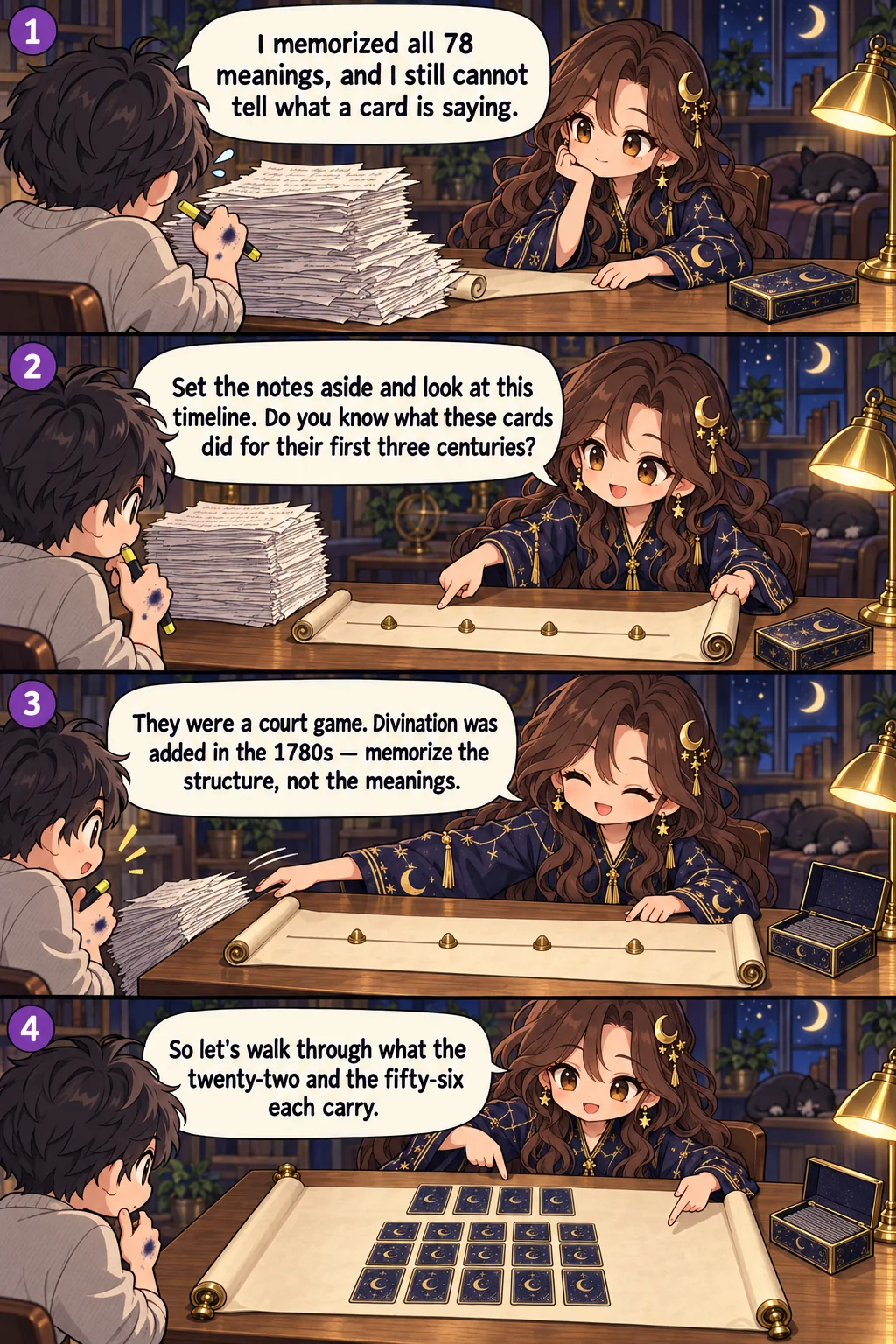
If you memorized all seventy-eight meanings and still freeze in front of a spread, the problem may not be your memory but what you chose to memorize. Keyword lists for every card are five seconds away in any search box. What those lists never tell you is how the seventy-eight are divided in the first place, and why they were divided that way.
So this guide opens with one question and comes back to it later. If tarot is a tool for reading the future, why did nobody use it that way for its first three centuries? Once that is answered, the way you learn the deck changes.
Today's question
Seventy-eight cards, and always stuck in the same place. Why?
Tarot is not a bundle of seventy-eight separate meanings. It is a grid that splits ordinary human experience into layers. Learn the cells first and the individual meanings settle into place on their own.
The short answer: tarot is a grid of seventy-eight cells
A tarot deck holds two blocks with genuinely different jobs. There are twenty-two named cards, and fifty-six more divided into four suits. They are not two halves of the same task. The twenty-two ask which chapter of a life you are standing in. The fifty-six ask what is happening inside that chapter.
That gives you a reading order that has nothing to do with memorized meanings. Several named cards in one spread suggests the question is about the chapter itself rather than day-to-day adjustment. A spread made only of suit cards suggests the chapter stays put while the arena and the stage shift. You can make that call without knowing a single card definition.
| Layer | What it holds | Count | Its job in a reading | What it does not answer |
|---|---|---|---|---|
| Major Arcana | Twenty-two named turning points | 22 cards | Places the question inside a chapter of a life | When, how much, or who |
| Suits (four) | The four arenas where things happen | 14 each | Narrows which arena the story belongs to | Whether that arena is good or bad |
| Numbers (Ace to Ten) | Stages of progress inside one arena | 10 each | Shows whether it is starting, mid-flight, or overrun | Pace and how long it will take |
| Court cards | Four postures for handling that arena | 4 each | Mirrors a person, or your own approach | The identity of a specific real person |
How this guide reads cards
No card name gets translated straight into an outcome. Instead of “Tower equals disaster” or “Death equals ending,” we ask which layer the card sits in and what it is asking there. Fix the layer and the individual meaning lands in a much narrower, much more useful range.
The Minor Arcana — arena, then stage
The fifty-six split into four suits of fourteen. Ten numbered cards run from Ace to Ten, joined by four court cards called Page, Knight, Queen, and King. The suit sets which arena. The number sets which stage of that arena.
The number axis in particular asks very little memorization. An Ace is the seed of that arena, the middle numbers carry friction and adjustment, and the Ten is that energy carried all the way out. A Ten can read as completion or as too much, and the card art plus the question decide which. That is why the Ten of Pentacles reads as an accumulated foundation while the Ten of Swords reads as more thought than anyone can carry.
Court cards are usually introduced as “people around you,” which throws away half of their range. They are also four postures for handling the arena: learning it, pushing at it, holding it, and taking responsibility for it, mapped onto Page, Knight, Queen, and King. Used that way they become a mirror for how the querent is currently approaching the arena. Suit-level detail continues in the Wands guide.
Suits and elements — a standard, but not the only one
Mapping the four suits onto four elements is close to universal today. The mapping did not come out of the cards themselves, though. It was systematized by a late-nineteenth-century Western esoteric order, and the Rider-Waite-Smith line carried it forward until it hardened into convention. It is standard, but it is not exclusive.
| Suit | Standard element | Arena it covers | In other traditions |
|---|---|---|---|
| Wands | Fire | Drive, initiation, momentum | Some decks assign Air instead |
| Cups | Water | Feeling, relationship, mood | Near-universal agreement |
| Swords | Air | Judgment, language, conflict | Some decks assign Fire instead |
| Pentacles | Earth | Body, money, material base | Near-universal agreement |
Wands and Swords are where decks genuinely disagree. Modern decks exist that give Wands to Air and Swords to Fire, and older Marseille-style decks do not state an element for either suit at all. Rather than memorizing “Wands are Fire” as a fact, it is more useful to check which mapping your own deck chose. Most companion booklets say so on the first few pages.
The Major Arcana — and when the Fool’s Journey appeared
From the Fool at zero to the World at twenty-one, each of the twenty-two carries a name. A widespread way of reading them is as one story: the Fool sets out, meets the world, and arrives at completion. That reading is called the Fool’s Journey, and most introductory books teach the twenty-two through it.
One thing is worth stating plainly. The Fool’s Journey is not a structure the fifteenth-century card makers designed. It is a name Eden Gray gave in 1970. It was the title of the epilogue in her A Complete Guide to the Tarot, and it settled in as standard commentary alongside the late-twentieth-century tarot revival. Early decks ordered their trumps differently by region, and nothing instructed anyone to read them as a single narrative.
None of that makes the frame useless. Learning the twenty-two as a flow is far faster than learning them as isolated symbols, and “where in this journey are we” works well as a live reading question. It is simply more accurate to keep inherited structure and well-made modern interpretation in separate boxes, so that meeting a different framework later does not throw you. Card-by-card coverage begins in Major Arcana, part one.
When tarot became divination — what the timeline answers
Back to the opening question. Tarot cards first appear in the record in a Florentine court document from 1440, under the name carte da trionfi, cards of triumph. It was the name of a card game played by aristocrats. The surviving luxury decks from that period show no sign of divinatory use.
The turn comes in 1781, when Antoine Court de Gébelin argued in Le Monde Primitif that tarot was a lost book of ancient Egyptian priests. His evidence was the impression the pictures made on him. This was eighteen years before the Rosetta Stone surfaced and four decades before hieroglyphs could be read. The claim has no support in the sources, but it was decisive in placing tarot inside a lineage of mystery. Etteilla followed in 1788 with the first deck designed specifically for divination.
What the timeline tells you
Tarot as cards is roughly 580 years old. Tarot as divination is roughly 240. For the first three centuries nobody asked these cards about the future. So “an ancient tool of prophecy” is not an accurate way to introduce them.
This does not diminish tarot. It clarifies where the real asset sits. Two and a half centuries of people holding their situations up against these seventy-eight cells produced a working vocabulary of symbols. That vocabulary, not predictive accuracy, is why the deck is still in use.
What Jung actually said
Carl Jung appears in almost every tarot introduction, usually in the form “Jung explained that tarot connects to the collective unconscious.” It is worth checking the actual remark.
Jung discussed tarot at the Visions Seminar on 1 March 1933. There he called the cards “sort of archetypal ideas” and described the deck as “an attempt at representing the constituents of the flow of the unconscious.” So the link to archetypes is genuinely his. What is also true is that Jung published essentially nothing on tarot. The elaborate Jung-and-tarot systems in circulation today are mostly later writers applying his concepts to the cards.
Keeping those apart is practical. Reading cards through Jungian concepts remains a legitimate approach; calling it “the method Jung endorsed” has no basis.
Three steps of a reading — ask, draw, read
With the structure in hand, a reading is three steps. The first is framing the question, and most of the outcome is decided here. A closed question like “will I succeed if I change jobs” leaves the cards nowhere to answer. Open it — “what am I not seeing as I consider this move” — and any of the seventy-eight cells can carry a reply.
The second is the draw. Deciding how many cards go where is what a spread is, and every position is best understood as a sub-question carved out of the main one. One card is enough at the start. You add positions when you can split the question more finely, not before. Choosing and building spreads is covered in the tarot spread guide.
The third is reading. Before reaching for a card’s meaning, apply the layers: named card or suit, which arena, which stage. Then look at what actually catches your eye in the image. First impressions are often accurate, not because of any mysterious faculty, but because the art was drawn to provoke exactly that response.
Reversals are optional
Reading a card differently when it lands upside down is called a reversal, and it is not a rule you must follow. Plenty of readers work upright-only, and they are not doing it wrong. If you do use reversals, avoid collapsing them into “the bad version.” Weakened, turned inward, or not yet arrived are readings that fit far more often. Reversals get their own treatment in the reversed cards guide.
If you want to read tarot alongside Korean Saju, it is safer to settle first how the two layers overlap. Why neither system can verify the other is covered in Saju × Tarot cross reading, and if the Saju side is unfamiliar, what Saju is is the place to start.
In one sentence
Tarot is not a prediction device but a grid of seventy-eight cells, and a reading is the act of holding your present question up against that grid.
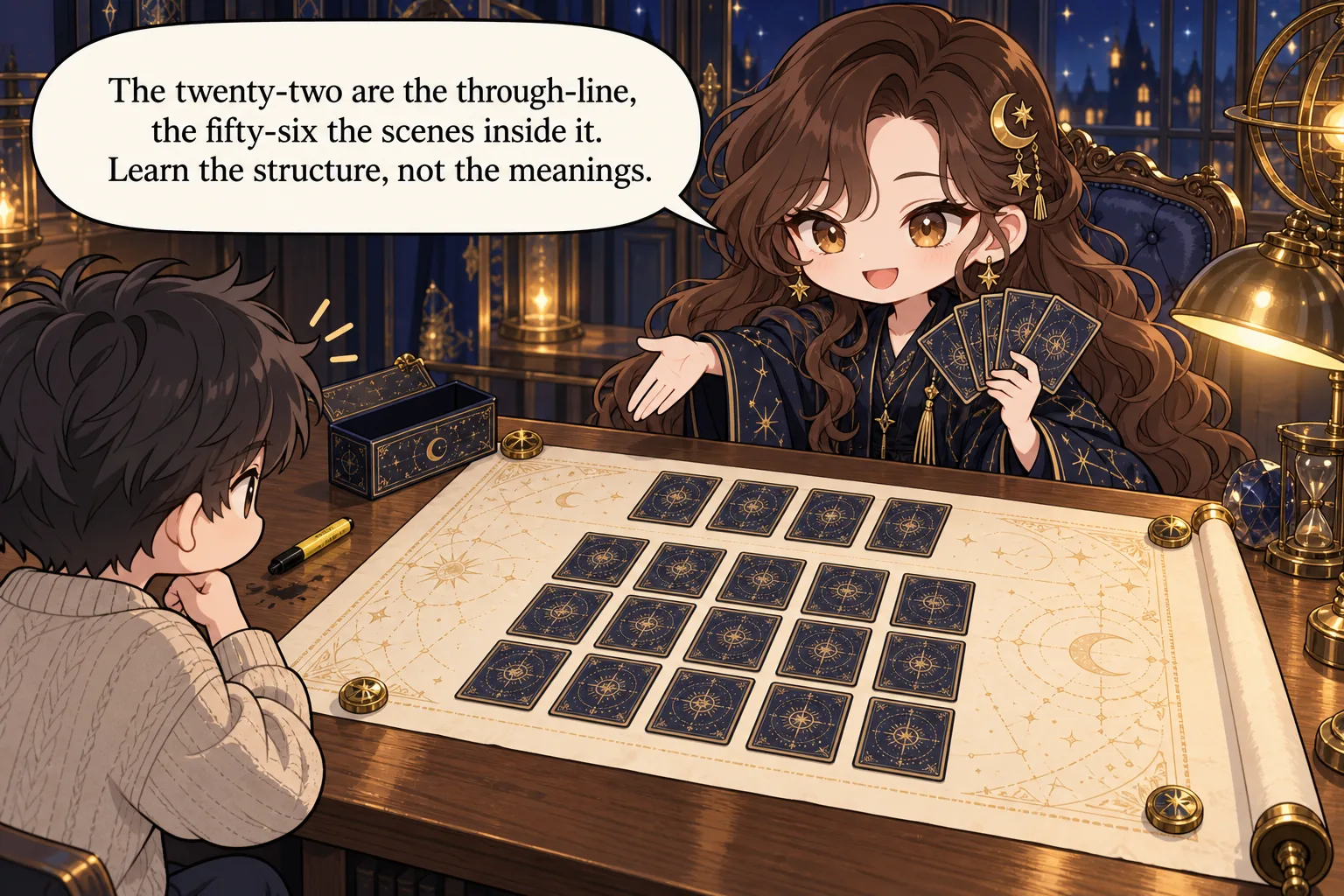
Start with one card a day. Before recalling its meaning, notice whether it came from the twenty-two or the fifty-six.
Sources and production notes
The dates come from the following. The cards’ first documentary appearance is the carte da trionfiof a 1440 Florentine court record. The turn to divination runs through Antoine Court de Gébelin’s Le Monde Primitif(1781) and Etteilla’s divination deck (1788). The Fool’s Journey is the epilogue title of Eden Gray’s A Complete Guide to the Tarot (1970). Jung’s remark is recorded in the Visions Seminar of 1 March 1933. The spread-side citation, A. E. Waite’s The Pictorial Key to the Tarot (1910), is not covered here and is handed to the tarot spread guide.
Four things are deliberately left unasserted. First, that one suit-to-element mapping is correct; a standard and a dissenting tradition both exist. Second, that Jung treated tarot systematically; the seminar remark is real, the writing is not. Third, Egyptian or Romani origins, which the sources do not support. Fourth, that any particular deck is objectively better for beginners. Rider-Waite-style decks are commonly recommended for exactly one reason: their numbered cards carry scenes, which gives a learner more to work with.
While checking this, the earlier version of this page turned out to assert two of those points — presenting the Fool’s Journey as the original meaning of the twenty-two, and Jung’s remark as published work. Both are corrected above against the sources listed. This article introduces a traditional symbolic system for general interest and does not offer scientifically validated prediction.
Mystic Universe Editorial
Authorship & review
This article introduces tarot as a traditional symbolic system. It is not scientifically validated prediction, and every date and attribution is listed in the sources section.
Frequently Asked Questions
Q.Does tarot predict the future?▾
Tarot was only used for divination from the 1780s onward; for roughly three centuries before that it was a court card game. This guide therefore presents it not as a prediction device but as a grid of symbols that splits human experience into twenty-two and fifty-six. A reading is closer to holding your present question up against that grid.
Q.Do tarot cards have to be received as a gift?▾
That is folklore with no basis. A deck you chose yourself is usually the one you handle most comfortably. Rider-Waite-style decks are commonly recommended to beginners for one practical reason only: their numbered cards carry scenes, which gives a learner more interpretive footholds.
Q.Is the Fool's Journey an original concept?▾
No. It is a twentieth-century interpretive frame named by Eden Gray as the epilogue title of A Complete Guide to the Tarot (1970). Early decks ordered the trumps differently by region and gave no instruction to read them as one narrative. It remains a useful way to learn the twenty-two as a flow, which is why this guide uses it after naming it as modern.
Q.Are Wands Fire or Air?▾
The Rider-Waite-Smith standard is Wands for Fire and Swords for Air. Modern decks exist that reverse this, giving Wands to Air and Swords to Fire, and older Marseille-style decks state no element for either suit. Rather than memorizing one answer, check which mapping your own deck chose in its companion booklet.
Q.Do I have to use reversals?▾
No. Many readers work upright-only and they are not doing it wrong. If you do use reversals, avoid fixing them as the bad version of a card. Weakened, turned inward, or not yet arrived are readings that fit considerably more often.
Related Articles
Start with one card today?
The Fortune tab draws one card for today and three for the week.
Draw Today's CardThis content is for entertainment purposes only and does not replace professional advice.