
Why Did People Begin Reading Fate From One Star in the Northern Sky?
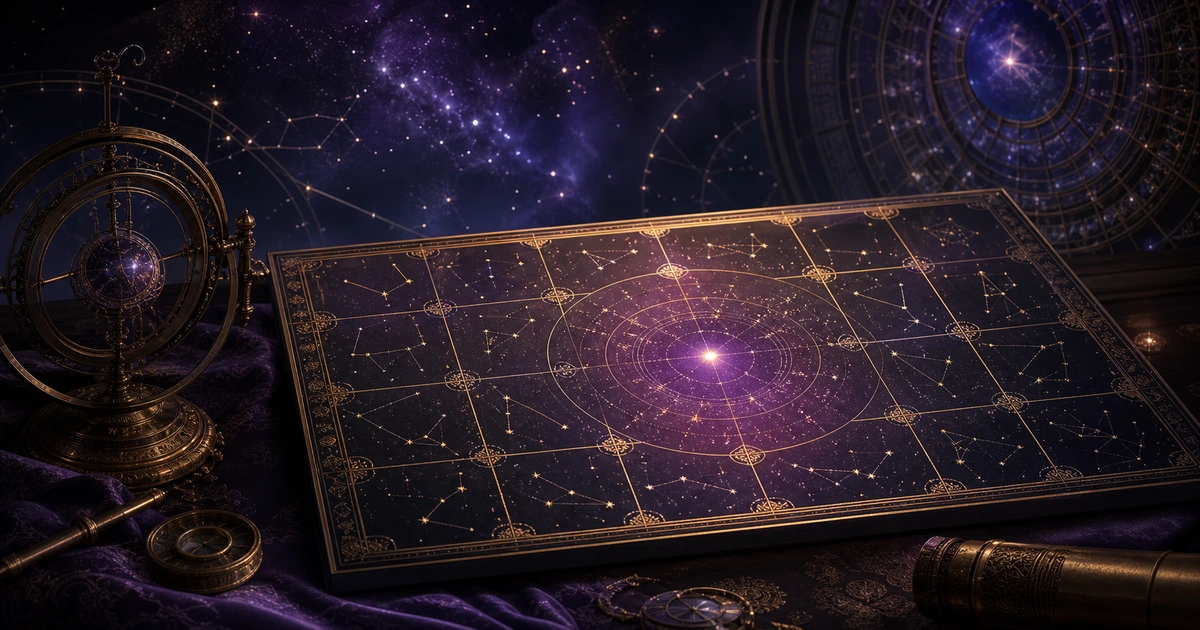
If you watch the night sky long enough, a strange scene appears. Stars seem to rise, set, and shift with the seasons, yet the northern sky holds one point that feels unusually still. Traditional observers connected that center with Zi Wei (紫微), the image of Polaris or the Purple Star. Because the sky seemed to revolve around it, Zi Wei became an image of the heavenly throne, order, and the axis around which life can be oriented.
Zi Wei Dou Shu begins from that image. Zi Wei points to the central star of the northern sky; Dou Shu suggests counting and arranging stars into a chart. If Saju reads the elemental balance of four pillars, Zi Wei Dou Shu lays out a destiny astrolabeand asks, "In which room of life does this pattern turn on first?"
Today's question
How is Zi Wei Dou Shu different from Saju, and why does it use a chart?
This guide is not a star-name memorization list. It follows why the system starts from the image of Polaris and turns life into a 12-palace astrolabe.
1
Destiny Palace as the axis
12
Palaces as life rooms
14
Major stars setting the tone
Read the Origin as Tradition Plus Historical Caution
Zi Wei Dou Shu is often traditionally linked to the Northern Song Daoist figure Chen Xiyi, also known as Chen Tuan. Historically, however, the surviving books and clearly traceable terminology become much easier to see in later sources, especially around the Ming period and after. So this guide does not claim one simple inventor. It treats Zi Wei Dou Shu as a tradition that organized northern-sky symbolism into a structured chart-reading system.
What Is Zi Wei Dou Shu? A Star Map Dividing Life Into 12 Rooms
Zi Wei Dou Shu is an East Asian destiny-reading system that uses birth data to construct a personal chart, then reads the stars and palaces inside it. The stars are not usually treated like telescope-tracked objects in the modern astronomical sense. They work more like a symbolic language for roles, pressures, habits, and life themes.
Its appeal is that it does not stop at "What kind of person am I?" The same person may be careful in love, bold at work, conservative with money, and surprisingly lucky when moving into new environments. Zi Wei does not treat those differences as contradictions. It divides life into 12 rooms and asks, which version of you appears in which room?
A Beginner Sequence for Reading the Chart
Instead of memorizing every star at once, start with the axis and the rooms. That is where the story begins.
Start with the Destiny Palace
The Destiny Palace (命宮) is the chart's central axis. It frames temperament, decision style, and the main stage where life begins to speak.
Which star-language does this person use to interpret life?
Read the 12 palaces as life rooms
Spouse, Wealth, Career, Travel, Property, and other palaces divide life into rooms. The same star changes its voice depending on which room it occupies.
Does this pattern show up in relationships, work, movement, or money?
Connect Four Transformations and San Fang Si Zheng
Lu, Quan, Ke, Ji and palace relationships keep you from reading one palace in isolation. They turn symbols into a connected structure.
Which palaces are pushing and pulling on the same theme?
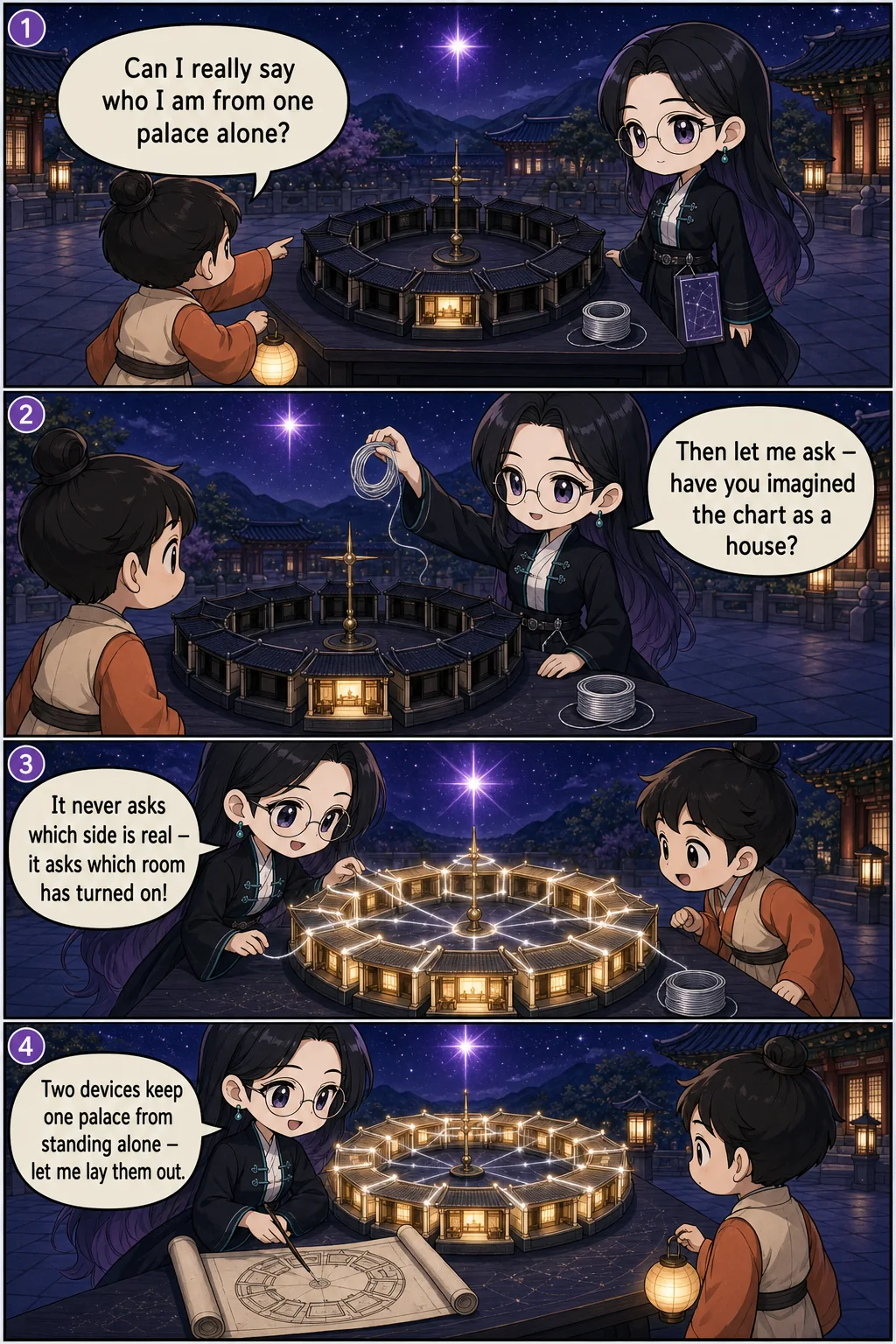
Reading a Chart Is Like Seeing Which Lights Turn On Inside a House
A Zi Wei chart can feel intimidating at first because it is full of palace boxes and star names. But imagine it as a house. The Destiny Palace is the entryway and living room where you first appear. The Spouse Palace is the room of close partnership. The Wealth Palace holds money and resources. The Career Palace is work and public role. The Travel Palace turns on when you step outside your familiar environment.
For example, someone may look quiet and cautious in the Destiny Palace, yet show decisive momentum in the Career Palace. In ordinary life they seem careful; in work situations they become clear and directive. Zi Wei does not ask which side is the "real" personality. It asks which room has turned on.
Self axis
Destiny · Fortune · Parents
How you recover alone, how you respond to authority, and the basic lens through which you read life.
Relationship axis
Siblings · Spouse · Children · Friends
The distance that repeats with close people, the temperature of partnership, and how collaborators support you.
Reality axis
Wealth · Career · Property
How you hold resources, what role work asks you to play, and how home or foundations become stable.
Change axis
Health · Travel
The pattern of overextension, the outside stage where you become stronger, and turning points through movement.
The 14 Major Stars Are the Chart's Tone, Not a Personality Label
The 14 major stars often discussed in Zi Wei Dou Shu are Zi Wei, Tian Ji, Tai Yang, Wu Qu, Tian Tong, Lian Zhen, Tian Fu, Tai Yin, Tan Lang, Ju Men, Tian Xiang, Tian Liang, Qi Sha, and Po Jun. Their names feel classical, but in interpretation they work as symbolic star archetypes. Some emphasize order and coordination, some strategy and movement, some visibility and expression, and some breakthrough or decisive change.
The important point is not to split them into simply "good stars" and "bad stars." Zi Wei can become leadership when supported, but isolated responsibility when unsupported. Fiercer stars such as Qi Sha or Po Jun are not automatically negative; in the right context, they can become engines of transition and decisive action.
Do Not Conclude From One Star
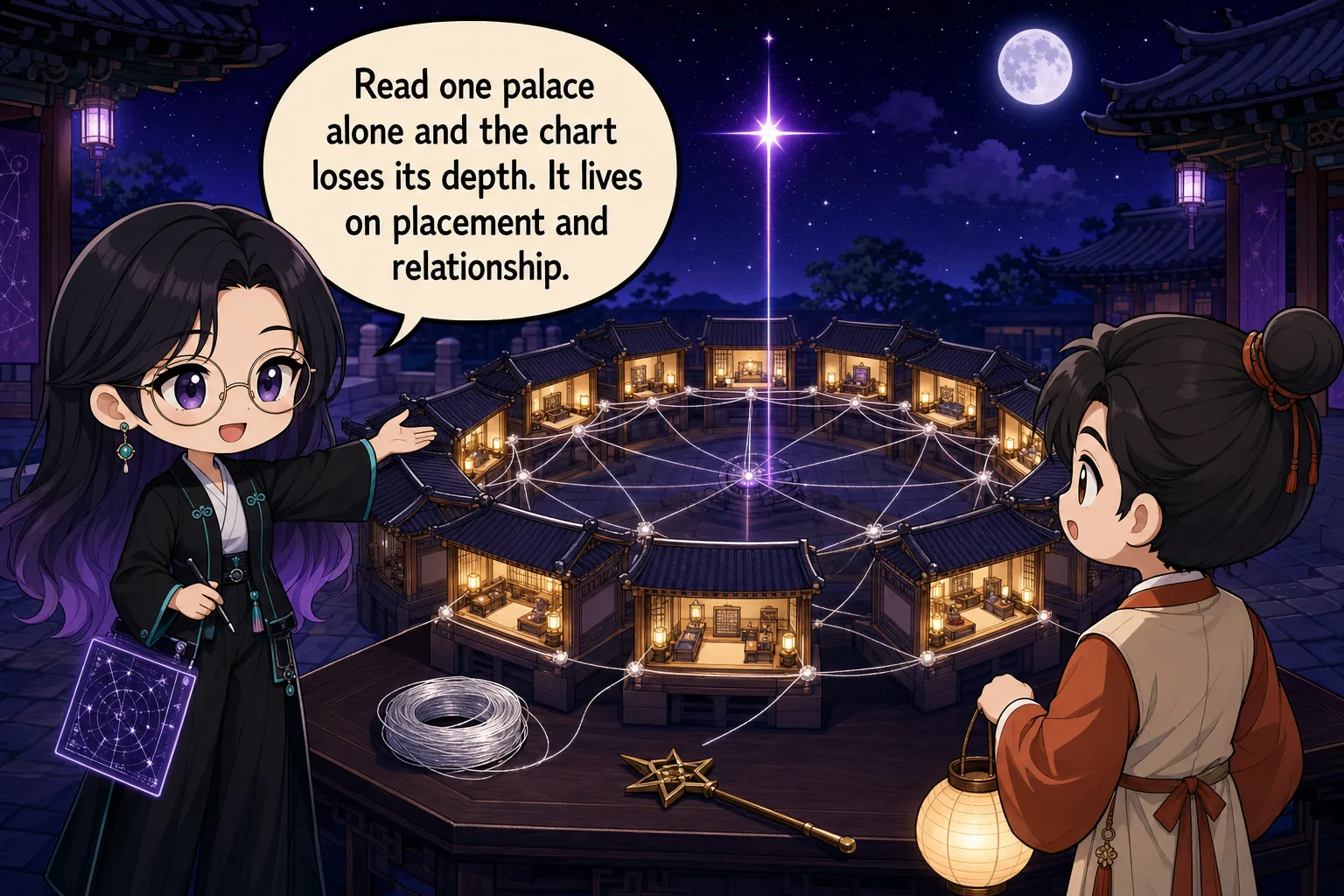
Zi Wei interpretation depends on placement and relationship. Major stars set the tone, supporting stars refine or distort it, and Four Transformations show which domains become activated. If you read one palace alone and stop there, the chart loses its depth.
Four Transformations and the Triangle-and-Axis View
A chart looks complicated less because of the number of stars than because of the connections. Zi Wei Dou Shu has two devices that stop you from reading a single palace in isolation.
The first is the Four Transformations— Wealth (祿), Power (權), Status (科), and Entanglement (忌). They add flow and emphasis to how a star behaves: where opportunity gathers, where drive lands, where recognition attaches, and where the mind gets caught and turns something into an unfinished task. Reading any one of them as simply "lucky" or "unlucky" flattens the chart. Their meaning cannot be separated from the star and palace they land on.
The second is the triangle-and-axis view: when you read one palace, you read it together with the two palaces it forms a trine with and the palace directly opposite. The Career Palace, for instance, is read with the Life and Wealth Palaces and its opposite, the Spouse Palace. That keeps work from being locked inside one room and ties it to who you are, what you earn, and who you partner with. Life does not run on one domain at a time, and the chart is built to reflect that.
How Is Zi Wei Dou Shu Different From Saju?
Both systems care about birth data, but their angle is different. Saju reads Five Element balance, Heavenly Stems, Earthly Branches, and luck cycles to understand broad temperament and timing. Zi Wei Dou Shu reads star placement across 12 palaces to divide life into more specific domains. They also handle time differently: Saju reads the temperature of a period through major and yearly cycles, while Zi Wei Dou Shu watches those cycles move across the 12 palaces to see which room lights up.
| Frame | Saju | Zi Wei Dou Shu |
|---|---|---|
| Core question | How is my elemental balance and timing structured? | Which life domain activates which pattern? |
| Best at | Temperament, balance, useful elements, major and yearly cycles | Domain readings such as Destiny, Spouse, Wealth, Career, and Travel |
| Common mistake | Judging the whole chart from one stem or branch | Judging the whole chart from one star or one palace |
Three Beginner Traps to Avoid
1. Birth time matters a lot
In Zi Wei Dou Shu, the palace axis and many chart relationships depend on the birth hour. Without reliable time, the chart can become unstable. Mystic Universe's Zi Wei Destiny Palace reading therefore opens from a Saju profile with usable birth time.
2. An empty palace is not automatically bad
Beginners often worry when a palace has no major star. But in Zi Wei, empty palaces are interpreted through the opposite palace and connected palace relationships. Empty does not mean missing; it often means this domain must be read through another room.
3. Four Transformations show activation, not guaranteed events
Hua Lu, Hua Quan, Hua Ke, and Hua Ji can be understood as directions of opportunity, power, recognition, and entanglement. Hua Ji does not guarantee disaster. It usually marks a domain that becomes more sensitive and needs conscious management.
How to Use Zi Wei Dou Shu Practically
Zi Wei Dou Shu becomes useful when you move beyond "What kind of person am I?" and ask, Where does my pattern repeat first? Do relationship issues follow a familiar shape? Are you strong in work but unstable in resource handling? Does your life change more through home, movement, or public role? The more specific the question, the more practical the chart becomes.
When you read a Zi Wei Destiny Palace report in the app, use the same path: start with the Destiny Palace keyword, move to the palace connected to your question, then compare it with your Saju element balance and timing. You can also layer it with other self-understanding lenses to notice where the signals overlap.
Mystic Universe Editorial
Authorship & review
Mystic Universe editorial team. This guide cross-checks public Zi Wei Dou Shu primers with our Zi Wei Destiny Palace reading frame, without impersonating any real practitioner or credential.
Frequently Asked Questions
Q.How is Zi Wei Dou Shu different from Saju?▾
Saju focuses on Heavenly Stems, Earthly Branches, Five Element balance, and major or yearly timing cycles. Zi Wei Dou Shu divides life into 12 palaces and reads star placement and Four Transformations across domains such as relationships, wealth, career, and movement.
Q.Do I need an accurate birth time for Zi Wei Dou Shu?▾
Yes. Zi Wei Dou Shu depends heavily on the birth hour because the Destiny Palace and palace structure are tied to it. Without usable time, the chart's central axis can become unreliable.
Q.Are some of the 14 major stars good and others bad?▾
Not in a simple way. Each star has constructive and difficult expressions. Its meaning changes by palace placement, supporting stars, Four Transformations, and connected palace relationships.
Related Articles
Curious about your Day Master?
Enter your birth details and AI will show your Day Master and Five Elements analysis.
Check My Saju for FreeThis content is for entertainment purposes only and does not replace professional advice.