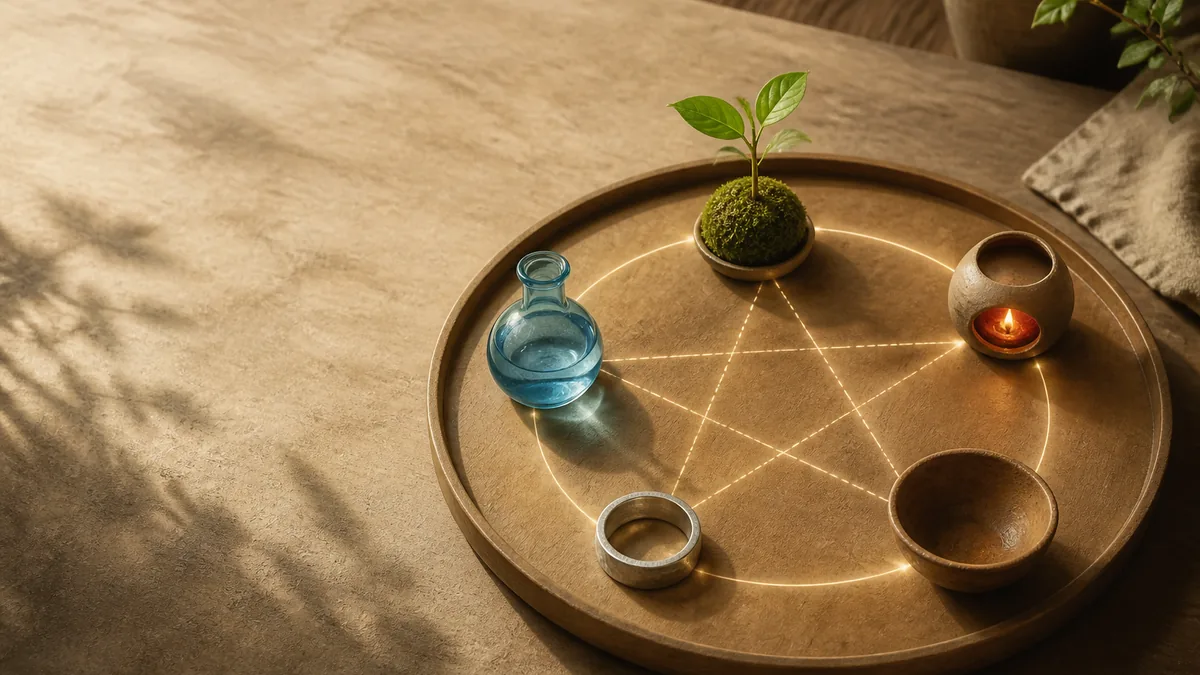
If Water is absent from a Saju chart, should you drink more water or wear blue? That question treats the Five Phases as five substances that can be poured into a missing box. The word commonly translated as “element” is xing, movement or phase. A symbolic object does not automatically change the relational structure of a birth chart.
This article asks one question: if Wood, Fire, Earth, Metal, and Water are not merely material names, what do generation and control actually describe? We will read each phase as a verb, place the two cycles on the same wheel, and then apply them to a chart without turning absence into a prescription.
Today’s question
Can an object fill a missing phase in my chart?
The Five Phases are a traditional language that classifies change into five modes. Count, season, strength, relationship, and flow must be read together.
The short answer: the Five Phases are five verbs of change
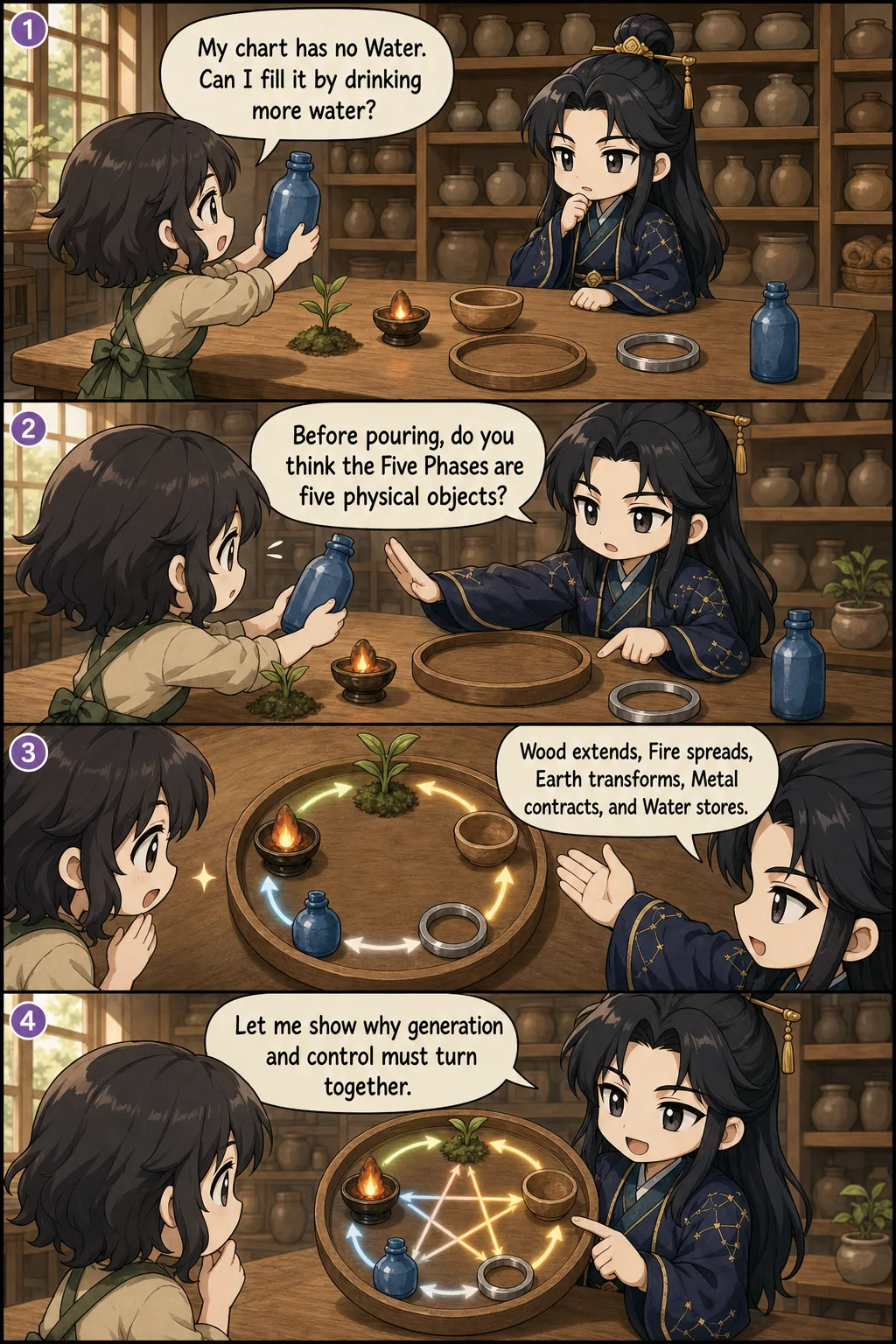
Wood, Fire, Earth, Metal, and Water borrow their names from familiar materials, but traditional descriptions focus on what those forms do. The “Great Plan” in the Book of Documents describes Water as moistening downward, Fire as flaming upward, Wood as bending and straightening, Metal as yielding and changing, and Earth as receiving sowing and harvest. These are directions of action, not five personality scores.
That is why “Wood people are always creative” or “too much Metal makes a person cold” is not an adequate reading. Wood changes with season, roots, dryness, and its relations to Water, Fire, Earth, and Metal. It may resemble a new shoot, a spreading canopy, or dry wood that cannot grow. The Stems and Branches guide shows where phase associations enter the eight characters.
| Phase | Core movement | Modern observation | Reduction to avoid |
|---|---|---|---|
| Wood | Sprouts, extends, chooses a direction | Initiation, growth, connection | Not literal timber or a permanently kind personality |
| Fire | Spreads, rises, becomes visible | Expression, diffusion, visibility | Not simply anger or a fiery temperament |
| Earth | Receives, mixes, transforms | Mediation, accumulation, conversion | Not motionless stability alone |
| Metal | Contracts, distinguishes, gives form | Selection, editing, standards | Not literal metal or money itself |
| Water | Descends, stores, prepares | Recovery, inquiry, potential | Not something added by drinks or blue objects |
Generation supports; control regulates
The generating cycle runs Wood to Fire, Fire to Earth, Earth to Metal, Metal to Water, and Water back to Wood. It is a traditional relational model rather than a literal account of modern chemistry or physics. One phase creates a condition for the next. As a process metaphor, a direction becomes expression, expression leaves accumulated results, accumulation enables selection and standards, and contraction stores resources for the next inquiry.
The controlling cycle runs Wood over Earth, Earth over Water, Water over Fire, Fire over Metal, and Metal over Wood. Control does not mean that one phase hates or destroys another. It sets limits, channels excess, and creates usable form. Water without a bank can flood; growth without pruning can scatter light and resources. Regulation allows production to continue rather than opposing it.
| Relation | Basic sequence | What it models | Misreading to avoid |
|---|---|---|---|
| Generation | Wood, Fire, Earth, Metal, Water, Wood | One phase provides conditions for the next | Supply may also exhaust the giver or overload the receiver |
| Control | Wood over Earth, Earth over Water, Water over Fire, Fire over Metal, Metal over Wood | Limits excess and shapes a process | Control is not automatically conflict, evil, or bad luck |
| Drain | A phase generates the next one | Expression and production move resources outward | Generation is not good only for the receiver |
| Power difference | The same arrow changes under unequal strength | Test weak regulation and excessive supply | Do not judge from the diagram alone |
Generation is not always good; control is not always bad
Continuous supply can overfeed the receiver and drain the giver. Appropriate control can create focus, standards, and accountability, while overwhelming control can become pressure or damage. The relation name never settles the outcome by itself. Ask who is strong, who is weak, in what season, and whether another path can carry the flow.
How the Five Phases are read in a Saju chart
- Set the reference: identify the Day Master, the Heavenly Stem of the birth day.
- Read the season: check which phases gain or lose support in the Month Branch.
- Check roots and visibility: find support in Branches, Hidden Stems, and exposed Stems.
- Trace the flow: see who generates or controls whom, and where energy gathers or stops.
- Translate through the Ten Stars: name the relations as peers, output, wealth, authority, or resource.
The same Wood-generates-Fire arrow changes meaning with the reference point. For a Wood Day Master, Fire can represent output: the Day Master sends energy into expression and production. For a Fire Day Master, Wood is resource: something that supports and feeds the reference. The phase relation stays the same while its human interpretation changes. TheTen Stars guide develops that translation.
Read a pathway, not a pile
After counting the five phases, draw the arrows that actually connect them. A rare phase may bridge two strong clusters, while a frequent phase may have nowhere to send its force. Function depends on position and connection, not rarity alone.
Counting the eight visible characters is also insufficient. Hidden Stems inside Branches, seasonal command, roots, combinations, and the continuity of the cycle can make one visible occurrence influential and three visible occurrences weak. “Three is strong, one is weak” is arithmetic, not a complete condition assessment. A chart is a flow diagram, not a stock count.
A missing phase is not automatically a needed phase
If Metal is absent from the visible grid, Metal is not automatically Yongsin. Adding it may amplify a flow that is already excessive or interrupt a relation that the chart needs. Conversely, a phase that appears several times may be seasonally unsupported and rootless. Yongsin is chosen only after defining the problem being addressed, such as Day-Master strength, climate, passage, pathology, or chart structure. It is not a five-box completion exercise.
Blue clothing, metal jewelry, foods, and room decor can be preferences or reminders. They are not evidence that a natal relation was physically added. Health symptoms belong with qualified health professionals; financial choices require income, cost, and risk data. The Yongsin guide separates its different methods and the limits of symbolic daily applications.
Symbol versus intervention
A blue notebook can remind you to pause and record, but the intervention is the pause and record—not the pigment. Keep the symbol if it helps the behavior; do not turn it into a guaranteed remedy or a reason to delay professional help.
A safe way to practice the model in daily life
Review one project using five verbs. Mark where you initiated direction as Wood, made the work visible as Fire, combined inputs into an outcome as Earth, edited and set standards as Metal, and paused to store learning as Water. This is not a fortune remedy. It is a systems thinking exercise that helps reveal a missing function in a process.
If you start constantly but rarely finish, buying a “Metal object” does less than defining a completion standard and deletion rule. If rules leave no room for novelty, reserve a small exploration period. If continuous visibility has exhausted the team, schedule storage, review, and recovery. Translating symbols into observable action keeps the model from labeling people and turns it toward bottlenecks.
Then draw both cycles. The outer generating ring asks what each stage hands to the next. The inner controlling path asks what prevents each stage from overflowing. A healthy process needs both questions. More resources without selection can create clutter; more standards without nourishment can stop growth. Balance is dynamic coordination, not equal quantities in five boxes.
Three diagnostic questions for any phase claim
- What is the reference? A phase means little until you know whose relation and which chart layer is being discussed.
- What is the condition? Record season, roots, support, drain, and regulation instead of counting alone.
- What would contradict the claim? Look for behavior and outcomes that do not fit the proposed pattern.
These questions do not turn a traditional system into modern science. They do make interpretation more accountable and less vulnerable to flattering generalities. When evidence is mixed, preserve the uncertainty. A phase is a lens for organizing change, not a diagnosis or permanent identity.
One-sentence summary
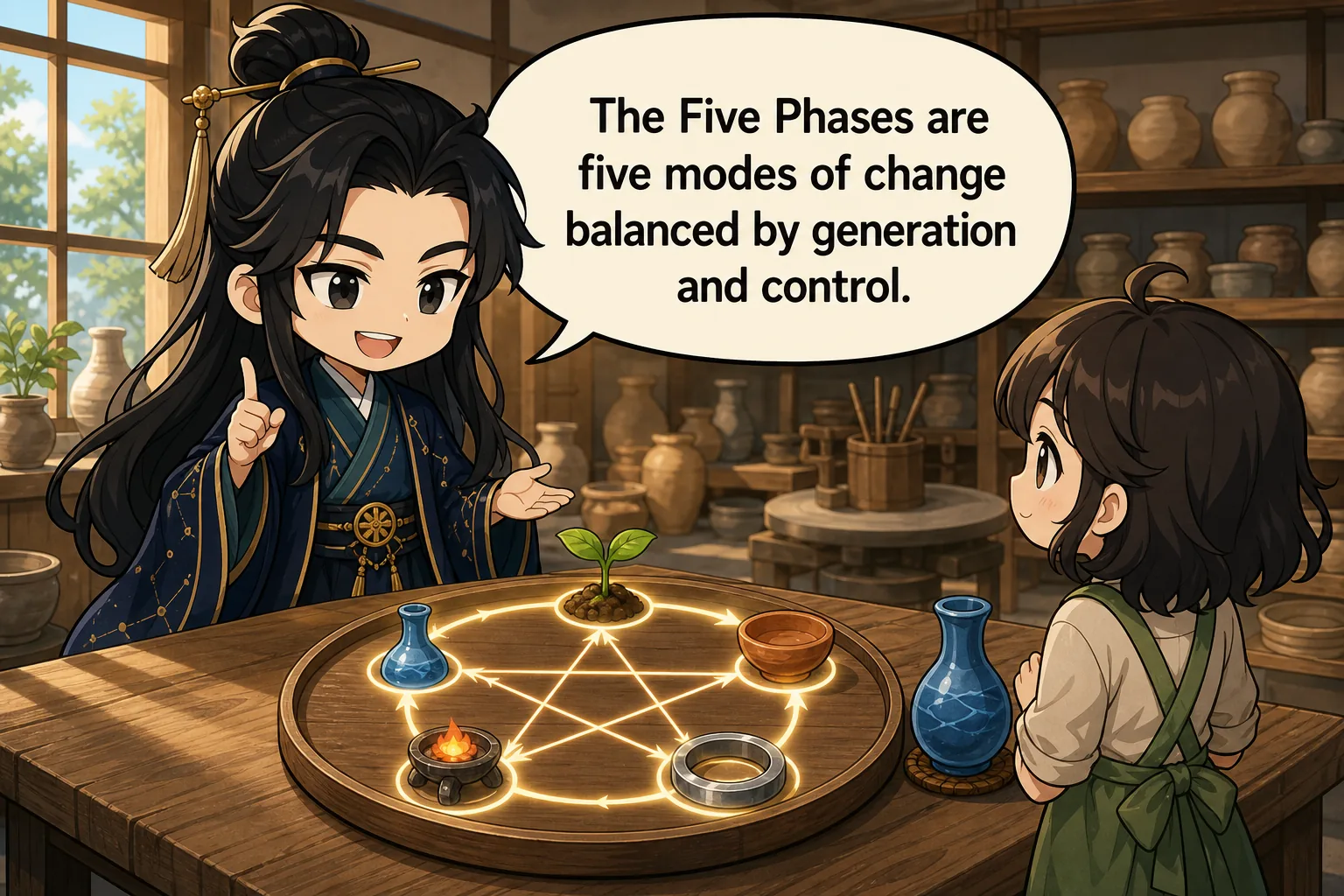
The Five Phases are not a scorecard of substances; they are a language of change in which generation and regulation turn together.
Sources and editorial note
The classical ordering and qualities were checked against the “Great Plan” section of the Book of Documents. Huh Jae-su’s 2024 vector analysis of Five-Phase generation and control was reviewed as an example of modern formal modeling, not as scientific proof of the tradition. The production sequence and control sequence were also checked against the constants used in packages/core.
This page explains a traditional classificatory system. It is not medical, nutritional, psychological, or financial treatment. The old automatic prescription—“fill the missing element to improve life flow”—was removed. Season, strength, the whole structure, and the chosen Yongsin method must come before any claim about what is useful.
Mystic Universe Editorial
Authorship & review
The Five Phases are a traditional classification of change, not medical, nutritional, psychological, or financial treatment. Visible counts alone cannot determine deficiency or Yongsin.
Frequently Asked Questions
Q.Are the Five Phases literally Wood, Fire, Earth, Metal, and Water?▾
Their names come from familiar materials, but the framework also describes five modes of change: extending, diffusing, transforming, contracting, and storing. They are not five fixed personality types.
Q.Is the controlling cycle bad?▾
No. Control limits excess and creates usable form. Its effect depends on strength, season, and other paths; proportionate regulation can focus a process, while overwhelming control can create pressure.
Q.Is an absent phase automatically my Yongsin?▾
No. Visible count is only an inventory. Season, Day-Master condition, roots, generation-control flow, and the chosen Yongsin method must be assessed first.
Q.Can colors or objects fill a missing phase?▾
They may serve as preferences or behavioral reminders, but they do not prove that a natal relation has been physically added. Real health, financial, and life decisions need relevant evidence and expertise.
Related Articles
Curious about your Day Master?
Enter your birth details and AI will show your Day Master and Five Elements analysis.
Check My Saju for FreeThis content is for entertainment purposes only and does not replace professional advice.