
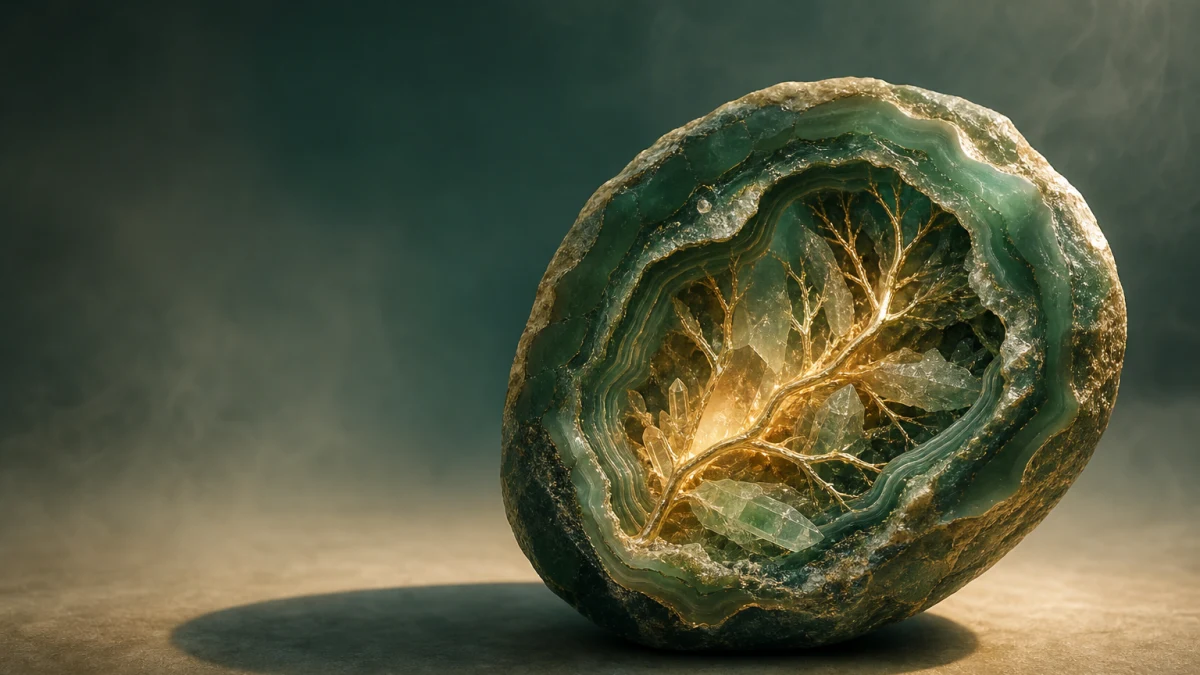
A Saju chart looks like eight characters, but an Earthly Branch is not a one-letter box. Each branch is understood to contain one or more Heavenly Stem energies beneath its visible surface. These are called Jijanggan, or Hidden Heavenly Stems. The idea helps explain why a reading may discuss a Wealth, Officer, or Resource theme even when that Ten God is not visible among the four stems.
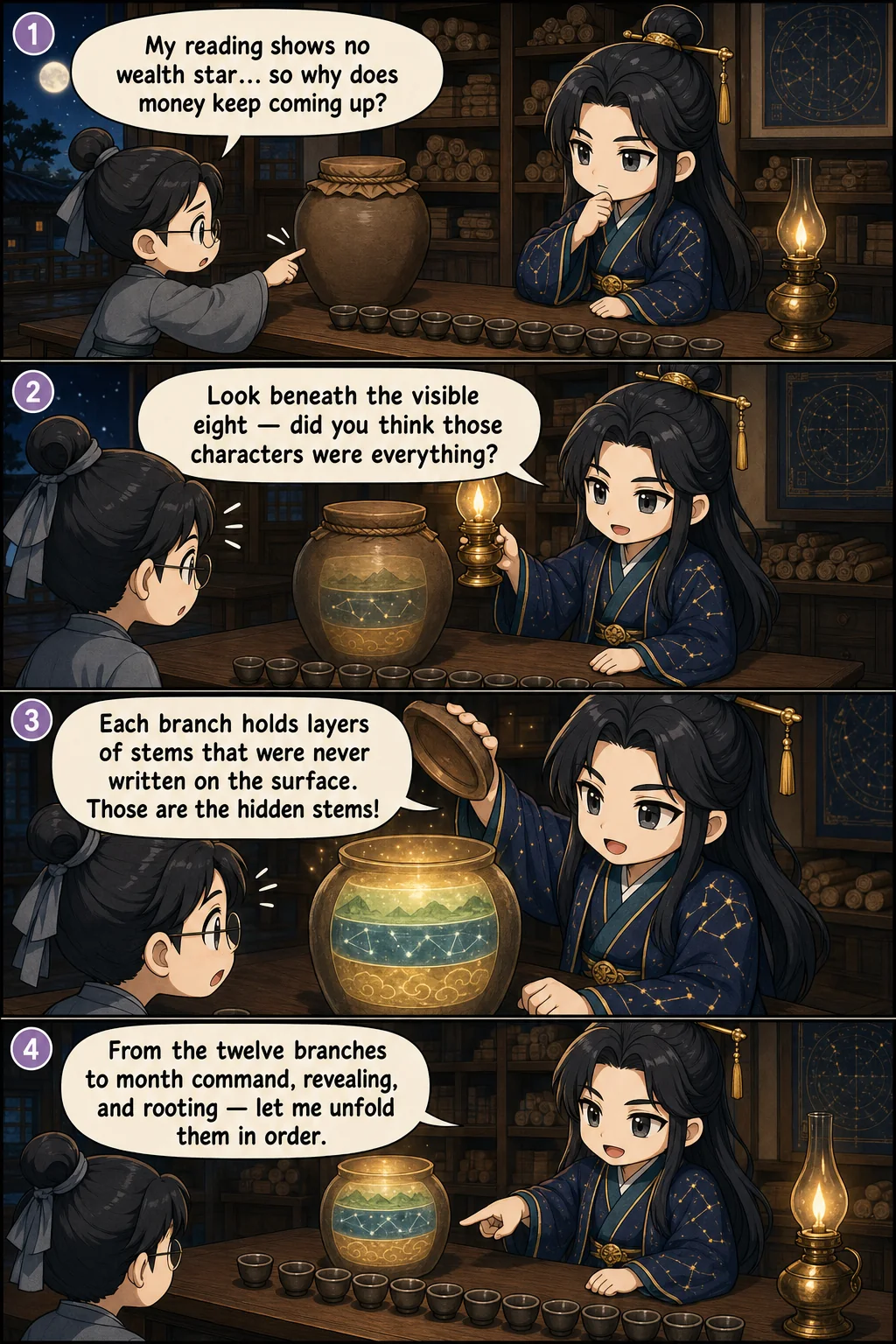
Hidden stems are not a code that reveals a secret talent, a hidden relationship, or a guaranteed event. They are a way to read seasonal layers, roots, and conditions inside the branches. This guide explains what they mean, gives a beginner-friendly twelve-branch table, and shows how to use the idea without letting one character decide the whole story.
Today's question
When does an energy hidden in a branch become visible in life?
A hidden stem does not automatically become a hidden event. It is a clue for asking which energy may work more easily when the visible chart, the seasonal month, exposure, combinations, clashes, and timing all meet.
Hidden stems in one sentence
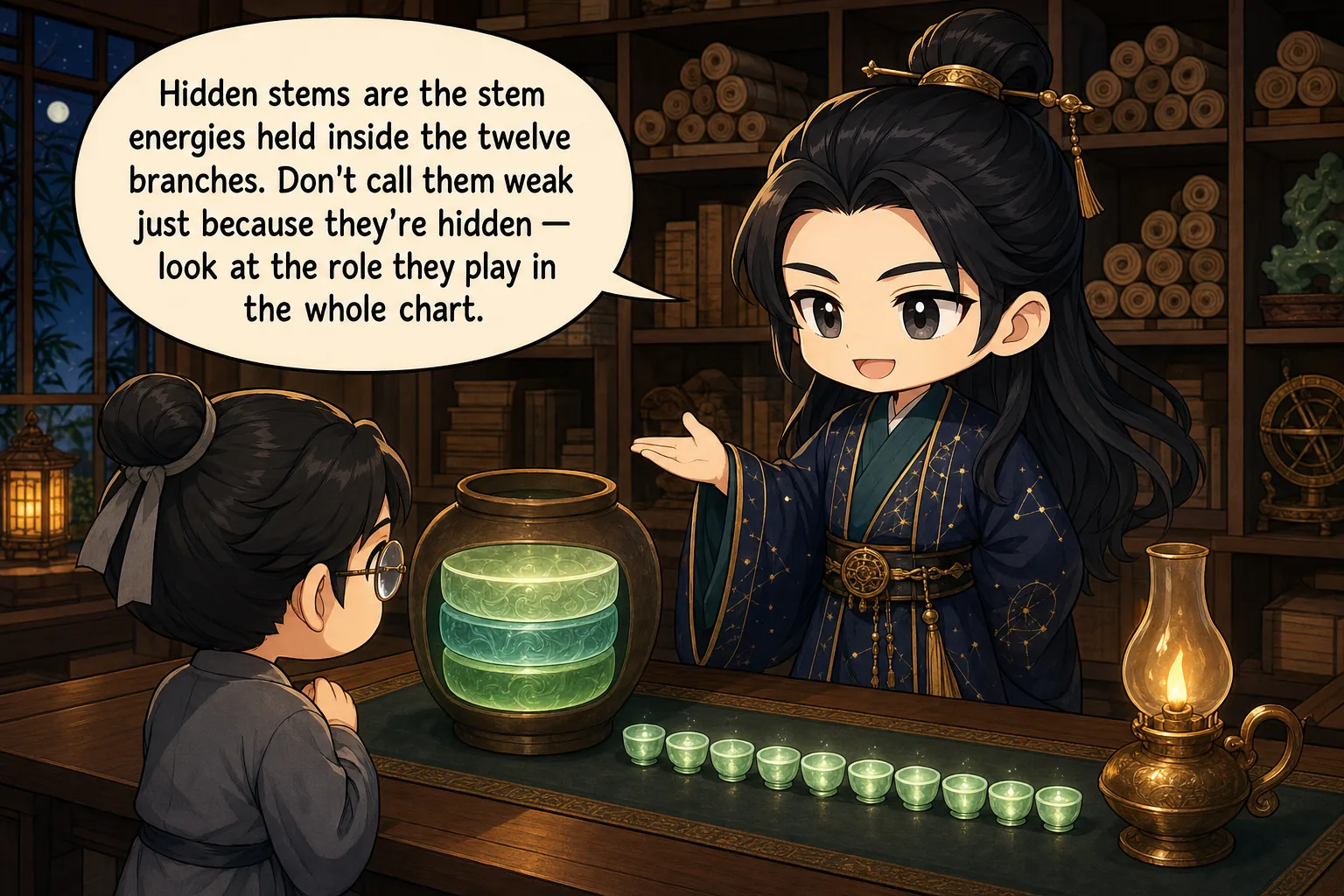
Hidden stems are Heavenly Stem energies contained within the twelve Earthly Branches. If stems are the language that is easier to see, branches and their hidden stems speak about season, roots, and internal conditions. Hidden does not automatically mean weak, and visible does not automatically mean strong.
A grounded way to read hidden stems
Keep the visible chart first, then add the branch layers and timing. This order makes it much harder to over-read one symbol.
Read the visible eight characters first
Hidden stems do not replace the visible Heavenly Stems and Earthly Branches. Start with the Day Master, seasonal month, Five Element balance, Ten Gods, combinations, clashes, and timing cycles.
Which energies are already visible on the surface of the chart?
Check the seasonal layers inside each branch
A branch is often explained through residual energy, transitional energy, and principal energy. This is a seasonal language: use the principal energy as an anchor while keeping the other layers in context.
What does this branch hold at its center, and what does it retain in the background?
Look for exposure and whole-chart conditions
A hidden stem becomes more relevant when it is exposed among the Heavenly Stems, connected to the month branch, supported by other branches, or activated by timing. Presence alone does not measure strength or predict an event.
Does this energy have conditions to become active in this chart and this period?
Earthly Branches Hold Seasonal Layers
The ten Heavenly Stems describe ten elemental Yin-Yang energies. The twelve Earthly Branches describe the seasonal, temporal, and directional rhythms from Ja to Hae. In the hidden-stem framework, a branch is not sealed into a single element. It may contain an energy left over from the previous season, an energy in transition, and a principal energy at its center. These are often called residual, middle, and principal qi.
Take In (Tiger) as an example. It contains Mu, Byeong, and Gap, with Gap Wood treated as the principal energy. The image is early spring: earth continuing from winter, Fire beginning to warm, and Wood becoming the main force. The value of the table is not merely memorization. It reminds us that one branch carries a thickness of seasonal time.
The Twelve Earthly Branches and Their Hidden Stems
| Branch | Residual / Middle / Principal | A useful starting lens |
|---|---|---|
| Ja (子) | Im / none / Gye | Water at the center; use it to ask about depth, concentration, and inner thought |
| Chuk (丑) | Gye / Shin / Gi | Earth containing winter Water and Metal; read storage and persistence in context |
| In (寅) | Mu / Byeong / Gap | Spring Wood holding Earth and Fire; Gap is the main axis of beginning and growth |
| Myo (卯) | Gap / none / Eul | Wood-centered spring; read softness and persistence together |
| Jin (辰) | Eul / Gye / Mu | Earth holding Wood and Water; check change and storage across the whole chart |
| Sa (巳) | Mu / Gyeong / Byeong | Fire holding Earth and Metal; separate outward heat from inward pragmatism |
| O (午) | Byeong / Gi / Jeong | Strong Fire with Earth; notice both passion and the need for regulation |
| Mi (未) | Jeong / Eul / Gi | Earth holding Fire and Wood; consider cultivation and ripening together |
| Sin (申) | Mu / Im / Gyeong | Metal holding Earth and Water; read execution and flexibility in context |
| Yu (酉) | Gyeong / none / Shin | Metal at the center; use it to consider standards, refinement, and closure |
| Sul (戌) | Shin / Jeong / Mu | Earth holding Metal and Fire; distinguish protection from inner heat |
| Hae (亥) | Mu / Gap / Im | Water holding Earth and Wood; consider rest as a place where growth is seeded |
Different lineages organize the order and weight of these layers differently. This guide follows the residual-middle-principal descriptions in Mystic Universe's twelve-branch knowledge data for learning purposes. Finding one entry in a table is not enough to decide a Ten God's strength, a personality trait, or an event. The seasonal month and the whole chart come first.
The Month Branch: Why Your Birth Month Weighs the Most
Not every branch carries the same weight. The month branch — the branch of the month you were born in — gets special treatment, and that priority is called the seasonal command. The month branch is the season itself, so it sets the temperature and humidity of the whole chart.
Two people can both have a Gap (甲) Wood Day Master and read very differently. Born in the Tiger month, that Wood stands on top of its own season. Born in the Monkey month, the same Wood has to hold its ground in a season where Metal is strong. The character is identical; the usable strength and the support it needs are not. That is why the month branch comes first when you think about a useful element.
Which of the month branch's hidden stems holds command at a given moment is handled differently across lineages. This guide recommends the conservative order: anchor on the principal energy and read it together with the whole chart. Systems that divide the month by solar-term day counts also exist, but that is contested ground, so it is safer not to read it as settled fact.
Exposure Connects an Inner Energy to the Visible Chart
When a Heavenly Stem held inside a branch also appears among the visible Heavenly Stems, it is called tugan, or exposure. Exposure from the month branch is especially important in many approaches to pattern and useful-element reading because the seasonal center becomes connected to an outward expression. It still does not mean automatic success, nor does the absence of exposure mean the energy never matters.
The same hidden stem behaves differently depending on whether it sits in the month branch or day branch, has roots elsewhere, meets a combination or clash, and receives support from the current major or yearly cycle. Instead of saying, “There is hidden Wealth, so money is guaranteed,” ask which roles, actions, or periods might give that energy a practical way to be used.
Rooting: When a Heavenly Stem Reaches Into a Branch
Exposure describes an inner energy surfacing. Rooting runs the other way. When a Heavenly Stem in your chart meets its own element among the hidden stems of a branch, that stem is said to have a root. This guide uses the broader criterion — same element counts — so Gap (甲) Wood roots not only in the Tiger branch (principal Gap) but also in the Rabbit branch (principal Eul). Even so, the same stem as principal energy is the strongest root, followed by the same element in the opposite polarity, then a trace in residual or middle energy. Some lineages count only an identical stem as a root, so decide which criterion you use and apply it consistently.
Checking it is straightforward.
- Write out the four Heavenly Stems of your chart.
- Using the twelve-branch table above, find the branches whose hidden stems carry the same element as each stem.
- Mark it as rooted and note the strength — identical stem as principal (strong), same element as principal (moderate), residual or middle only (weak). If none, it is rootless.
- Mark separately whether the root sits in the month branch — the seasonal center carries different weight.
Even so, the presence of a root does not settle strength on its own. Whether the root is a principal, residual, or middle energy, whether that branch is pulled by combinations or clashes, and whether major and yearly cycles support or shake it all change how it feels in practice. Treat rooting as the question of how much of that stem you can actually use, not as a verdict.
Three Common Mistakes
1. Treating an invisible Ten God as if it does not exist at all
A Ten God may not appear on the surface but can still be present in a branch. Presence and current strength are different questions. Hidden stems add a possible layer; they do not instantly make that layer dominant.
2. Reading only the principal energy
Principal energy is an important anchor, but residual and middle energies can matter near seasonal boundaries and in the storage branches. Do not add the three layers like points. Ask what is central and what remains in the background.
3. Using one hidden stem to predict romance, money, or health
Terms such as hidden combination and opening storage can sound dramatic, but one symbol cannot establish a relationship, financial outcome, or health event. Put real-world information and qualified professional advice first for important decisions.
Bring the Symbol Back to Daily Observation
Hidden stems are not meant to split people into an outward self and a secret self. They can be a gentler way to notice differences: perhaps you appear quiet, yet show intense initiative in a particular kind of work; perhaps you decide quickly, yet need a long stretch of solitude to think things through. Seasonal layers offer a symbolic language for observing those conditions.
If a branch in your own chart interests you, start with its principal energy, then check its other layers. Next, look for the same stem on the surface and for the same element in your current timing. Rather than declaring a meaning at once, ask: “Under these conditions, what do I protect, value, or have energy to do?” That question is usually more useful than a fixed label.
Editorial note and scope
This guide was prepared by cross-checking foundational ideas about Earthly Branches, Hidden Heavenly Stems, seasonal month, and exposure with Mystic Universe's twelve-branch hidden-stem knowledge data. Lineages can differ in their tables and strength rules. We do not impersonate a real practitioner or credential, and this content is for reference and entertainment, not a substitute for medical, legal, financial, or other professional advice.
Related Guides
- Heavenly Stems & Earthly Branches — learn the base language of the ten stems and twelve branches
- Five Elements Guide — review Wood, Fire, Earth, Metal, and Water
- Pattern Guide — go deeper into why month branch and exposure matter
Mystic Universe Editorial
Authorship & review
Mystic Universe editorial team. This guide cross-checks foundational Earthly Branch, Hidden Stem, seasonal-month, and exposure concepts with our twelve-branch jijanggan knowledge data, without impersonating any real practitioner or credential.
Frequently Asked Questions
Q.Why do Hidden Heavenly Stems matter?▾
They show which Heavenly Stem energies are contained within an Earthly Branch. They provide context for possible Ten God themes not visible on the surface, the seasonal center of the month branch, exposure, and pattern reading. They do not decide strength or events by themselves.
Q.What are residual, middle, and principal energies?▾
They describe an energy left from the previous season, an energy in transition, and the branch's central energy. Lineages can organize their order and weight differently, so use principal energy as an anchor while reading the seasonal month and whole chart together.
Q.Does a Hidden Stem do nothing without exposure?▾
No. Exposure is an important connection between an inner energy and the visible chart, but hidden-stem activity also depends on the month branch, roots, combinations, clashes, and major or yearly timing. A simple present-or-absent rule is too narrow.
Related Articles
Curious about your Day Master?
Enter your birth details and AI will show your Day Master and Five Elements analysis.
Check My Saju for FreeThis content is for entertainment purposes only and does not replace professional advice.