
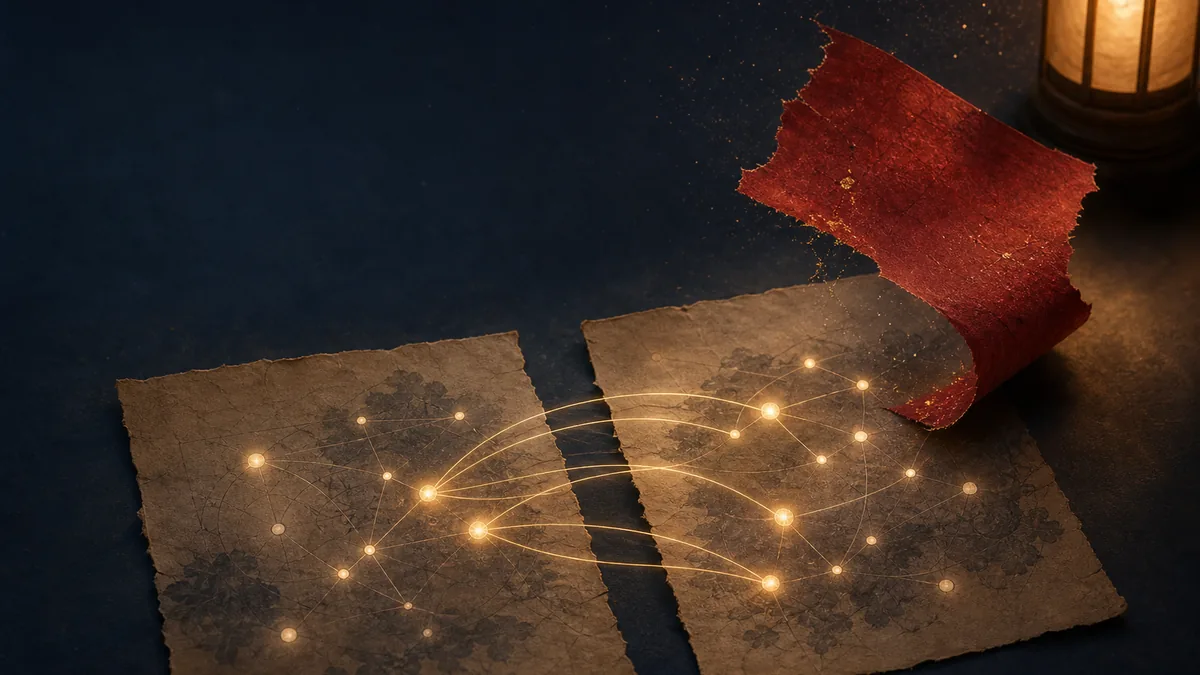
Someone once looked at your charts and said, "this pairing is… difficult." The strange part is that the relationship kept working anyway. Nobody broke up, there was no great fight, and yet that single remark is the part that stayed.
So this guide changes the order of the questions. Instead of asking "what counts as good compatibility," it starts here: who issued the verdict that a pairing is bad, and what were they reading? That question gets answered at the end. First, how compatibility is actually read.
Today's question
Is compatibility a judgment about two people's future?
Saju compatibility is closer to a map than a verdict. It marks where two people meet easily and where they are likely to diverge. Once you know the reading order, there is much less to fear in it.
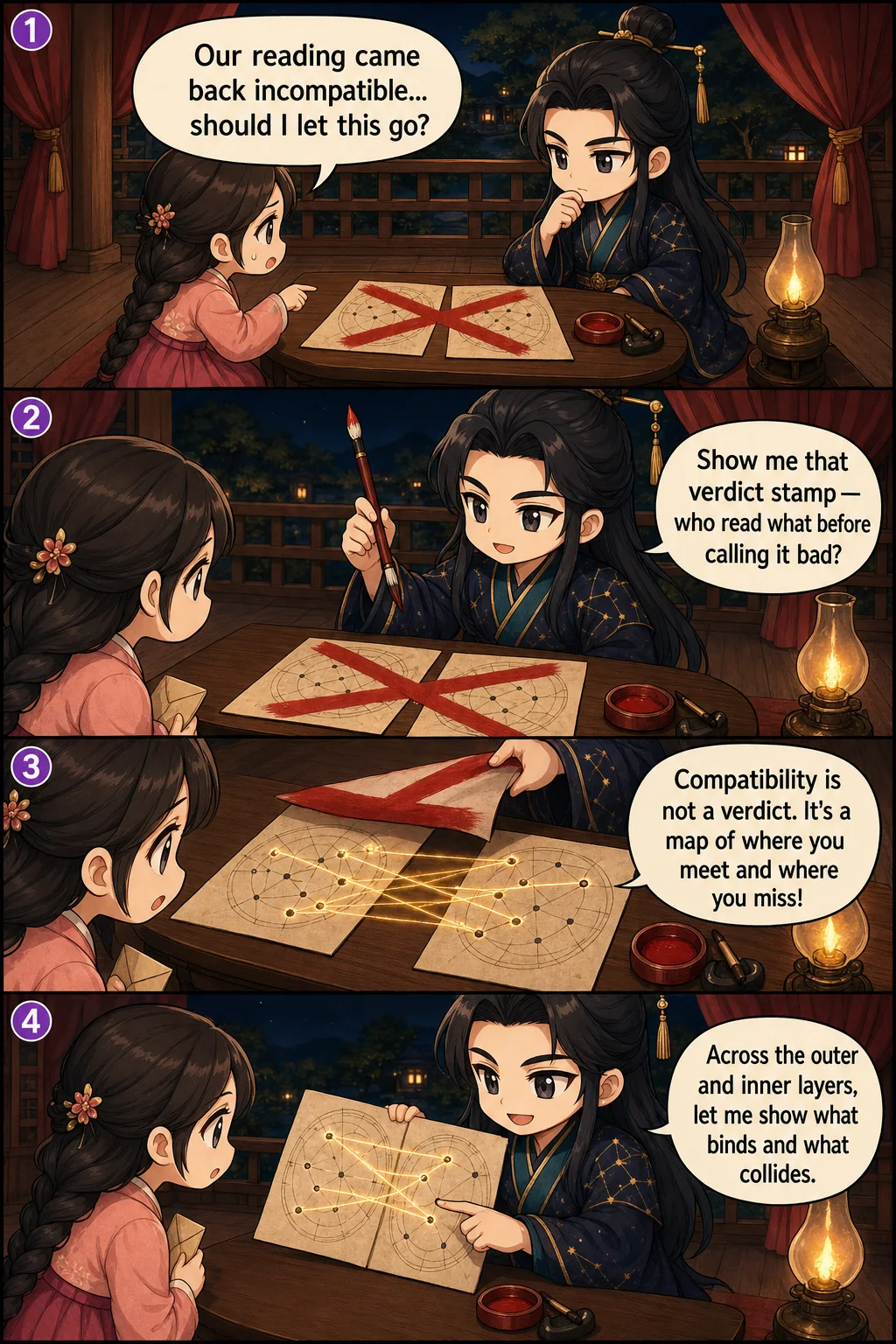
Read Compatibility in This Order
The short version: compatibility is read in four passes. What matters is that each pass pairs what you look at with what you must not conclude from it. Pull a single pass out and treat it as the answer, and the reading almost always misses.
| Pass | What you look at | What not to conclude here |
|---|---|---|
| 1 | Year Branches — outer compatibility | That one zodiac animal settles the whole match |
| 2 | Day Masters — Stem combination | That no combination means no real bond |
| 3 | Day Branches — bond or clash in daily life | That a clash guarantees conflict |
| 4 | Five Element balance — what each supplies | That being alike is what makes a match work |
Outer and Inner Compatibility Come From a Different Tradition
Outer and inner compatibility are the terms that come up most often. But those two, and the Day Master reading most consultations use today, come from different traditions. Stitching them into one system produces explanations that contradict each other, so this guide names where each layer comes from and sets them side by side.
Wedding folk tradition
Outer compatibility
Compares the Earthly Branch of the birth year — the zodiac animal — between two people.
This layer reads one character out of eight. Useful for a quick scan, never a conclusion.
Wedding folk tradition
Inner compatibility
Compares how the Five Element energies of two people interlock.
Inner means deeper than the surface layer. In Korean the term is often misread as sexual; it is not.
Ziping practice
Day Master reading
Centers on the Heavenly Stem of the birth day (the self) and its Branch (the spouse seat).
This is the layer most consultations lean on today. It comes from a different tradition than the two above.
In short, outer and inner compatibility descend from wedding folk practice, while the Day Master and Day Branch reading belongs to Ziping practice. They are not competing for accuracy; they look at different layers. This guide uses both without blending them.
The Day Master — Where the Two Selves Meet
In Saju, the Day Master is the Heavenly Stem of the birth day, and among the eight characters it stands for the self. That is why the relation between two Day Masters is the starting point in practice, ahead of the zodiac animal.
Five pairs of Day Masters form a Heavenly Stem combination. Combination does not translate to "good." It names a quality: two energies bind and begin to move as one.
Gap-Gi (甲己)
Each slows the other down into steadiness
Eul-Gyeong (乙庚)
Softness and hardness file each other smooth
Byeong-Sin (丙辛)
The force that reveals meets the force that refines
Jeong-Im (丁壬)
Warmth and current spread into one another
Mu-Gye (戊癸)
The force that holds meets the force that seeps in
The obvious follow-up: if there is no combination, is there no bond? No. There are only five pairs, so most couples have none. Having no combination simply means one automatic source of pull is absent — not that the relationship is weak.
What Binds and What Collides — Read by Seat
Two words are worth defining before anything else. Combination is binding. Clash is divergence. Neither is good or bad; both name a quality of relation. Combination pulls two things together, clash pushes them apart. That is all.
What matters is which seat the combination or clash lands in. The same clash shows up as a different scene in life depending on whether it sits in the Year Branch or the Day Branch.
Year Branch
Background, family, first impression — the outward layer
A bond here feels easy from the start; a clash can make early meetings awkward. This layer says little about how a relationship ends.
Day Branch
The spouse seat — the layer of daily life together
A bond here makes sharing space comfortable. A clash means that, love aside, daily habits are likely to grind.
Day Master to Day Master
Where the two selves meet directly
A Stem combination creates natural pull. The absence of one does not mean the absence of a bond.
How combinations and clashes form, and how Six Harmonies differ from Three Harmonies, is beyond this guide. That theory is covered in the guide to Stem and Branch interactions, and the finer conflict relations are handled combination by combination in the Hyeong, Pa, Hae deep dive. Wonjin, which comes up constantly in relationship readings, has its own guide.
Five Element Balance — Does Each Supply What the Other Needs?
The last pass places both charts side by side. People often say that if your partner holds an element you lack, the match is good. That is only half true.
A missing element is not automatically a needed element. Some charts are already balanced without it, and introducing that energy tips the scale instead. So the practical question is not "is it empty" but "does this energy help this chart." The concept that anchors that judgment is the Useful God.
A missing element is not automatically a needed one
This is the single most common shortcut in compatibility readings. A chart can already sit in balance without a given element, and adding that energy can tip it rather than help. Before treating "my partner has what I lack" as good news, check whether that element is actually favourable for the chart in question.
The question to ask, then, is not whether the two of you are different. It is whether what your partner carries helps your chart. Similarity comes second.
What I Found While Writing This
Preparing this guide meant putting the available sources side by side. The one I kept returning to was the Encyclopedia of Korean Culture entry on compatibility. It defines the practice plainly in the language of judgment — divination of "whether two people are suitable as spouses." And yet, inside that same entry, sits the line that compatibility "also serves as a pretext for politely declining a proposal."
Judgment and refusal sitting in one entry became the starting point for this guide, because it explains why the phrasing still lands so heavily today. The first draft opened with that history. A pre-publication review pointed out that leading with history conflicts with what someone searching for how to read compatibility actually came for, so the practical reading order moved to the front. The structure you are reading reflects that correction.
Three Common Misreadings
A Clash means bad compatibility
A Clash describes a quality of relation — divergence — not a coming event. Couples who stay together for decades often carry Clashes, and that tension is sometimes what keeps them moving.
More Combinations mean better compatibility
Many bonded points can feel comfortable, but they can also lock two people into each other. Counting Combinations is not how compatibility is read.
Compatibility decides the future of a relationship
Two couples with the same configuration live completely different lives. What compatibility shows is not the ending, but where to pay attention.
So Where Did "Bad Compatibility" Come From?
Something still does not add up. Compatibility is the work of seeing where two charts bind and where they diverge — so why does the language around it sound like a ruling? That came not from the practice itself but from the setting it was used in.
In traditional Korean weddings, compatibility was part of the napchaestage. The groom's side sent a card with his birth date and hour; the bride's side had a court astronomer or a diviner read fortune from it, and compatibility was checked at the same time. If the reading was favorable, the bride's side returned a date-selection card, and the marriage was settled. Compatibility was, before anything else, the language of a decision procedure.
Compatibility also served as grounds for refusal
The Encyclopedia of Korean Culture notes in its entry on compatibility that it "also serves as a pretext for politely declining a proposal." On origins, it records one account in which Empress Lü of Han produced the Nine Palace method as a way to turn down a marriage offer from the Xiongnu. It is one origin account among several, but it is clear that compatibility was used where a language of refusal was needed.
In an era when the two people could not meet beforehand, a family declining a proposal needed a way to step back without insulting anyone. "The compatibility does not match" filled that role. That is why the phrasing still lands so heavily today. It was built to carry a decision, not an explanation.
4
Passes in a reading
5
Stem combination pairs
2
Separate traditions in play
In one sentence
Compatibility is not a document that rules on how two people end. It is a map marking where you meet easily and where you are likely to diverge. Knowing where you diverge is what lets you protect it.
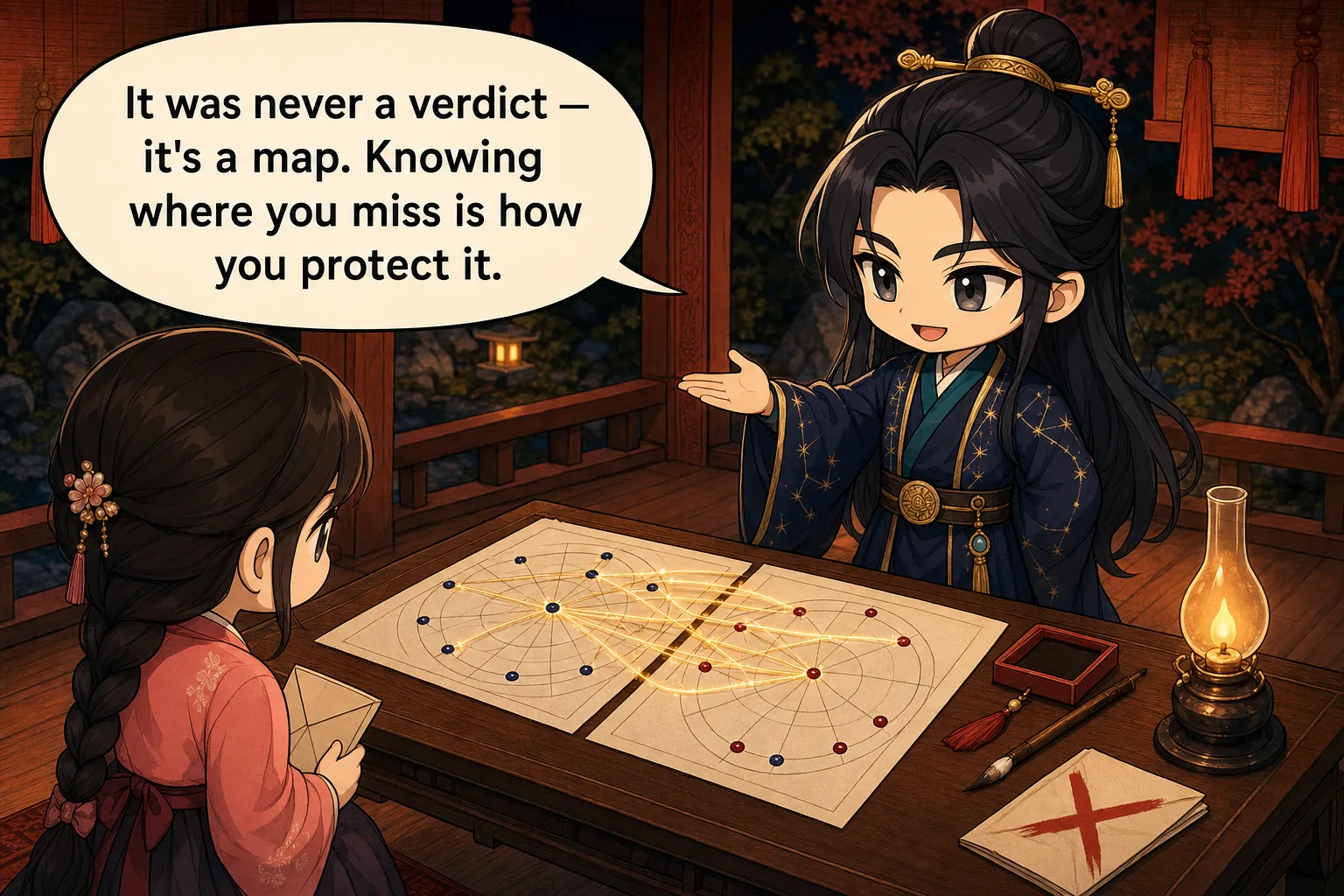
Check It With Your Own Chart
What you need now is the actual eight characters of both people. The Mystic Universe compatibility reading compares the two Day Pillars (Day Master and Day Branch) and returns a chemistry score and grade along with a detailed reading of the pairing.
Read that score as a starting point, not the verdict this article has been arguing against. Do not stop at the number — go into the detail and check whether the Day Masters bind or the Day Branches diverge, and you will see where the score came from. The Year Branch is not part of this analysis, so if outer compatibility interests you, compare the two zodiac animals separately.
Analyze the two charts together
Two questions are worth asking of the result. First, which real scene in your life matches the seat marked as divergent? Second, how are the two of you getting through that scene right now? Once those have answers, compatibility stops being a ruling and becomes material for a conversation.
Sources and Editorial Note
The historical section was written against the Encyclopedia of Korean Cultureentry on compatibility (written by Kim Ju-su, 1995, last revised 2023). The split between outer compatibility as the twelve Branches and inner compatibility as the Five Elements, the napchae sequence in which the bride's side has a court astronomer or diviner read the groom's birth card before returning a date-selection card, and the line that compatibility "also serves as a pretext for politely declining a proposal" all appear in that entry. The account of Empress Lü producing the Nine Palace method is one origin story among severalin the same entry, so this guide does not present it as settled fact. The weight compatibility carried in arranged marriage draws on the encyclopedia's entry on marriage.
The theoretical roots of Stem and Branch combinations sit in the Yuanhai Ziping lineage, which organized the Day Master-centered system. Authorship and compilation of that text are disputed, so this guide avoids naming a single founder. The five Stem pairs and the seat-by-seat readings here reflect what is in common use in consultation today; emphasis varies between schools.
This article introduces an interpretive tradition rooted in classical philosophy. It does not predict or guarantee the outcome of any relationship.
Frequently Asked Questions
Q.If our compatibility is bad, should we not marry?▾
Compatibility does not decide how a relationship ends. It shows where two people are likely to grind, and couples with the same configuration live very different lives. What you should take from it is not a ruling but where to pay attention.
Q.Which matters more, outer or inner compatibility?▾
Neither outranks the other; they read different layers. Outer (zodiac animal) and inner (Five Elements) compatibility descend from wedding folk practice, while the Day Master and Day Branch reading belongs to Ziping practice. Because they come from different traditions, they should not be merged into one comparison.
Q.Is checking zodiac-animal compatibility enough?▾
The zodiac animal is one character out of eight — the Year Branch. It works for a quick scan but never settles the match. You also need the relation between the two Day Masters and the bond or clash in the Day Branches, which is the spouse seat.
Q.Does a Clash always mean conflict?▾
A Clash names a quality of relation — divergence — not a coming event. Couples who stay together for decades often carry Clashes. What matters is which seat it sits in; a Day Branch clash usually shows up as daily habits pulling in different directions.
Related Articles
Curious about your Day Master?
Enter your birth details and AI will show your Day Master and Five Elements analysis.
Check My Saju for FreeThis content is for entertainment purposes only and does not replace professional advice.