

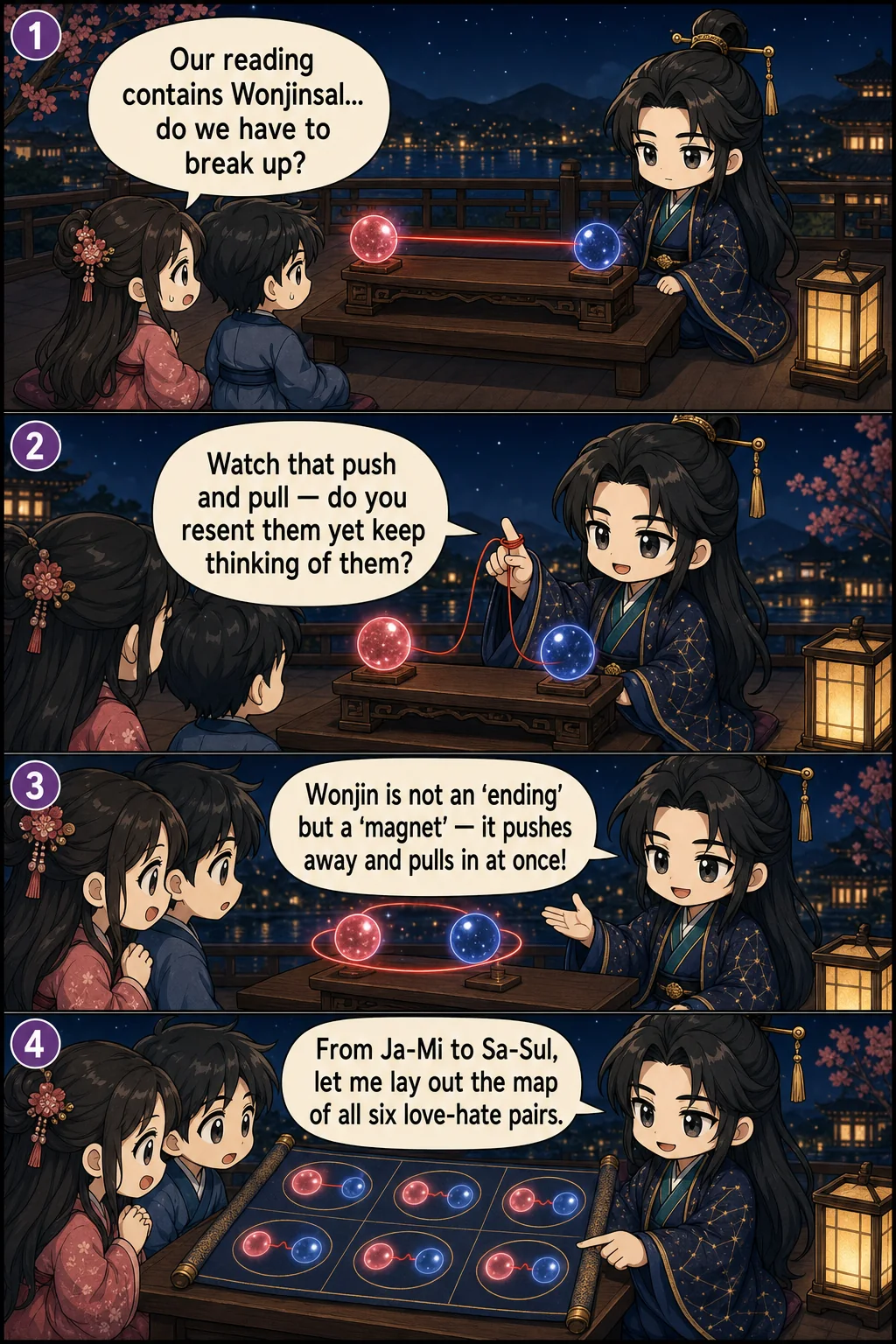
“Our chart has Wonjinsal” — did that one line make you wonder if you should just end the relationship? Wonjinsal is not a death sentence. It is a love-hate magnetism: you resent them, yet you cannot pull away. Why do some Wonjin couples split while others stay together for life? That fork is what this guide is about.
Wonjinsal (怨嗔殺) is one of the first stars a reader checks in compatibility. 怨 means “to resent,” 嗔 means “to bristle with anger” — taken literally, it says that when the two meet, they come to dislike each other. Yet in real practice it reads as a love-hate star: “resented up close, missed once apart.” Because dislike and attraction come as one, Wonjin is not a simple ominous star but closer to an unusually dense, high-intensity bond.
So this guide plants one question up front. If two people both carry Wonjinsal, why does one couple split while another can never part? We will pay that question back at the very end. Before that, we will walk through what Wonjin is, how to find your six pairs, how it differs from the often-confused Gwimun-sal, and how a Wonjin bond is meant to be handled.
Six pairs
branch Wonjin pairs
Love-hate
push and pull at once
vs Gwimun
two easily-confused stars
What Wonjinsal Means — 怨嗔, the Sense of Love and Hate
Let us start with the core: Wonjin is not “a bond to sever” but “a bond that pushes away while pulling in.” When two branches meet in a Wonjin relationship, they clash over small things and resentment rises easily — yet, strangely, the moment they part they miss each other. That is why Wonjin is often called the “love-hate (愛憎) star.” It describes a bond where affection and dislike are stuck together like two sides of a coin.
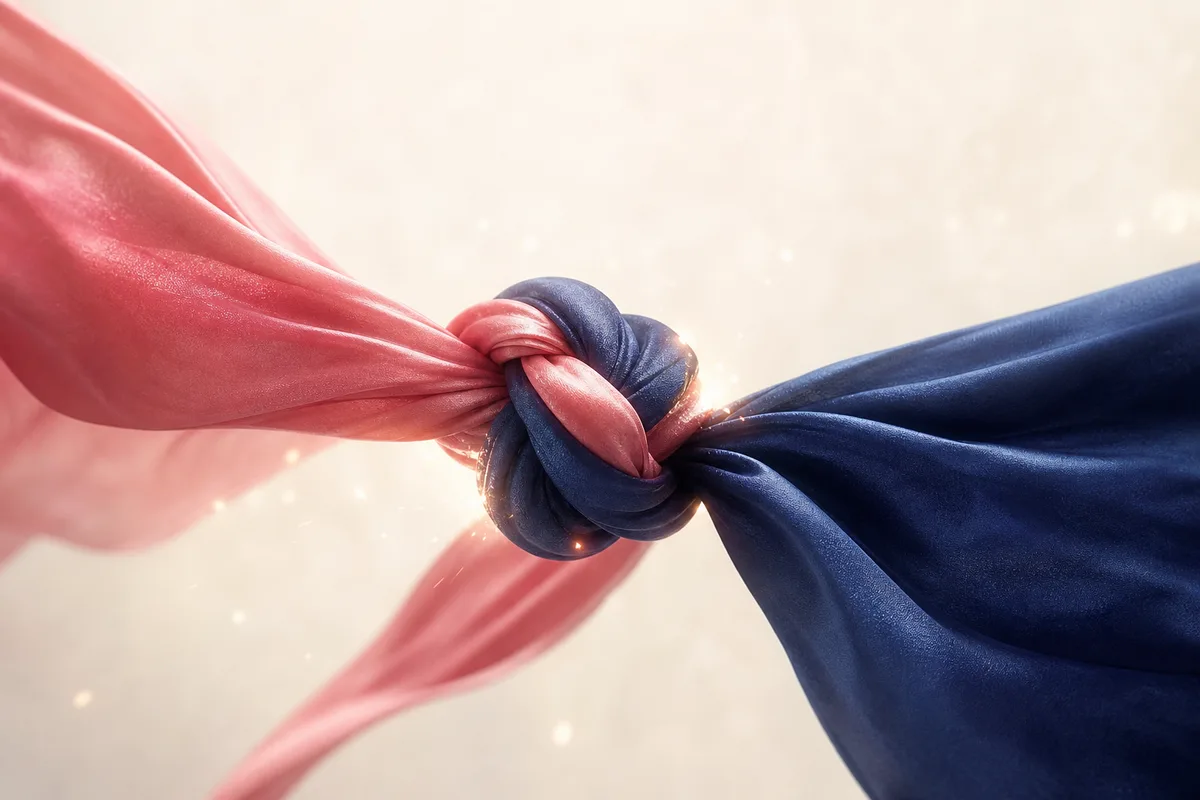
Traditional Saju treats the eight characters of a chart as given conditions and reads the special stars as secondary markers that color them. Wonjinsal, too, does not decide a breakup on its own; it merely marks a bond — between two people or within your own chart — where friction and attraction are both strong. If you want the full map of how Wonjin sits among the other stars first, reading the complete Shinsal guide alongside this one makes Wonjin’s place much clearer.
One-line summary
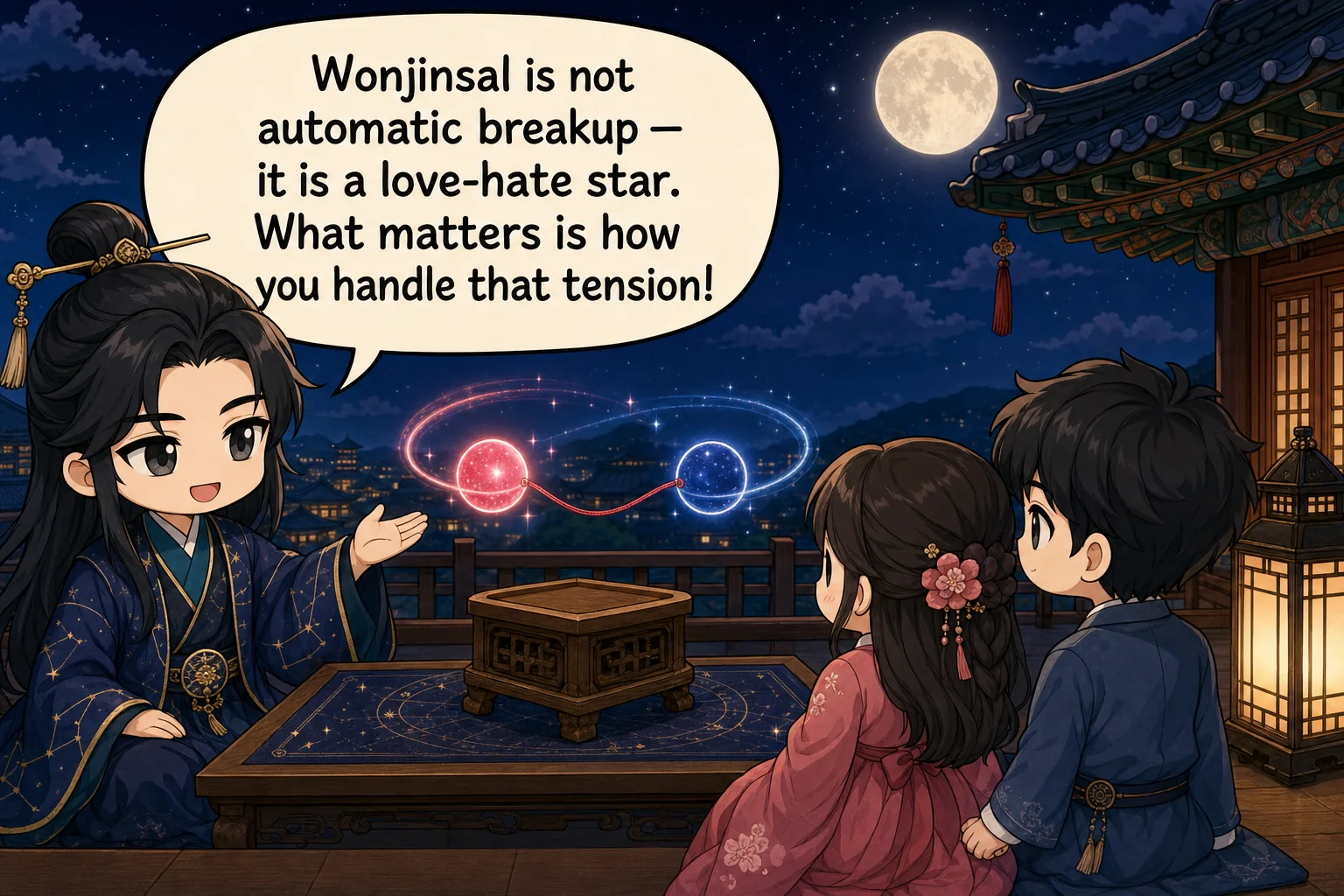
Wonjinsal is not “automatic breakup” but a “love-hate star.” Because dislike and attraction are one, it is a bond that repels yet never breaks — what matters is not whether the star is present but how you handle that tension.
The Six Wonjin Pairs — Start From the Branch Pairs
Wonjin forms only among six fixed pairs. It arises when a branch meets one particular counterpart, and when two branches face each other in one of the six combinations below, they are in a Wonjin relationship. In compatibility you compare the two people’s branches; in your own chart you compare the branches among your eight characters. Start by finding which pair your zodiac (year branch) or day branch falls into.
| Wonjin pair | Zodiac pair | One-line character |
|---|---|---|
| Ja-Mi (子未) | Rat · Goat | Subtle friction from clashing values |
| Chuk-O (丑午) | Ox · Horse | A gap in pace — easygoing meets impatient |
| In-Yu (寅酉) | Tiger · Rooster | Pride and principle bumping heads |
| Myo-Sin (卯申) | Rabbit · Monkey | Sensitivity and caprice pulling back and forth |
| Jin-Hae (辰亥) | Dragon · Pig | Love-hate of repeated hope and letdown |
| Sa-Sul (巳戌) | Snake · Dog | A temperature gap of approach and retreat |
The “one-line character” column is a rough sketch to show that each pair clashes in a slightly different way. A real reading also weighs both people’s Day Masters and elements, plus other combinations and clashes. If the way branches harmonize and collide is unfamiliar, skim the Combination, Clash, Punishment, Break, and Harm guide first and you will sense where a Wonjin relationship sits.
Wonjinsal vs Gwimun-sal — Two That Get Confused
Talk about Wonjinsal and Gwimun-sal (鬼門殺) almost always comes along. The two are often explained together, but their texture differs. If Wonjin is “love-hate and discord” — the tension of a bond that pulls even as it resents — Gwimun is closer to “sensitivity, intuition, and obsession,” an unusually acute, deeply probing temperament. Because the same pair can register as both Wonjin and Gwimun, they get confused all the more.
| Aspect | Wonjinsal (怨嗔) | Gwimun-sal (鬼門) |
|---|---|---|
| Core texture | Love-hate · discord | Sensitive · intuitive · obsessive |
| In a relationship | Tension that pushes and pulls | Deep immersion, probing |
| Temperament | Ambivalence of hate and pull | Acute intuition and sensitivity |
| What to watch | Adjust the distance of friction | Guard against over-immersion, burnout |
In short, Wonjin points to “the temperature of a relationship,” while Gwimun points to “the sensitivity of a temperament.” When the two appear together, the amplitude of emotion can grow larger, so it helps to handle Wonjin’s friction and Gwimun’s immersion as separate things.
Three Things Everyone Gets Wrong
What makes Wonjinsal frightening is not the concept but the misconceptions hardened around it. Correct these three, and seeing Wonjin on a compatibility chart will no longer make you flinch.
1. If compatibility has Wonjinsal, you will definitely break up?
The most common myth. Wonjin does not predict a breakup; it means “a strong bond that clashes often.” Plenty of Wonjin couples last for years. Because the dislike is large, so is the attraction — learn to handle the friction and it becomes a dense, close bond instead. Attitude, not the star’s presence, decides the outcome.
2. Wonjin is a mark of bad compatibility?
Branding Wonjin as “the worst match” overshoots too. Wonjin carries a strong pull inside it, creating a bond in which the two cannot be indifferent to each other. It can become a livelier, more tender relationship than a lukewarm match. The issue is not “badness” but “tension.”
3. Wonjin only applies to lovers and spouses?
Wonjin works not only in romance but in family, colleague, and business relationships — and even among the branches within your own chart. In that case it reads as ambivalence within yourself, an inner conflict that pushes and pulls on its own. See Wonjin as romance-only and you have understood just half.
What remains once the myths are corrected
Wonjin is not automatic breakup but a strong bond; not a mark of bad compatibility but tension; and it works not only in romance but in family, colleagues, and your own chart. Remember just these three and most of Wonjin interpretation falls into place.
Handling a Wonjin Bond — Attitudes That Reduce Friction
If you have Wonjin, the key is not to erase the tension but to “handle” it. Know in advance where friction tends to flare, and adjust distance, roles, and expectations, and the same Wonjin flows into a tender bond rather than a war of attrition. The cheat sheet below is organized so you can find the single row for your Wonjin pair. Save it and read only your zodiac-pair row when you need it.
| Wonjin pair | Main friction point | Easing keyword |
|---|---|---|
| Ja-Mi (子未) | Differing values and priorities | Acknowledge each other’s standards |
| Chuk-O (丑午) | Difference in speed and rhythm | Respect the pace, no rushing |
| In-Yu (寅酉) | Clash of pride and principle | Leave space instead of correcting |
| Myo-Sin (卯申) | Sensitivity and caprice | Honesty over emotional tug-of-war |
| Jin-Hae (辰亥) | Repeated hope and letdown | Lower expectations, say them aloud |
| Sa-Sul (巳戌) | Gap of approach and retreat | Respect each other’s distance |
The point is not to “remove” friction but to “anticipate and reduce” it. If you want to see how Wonjin plays out concretely in compatibility, read on in the Saju compatibility guide for the relational dynamics two people’s branches create. And if you are curious about the other trial-and-growth stars, the stars of challenge guide is worth reading alongside.
Wonjin Within Your Own Chart — the Seat Changes the Story
Wonjin is not only between two people. The branches within your own eight characters can meet as Wonjin too, and then it reads not as a relationship but as “ambivalence within you.” Depending on which pillars the Wonjin falls between, its texture changes.
| Seat of Wonjin | Area it symbolizes | Texture of the effect |
|---|---|---|
| Day ↔ Month branch | Self · social activity | Frequent love-hate with close people |
| Day ↔ Hour branch | Self · later years / children | Inner conflict lasting into later life |
| Year ↔ Month branch | Early years · background | Memories of friction and not fitting in |
Still, this table is a tool for orientation, not determinism. One Wonjin does not fix your life or your relationship; the flow of the whole chart, its relationships with other characters, and your own choices all act together. To dig deeper into the branch relationships adjacent to Wonjin, the Combination, Clash, Punishment, Break, Harm guide is a good starting point.
Conclusion — Wonjin Is Not an Ending but a Density
Now back to the opening question. If two people both carry Wonjinsal, why does one couple split while another can never part? The answer is clear. Wonjin only raises the intensity of a bond — both the attraction and the friction. What splits success from failure is not whether the star is present but how you handle that friction. Couples who anticipate friction and adjust distance move toward a dense bond; couples swept along by it move toward attrition.
So the order of studying Wonjin is always the same. First find your Wonjin among the six pairs, then distinguish the textures of Wonjin and Gwimun, then read which relationship and which pillar the Wonjin sits on, and finally translate it into practical attitudes for handling friction. Keep this order and Wonjin stops being a relationship death sentence and becomes a compass for handling a strong bond. If you want to know whether your compatibility or chart carries Wonjinsal — and how Gwimun and the Three Harmonies are placed — check your branch relationships at once in a free analysis, and apply today’s order to your own chart.
References · author note
This guide organizes traditional Wonjinsal (怨嗔殺) around the six branch pairs (Ja-Mi, Chuk-O, In-Yu, Myo-Sin, Jin-Hae, Sa-Sul), the love-hate reading, and the distinction from Gwimun-sal (鬼門殺), drawing on secondary compilations of shinsal theory in the Yeonhae Japyeong (淵海子平) and Sammyeong Tonghoe (三命通會) lineage, the shinsal entry of the Encyclopedia of Korean Culture (Academy of Korean Studies), and our own shinsal knowledge dataset (Wonjin mapped to love-hate conflict). Wonjinsal is a star that settled into later interpretive and compatibility practice, and definitions vary by school; this is a pen-name editorial review that impersonates no real fortune-teller or credential. This content is for reference and entertainment and does not replace medical, legal, or major life decisions such as divorce.
Related Guides
- Complete Shinsal guide — the full map of the special stars Wonjin belongs to, 40 at a glance
- Stars of challenge guide — the trial-and-growth stars, 20 including Wonjin
- Saju compatibility guide — the attraction and friction Wonjin creates between two people
- Combination, Clash, Punishment, Break, Harm guide — how branch relationships shake Wonjin’s effect
Mystic Universe Editorial
Authorship & review
This guide organizes traditional Wonjinsal (怨嗔殺) around the six branch pairs (Ja-Mi, Chuk-O, In-Yu, Myo-Sin, Jin-Hae, Sa-Sul), the love-hate reading, and the distinction from Gwimun-sal, drawing on secondary compilations of shinsal theory in the Yeonhae Japyeong and Sammyeong Tonghoe lineage, the Encyclopedia of Korean Culture, and our own shinsal dataset (Wonjin mapped to love-hate conflict). Wonjinsal settled into later interpretive practice and definitions vary by school; this is a pen-name editorial review that impersonates no real fortune-teller or credential.
Frequently Asked Questions
Q.If compatibility has Wonjinsal, will you definitely break up?▾
No. Wonjinsal does not predict a breakup; it means 'a strong bond that clashes often.' Plenty of Wonjin couples last for years. Because the dislike is large, so is the attraction — know where friction tends to flare and adjust distance, roles, and expectations, and it becomes a dense, close bond instead. Attitude, not the star's presence, decides the outcome.
Q.How does Wonjinsal differ from Gwimun-sal?▾
Their texture differs. Wonjinsal (怨嗔殺) points to 'love-hate and discord,' the tension of a bond that pulls even as it resents; Gwimun-sal (鬼門殺) points to 'sensitivity, intuition, and obsession,' an acute, deeply probing temperament. The same pair can register as both, which causes confusion, but Wonjin is 'the temperature of a relationship' and Gwimun is 'the sensitivity of a temperament.'
Q.Does Wonjinsal only apply to lovers and spouses?▾
No. Wonjin works not only in romance but in family, colleague, and business relationships — and even among the branches within your own chart. Wonjin within your own chart reads as ambivalence inside you, an inner conflict that pushes and pulls on its own. See Wonjin as romance-only and you have understood just half.
Q.What does it mean if Wonjinsal is inside my own chart?▾
It is when the branches within your own eight characters meet as Wonjin, read not as a relationship but as 'ambivalence within you.' Between the day and month branches it reads as frequent love-hate with close people; between day and hour, as inner conflict lasting into later life; between year and month, as memories of friction or not fitting in. It should still be read alongside the flow of the whole chart.
Related Articles
Curious about your Day Master?
Enter your birth details and AI will show your Day Master and Five Elements analysis.
Check My Saju for FreeThis content is for entertainment purposes only and does not replace professional advice.