
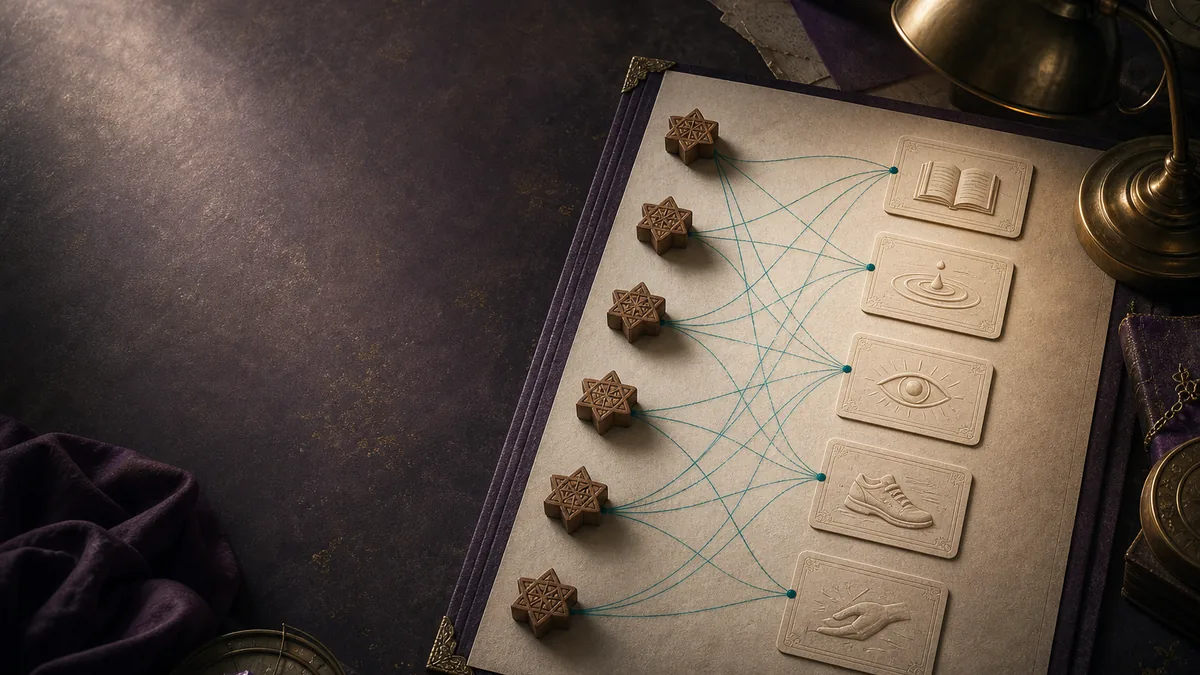
Your chart says you have a talent star, so why has no obvious gift appeared? The answer gets blurry when a star name is treated like a job title. Munchang does not automatically make a writer, and Dohwa does not automatically put someone on a stage.
This guide asks one question: if one Shinsal cannot guarantee talent, where should you look for ability? We will turn six familiar stars into lenses for observable, repeatable actions rather than a list of promised careers.
TODAY’S QUESTION
Why do many stars still leave my talent unclear?
Shinsal are auxiliary markers attached to particular stem-branch combinations. Used carefully, they point to a feature worth checking again; they do not replace the whole chart.
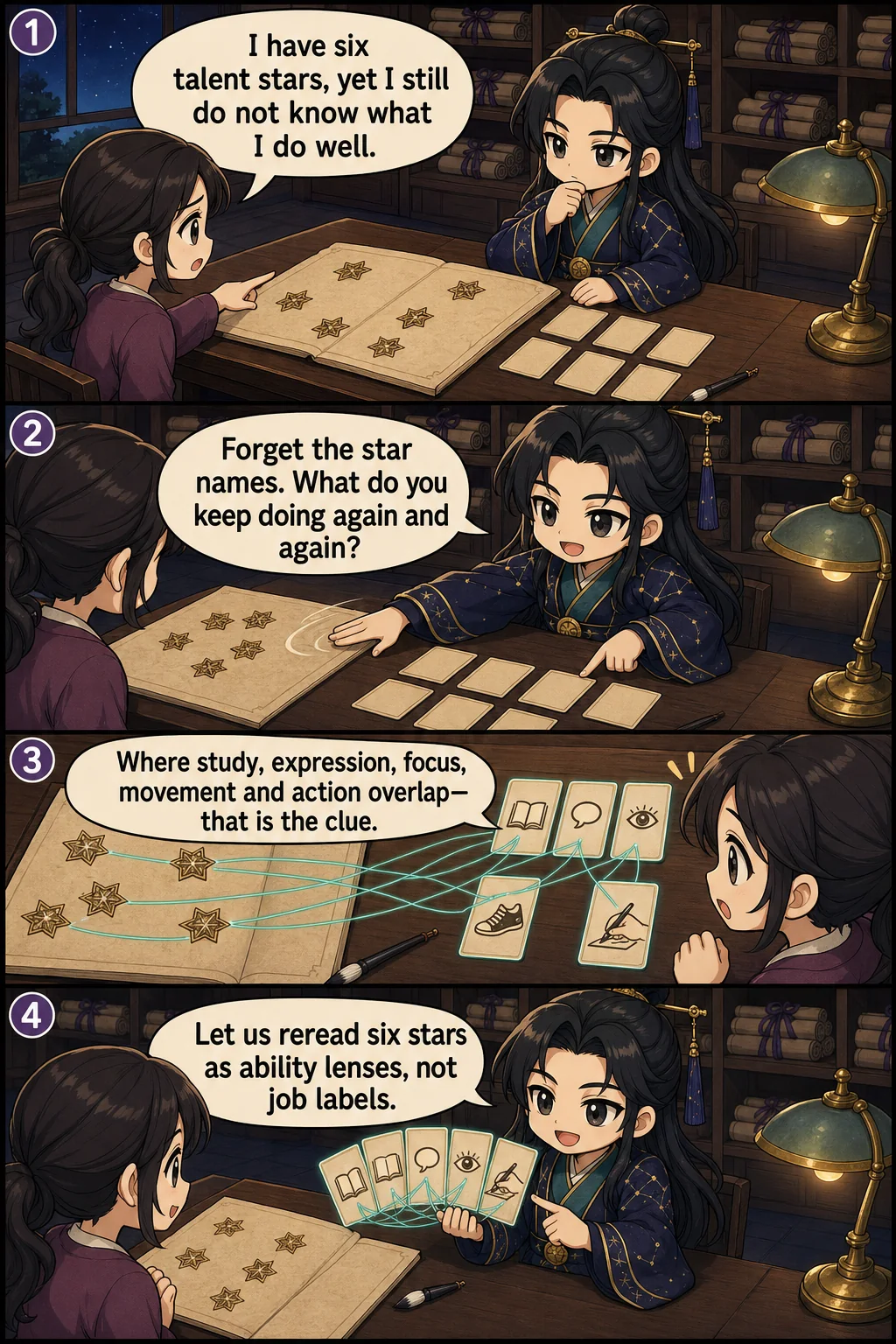
The short answer: Shinsal is a highlighter
A Shinsal is a traditional name for recognizing a particular combination among Heavenly Stems and Earthly Branches. It is not the lead actor that replaces seasonal strength, the Five Phases, Ten Stars, combinations, clashes, and chart context. It is closer to a highlighter that asks you to revisit one feature after the main sentence has been read. A highlighter does not write the sentence, and Munchang or Dohwa does not manufacture an ability that has never been practiced.
The reverse is equally important: having no so-called talent Shinsal does not mean having no talent. Expression can be examined through Output Stars, learning through Resource Stars, and responsibility through Officer Stars. Elemental condition and lived experience add more evidence. Read the complete Shinsal guide and theTen Stars guide if you want to place this small layer on the larger map.
The rule used in this guide
Do not end with nouns such as “Munchang means writer” or “Dohwa means entertainer.” Translate the symbol into verbs that can be observed: learn, explain, focus, attract response, move, organize, and finish. Call it a talent hypothesis only when the same verb repeats in other chart layers and in real life.
Turn six stars into six ability lenses
The legacy article ranked ten stars as S or A grade and connected them directly to successful professions. That looks decisive, but schools differ on which Shinsal they use and how they calculate them, and no common grading standard supports that ranking. This rewrite keeps six names that are present in the product’s knowledge or calculation surface and can be translated into actions a reader can actually test.
| Lens | Ability to inspect | Evidence in life | Overreading to avoid |
|---|---|---|---|
| Munchang | Turn thought into words and explanations | Do written or spoken artifacts keep accumulating? | Does not guarantee grades or genius |
| Hakdang | Build structures for learning and teaching | Does explaining to others deepen your own learning? | Does not equal a degree or credential |
| Dohwa | Attract attention and response | Does feedback gather in presentations or service encounters? | Do not reduce it to beauty or romance |
| Hwagae | Work alone long enough to shape meaning | Can you stay with research, art, or reflection? | Does not sentence anyone to solitude |
| Yeokma | Connect places, roles, and information | Does energy rise in fieldwork, travel, or circulation? | Does not force wandering or job-hopping |
| Jangseong | Take responsibility and order execution | Can you gather people and resources to finish? | Does not guarantee authority or promotion |
Munchang and Hakdang: follow the movement of knowledge
Munchang is traditionally associated with writing and articulate expression; Hakdang, literally a learning hall, with learning and teaching. Saying “good at school” is too vague to test. With Munchang, look for the repeated act of translating complex thought into a memo, explanation, diagram, or story. With Hakdang, look for a cycle in which learning becomes clearer when you teach, coach, or organize material for someone else.
Evidence might be a trail of notes that keeps growing, colleagues who repeatedly ask for your explanations, or work that improves with revision. Exam scores still depend on education, health, time, feedback, and practice. A traditional marker cannot guarantee a degree, credential, or result. In fact, “I have an academic star, so effort should be unnecessary” is precisely the shortcut that prevents a possible inclination from becoming a developed skill.
Dohwa and Hwagae: gathering attention and deepening alone
Dohwa can be read as a lens for scenes in which attention and response gather around a person. Hwagae can be read as a lens for the opposite-looking scene: staying alone with a subject long enough to give it form and meaning. A creator may use both. One phase develops material in solitude; another places it before an audience and learns from the response.
Reducing Dohwa to appearance or romantic trouble hides useful questions about presentation, hospitality, negotiation, and public communication. Turning Hwagae into a destiny of lonely artistry hides research, preservation, philosophy, and religious reflection. For the calculation, traditional background, and limits of the first symbol, continue with theDohwa deep-dive.
Yeokma and Jangseong: movement and completion
Yeokma is more useful as a question about what happens when you move than as a prediction that you must wander. Movement includes fieldwork and travel, but also carrying information between teams, languages, tools, or communities. Some people think more clearly once the setting changes; others gather fragmented knowledge and return with a map.
Jangseong points the inquiry toward responsibility, sequencing, and execution. The question is not whether someone is destined to command people. It is whether they repeatedly take ownership, allocate resources, set an order, and bring work to a finish. Movement without storage can scatter results, while leadership without delegation can become control. Yeokma needs a return path and archive; Jangseong needs feedback and shared ownership. The Yeokmasal guidedevelops that movement lens without the old curse narrative.
A useful overlap
A strong clue is rarely one flattering word. It is an action that appears through more than one lens: researching alone, translating the result for an audience, carrying it into a new setting, and then taking responsibility for delivery.
Confirm a talent hypothesis through three layers
- Chart: confirm that the product actually calculates the Shinsal in your chart. Do not infer it from one birth-year fact found in a random list.
- Structure: check whether the Day Master, elemental condition, Ten Stars, season, and roots repeat a compatible direction.
- Life: find behaviors, practice, and results that have appeared more than once.
A concrete life example is stronger than a flattering adjective. Look for documents you organized without being asked, explanations people requested again, difficult subjects you kept returning to, connections made during fieldwork, or projects you carried through a deadline. “Creative,” “smart,” and “charismatic” are labels; a sequence of actions is evidence.
If only one layer fits, keep it as a hypothesis. If two fit, it may deserve a small practice experiment. If all three overlap, it can justify a larger investment of time. Even then, a career decision must include market demand, income, health, family constraints, access to training, and personal values. Saju should not make that decision on your behalf.
Replace “no talent” with a small experiment
If the Munchang lens appears, explain one difficult concept in 200 words every day for a week and ask one reader where the explanation became unclear. If Dohwa appears, observe what feedback repeats across a small presentation, customer conversation, or community post. For Hwagae, protect two uninterrupted hours and preserve the artifact produced. For Yeokma, record what information becomes available only after moving between places or groups. For Jangseong, own the deadline and role allocation of one small project.
The order is hypothesis, practice, feedback, result—not star, confidence, destiny. The same discipline explains why a Day Master description is only one part of a person; see the10 Day Masters guide for that neighboring example.
One-sentence summary
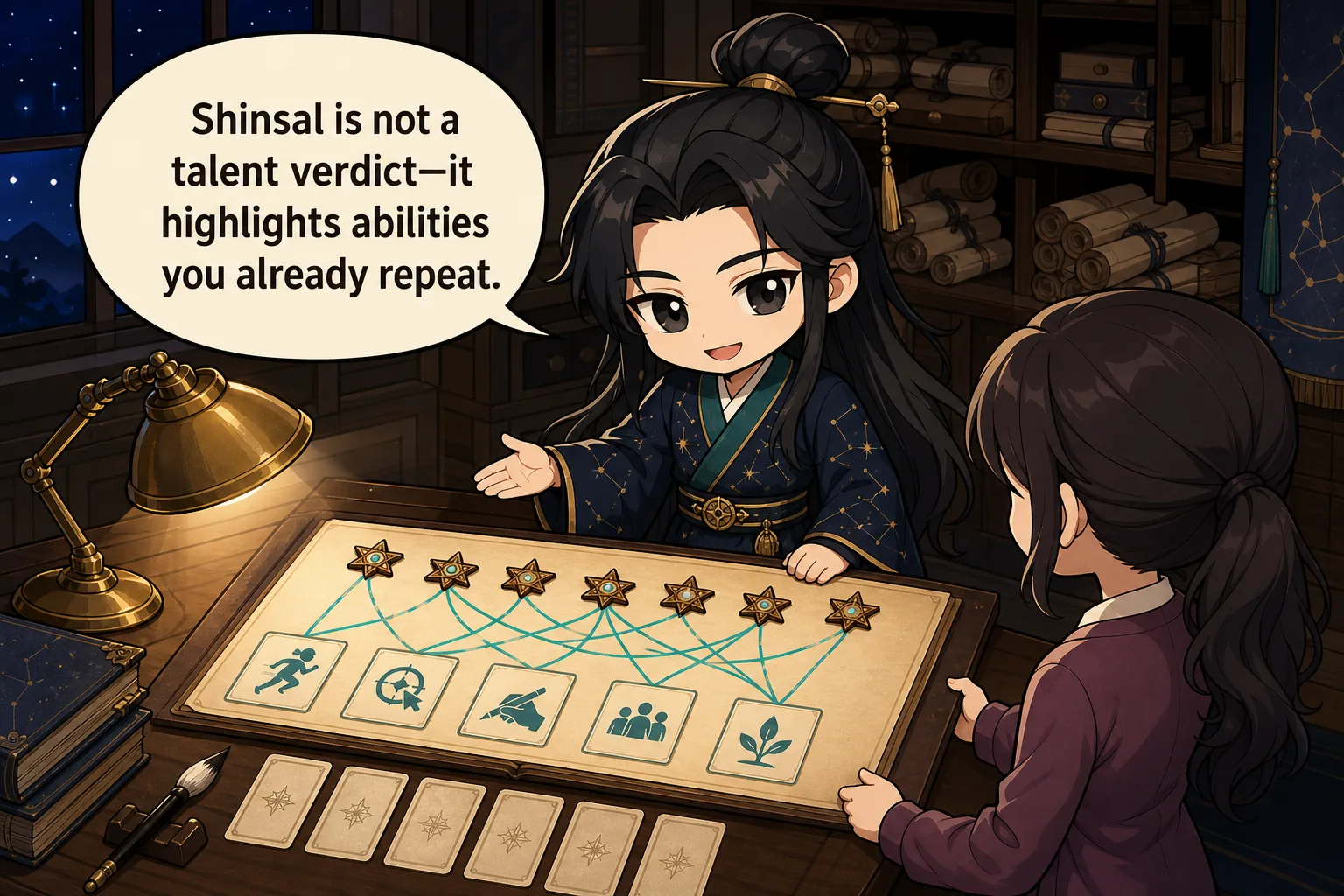
Shinsal is not a talent verdict; it is a highlighter that helps you notice abilities already repeating.
Sources and editorial note
Product terminology and detection scope were checked against packages/core/knowledge/shinsal.json and the actual Shinsal implementation. The traditional names Munchang and Hakdang were reviewed against the relevant portions of Sanming Tonghui. Kim Man-tae’s 2025 study, “A Study on the Major Shinsal in Saju-Myeongri,” was used to place Shinsal as auxiliary interpretive factors rather than substitutes for Five-Phase generation, control, combinations, and clashes.
The old Korean and English pages were used to identify search questions worth preserving. Unsupported S/A rankings, “jackpot” claims, and statements that a star is common among successful members of a profession were not carried over. This article describes a traditional self-reflection framework, not a scientific aptitude test, employment forecast, or guarantee of success.
Mystic Universe Editorial
Authorship & review
This article treats Shinsal as auxiliary markers in traditional Saju. They are not scientific aptitude tests or career predictions; ability still requires evidence from practice, context, and results.
Frequently Asked Questions
Q.Does a talent Shinsal guarantee aptitude in one field?▾
No. A Shinsal is an auxiliary marker. Treat it as a talent hypothesis only when the Day Master, Five Phases, Ten Stars, repeated behavior, and practice outcomes point in the same direction.
Q.Do I have no talent if these Shinsal are absent?▾
No. Learning, expression, responsibility, and execution also appear through the Ten Stars, Five Phases, and lived experience. An absent marker cannot erase demonstrated ability.
Q.Does Munchang guarantee academic or exam success?▾
Munchang is traditionally associated with organizing thought through language. It does not guarantee a score or admission; study routines, revision, feedback, health, and opportunity remain decisive.
Q.What should I do before choosing a career from Shinsal?▾
Write down three actions you repeatedly perform well, compare them with several chart layers, and test the overlap through a small real project. Use the star as a question, not a job label.
Related Articles
Curious about your Day Master?
Enter your birth details and AI will show your Day Master and Five Elements analysis.
Check My Saju for FreeThis content is for entertainment purposes only and does not replace professional advice.