
Told that Yeokmasal means you'll never settle down — that every job change and every move is your chart's fault? That's only half true. The classics describe the Post Horse Star not as a curse but as power that grows in motion. Why the same star makes one person drift and another go global is the real subject of this guide.
Yeokmasal (驛馬煞), the Post Horse Star, has one of the scariest reputations among the shinsal. Old sayings warned that a chart with the Post Horse would "wander far from home," and even today it gets blamed for restlessness and failed roots. Open the classical sources, though, and the tone is different. There the Post Horse is written up as the engine of movement, transition, and expansion — a star that, used well, carries rank and wealth toward you. In an era of overseas jobs, career pivots, and remote work, no shinsal has been re-evaluated more dramatically.
So this guide opens with one question and promises to pay it off at the end: if the star is the same, why does one person drift for a lifetime while another works on a world stage? Before we answer, we will walk through what Yeokmasal actually is, how to find yours, when it delivers and when it spins in place, and where to point all that horsepower.
4 branches
Post Horse letters (寅申巳亥)
4 trines
groups used to calculate
2 faces
breakthrough vs. spinning wheels
What Yeokmasal Is — the Classics Call It Drive
The short answer first: Yeokmasal is not "the star of failing to settle" but "the star whose power comes from motion." Yeok (驛) is the relay station of the old postal roads; ma (馬) is the horse that raced between those stations. Just as royal dispatches crossed a kingdom in a day by changing horses at each post, the Post Horse is a metaphor for energy built to travel far.
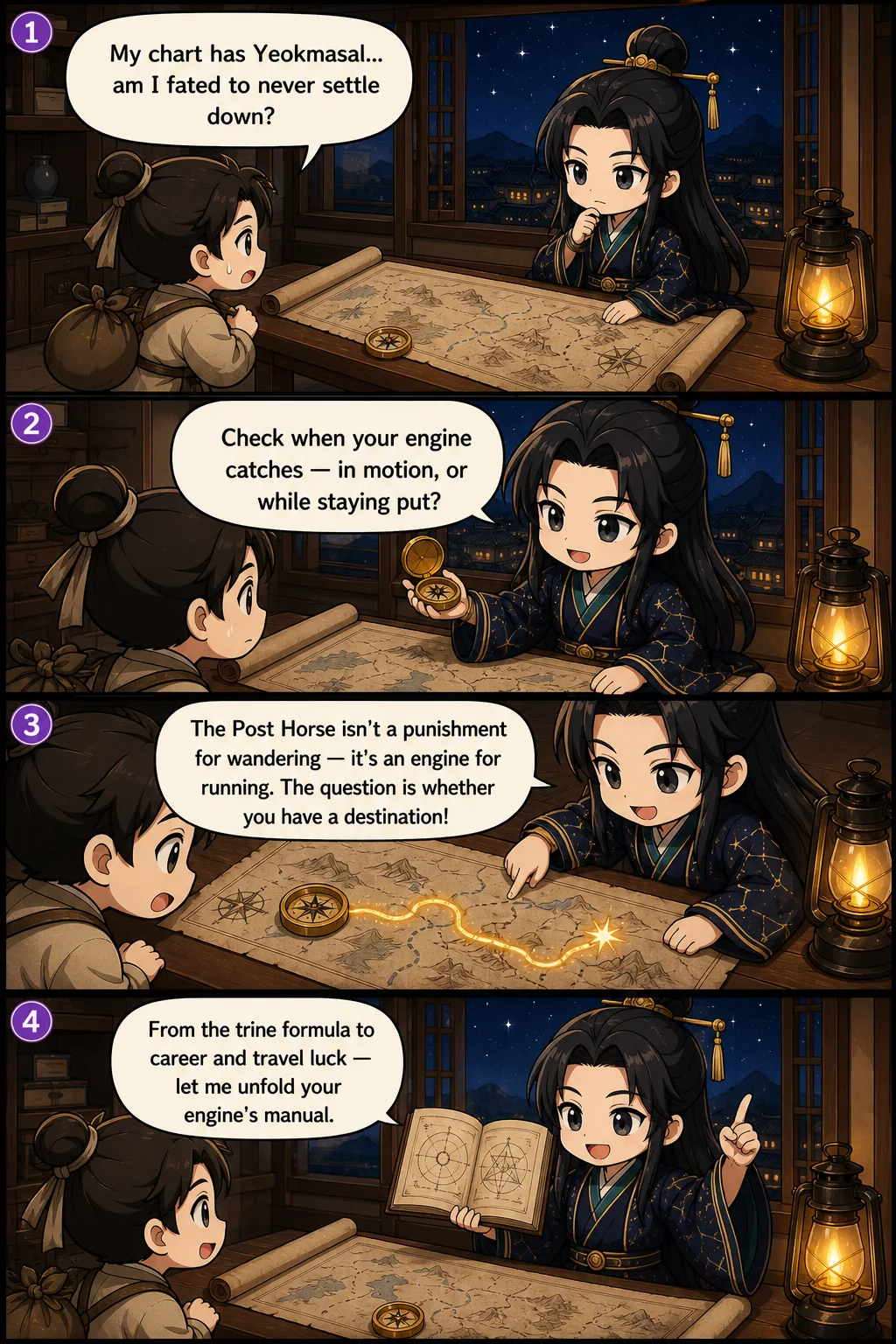
The Ming-era compendium Sanming Tonghui (三命通會) defines it in one elegant line: "stored, the energy is a station; in motion, it is a horse" (氣藏如驛 氣動如馬). At rest it quietly stockpiles; the moment it moves, it releases. Nowhere does the source text promise exile or death on the road — it frames the Post Horse as the five elements' flowing power waiting to be used. The frightening label is mostly later folklore, not doctrine.
Remember that shinsal are seasoning, not the dish: markers that color the reading of a chart rather than decide a fate. Yeokmasal simply shows how much "movement and transition" energy your chart carries. To see where the Post Horse sits within the full shinsal landscape, keep the complete Shinsal guide nearby as a map.
One-line summary
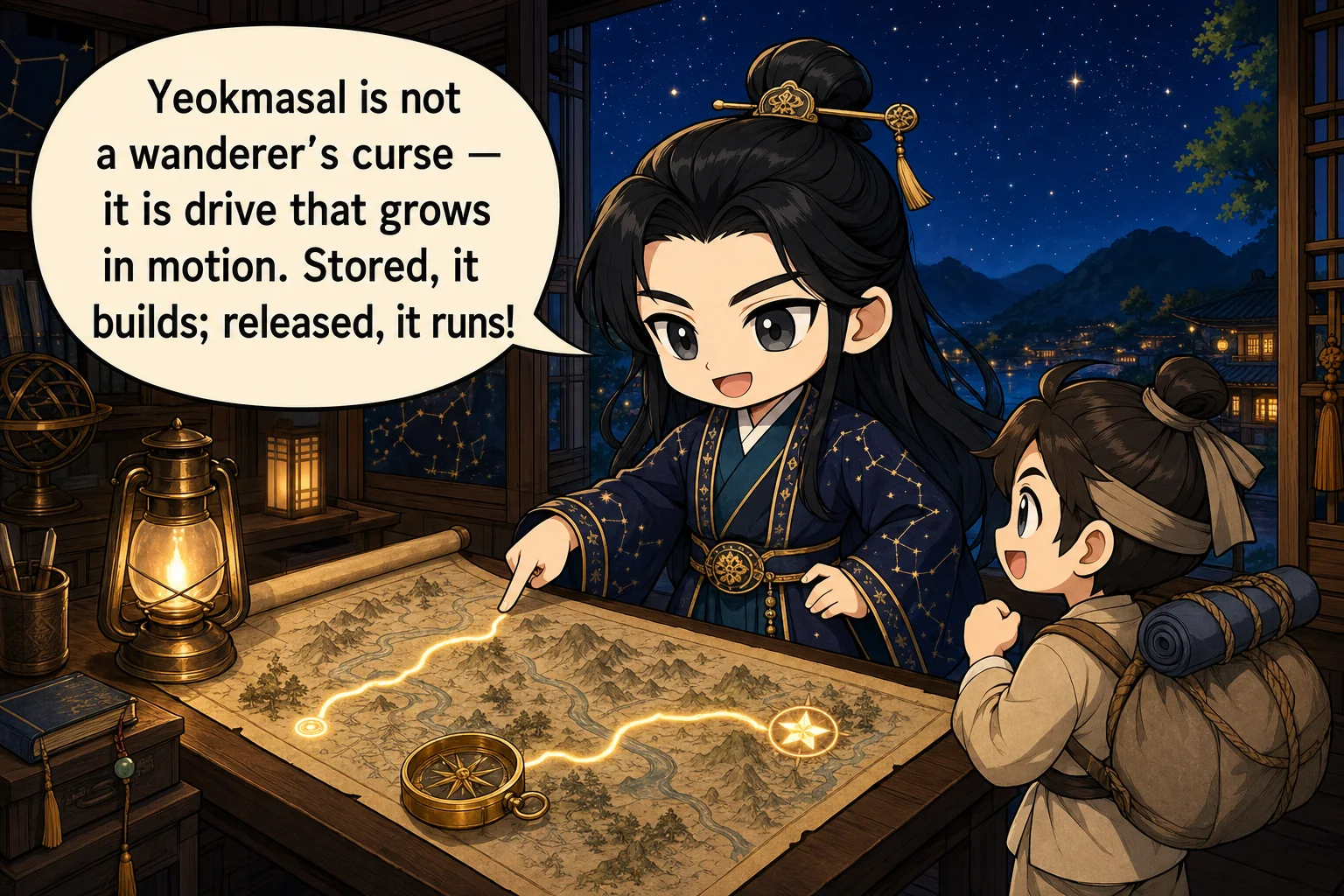
Yeokmasal is not a wanderer's curse but drive that grows in motion. The classical definition says it all: stored, a relay station; released, a running horse.
How to Find Your Post Horse — by Trine Group
The Post Horse doesn't attach to just any branch. Each reference branch fixes one letter through its trine group (samhap, 三合)— the trio of earthly branches that band together into one elemental force. Check both references: your year branch and your day branch. Find the trine each belongs to; the letter that directly clashes with that trine's first branch is a Post Horse candidate, and if it appears anywhere in your chart, Yeokmasal is in play. When year and day share a trine the candidates merge into one letter; when they differ, you have two letters to check — run the formula for each.
| Your trine (year/day branch) | Post Horse letter | Elemental force |
|---|---|---|
| Sin–Ja–Jin (申子辰) | In (寅) | Water trine |
| In–O–Sul (寅午戌) | Sin (申) | Fire trine |
| Sa–Yu–Chuk (巳酉丑) | Hae (亥) | Metal trine |
| Hae–Myo–Mi (亥卯未) | Sa (巳) | Wood trine |
Reading it is simple. If your year or day branch is one of Sin–Ja–Jin, your Post Horse letter is In (寅); for In–O–Sul it is Sin (申); for Sa–Yu–Chuk, Hae (亥); for Hae–Myo–Mi, Sa (巳). Notice the pattern: the Post Horse always lands on one of the four "birth branches" — In, Sin, Sa, Hae (寅申巳亥) — the letters that open each season. That is why the Post Horse reads as pioneering energy: it lives on the starting line.
One layer deeper: the first branch of each trine is the Earth Star (jisal) in the twelve-shinsal system — the ground you stand on. The Post Horse is precisely the letter that clashes with that ground. "The ground shakes, so you leave" was the old reading; "you must leave familiar ground to unlock power" is the modern one — two interpretations branching from a single structure. For how clashes work in general, continue with the branch relations guide.
The Two Faces of the Post Horse — Pairing Decides
The same Post Horse can end in opposite outcomes, and the classics say so themselves. Sanming Tonghui promises that with good companions the star lifts "the noble to honored office and the commoner to plenty" (君子常居榮位 小人主豐贍) — and warns that in poor pairings it produces busyness with nothing to show. Judging the Post Horse in isolation contradicts the very sources that defined it.
| Pairing | When it looks like | How the Post Horse expresses |
|---|---|---|
| Breakthrough pairing | with wealth stars or noble helpers | motion becomes opportunity — promotion, expansion, income |
| Spinning-wheels pairing | tangled with voids or excessive clashes | constant hustle that leaves nothing behind |
The signature breakthrough pair is the Post Horse meeting a wealth star: mobility harnessed to income, so the farther you range, the wider your earning radius. Our own analysis engine classifies the Post Horse as a wealth booster for exactly this reason. Tangled with voids (gongmang) or stacked clashes, though, the same star becomes wheels spinning in place. The fix is never to stop moving — it is to give the motion a destination.
Three Things Everyone Gets Wrong
What makes Yeokmasal feel heavy is not the concept but the folklore around it. Straighten out three misreadings and the fear mostly dissolves.
1. "The Post Horse means dying far from home"
The oldest myth. As we saw, the source texts define the Post Horse as flowing power, not punishment. It is also common: by rule of thumb, roughly one chart in three or four carries it. A letter that a third of humanity holds is a poor candidate for a curse.
2. "You must dissolve it with talismans or rituals"
Searches for "how to remove Yeokmasal" are endless, but the Post Horse is not a disease to cure. It is horsepower awaiting a route. Without a destination the same drive turns into restless drifting; with one, it becomes study abroad, relocation, a bold career move. What needs dissolving is directionlessness — not the star.
3. "More Post Horses, more misfortune"
Two or three Post Horses often get read as doom stacking up. Count is not a curse multiplier — it is engine displacement. Multiple Post Horses mean a stronger appetite for movement and change, which becomes stamina rather than suffering in travel-heavy, border-crossing, project-hopping work.
What remains once the myths fall
The Post Horse measures drive, not doom; it wants a destination, not a talisman; and its count is engine size, not stacked misfortune. Hold those three lines and most Yeokmasal readings fall into place.
Putting Your Post Horse to Work
If you carry the Post Horse, the goal is to route its drive into radius, not restlessness. Changing places costs you less energy than it costs most people, so the moves others dread — new city, new market, new environment — are your openings. The cheat sheet below is built to be saved: find the rows for your year- and day-branch trines — one row if they share a trine, two if they differ — and read across.
| Your trine | Post Horse letter | Drive keyword | Use it like this |
|---|---|---|---|
| Sin–Ja–Jin | In (寅) | pioneering starts | new markets, launches, first-mover roles |
| In–O–Sul | Sin (申) | speed and connection | trade, logistics, platforms, networking |
| Sa–Yu–Chuk | Hae (亥) | voyages and scale | global work, study abroad, import-export, remote teams |
| Hae–Myo–Mi | Sa (巳) | expression on the move | field sales, lecturing, content, publicity |
Translated into careers, the classic list runs through trade, aviation, logistics, diplomacy, journalism, and travel — work where movement is the job. But the body no longer has to move for the Post Horse to run: serving far-away clients, cross-border e-commerce, and project work that changes stages every quarter all count as wide radius. To overlay this with your elemental career profile, read the Five Elements career guide; if an actual move is on your mind, the moving-day Saju guide picks up where this section ends.
Position and Count — Where It Sits Changes What It Does
The finer reading of the Post Horse is positional. The four pillars stage four different arenas of life, so the same star tells a different story depending on where it stands.
| Where it sits | The arena it rules | How it tends to play out |
|---|---|---|
| Year branch | early years, roots | early independence; putting down roots away from home |
| Month branch | career and social stage | mobility built into the job — travel, transfers, pivots |
| Day branch | spouse and daily life | a shifting home radius; a partner who moves with you |
| Hour branch | later years, expansion | activity and new ventures lasting late into life |
Count matters too: one Post Horse is drive you summon when needed; two or more run like an always-on engine. Treat the table as a compass, not a verdict — schools differ on using the year branch alone versus year and day together, and a Post Horse arriving through luck cycles is read separately as that period's travel luck. For the sister star computed on the same trine frame, compare the Dohwasal (Peach Blossom) guide and watch the peak branches play the charm role that the birth branches play for movement.
Closing — the Post Horse Is a Direction, Not a Sentence
Back to the opening question: same star, so why does one person drift while another goes global? Because the Post Horse is thrust without a steering wheel. The fork in the road is not whether you have the star — it is whether you give that thrust a destination. Pointed, it becomes career range; unpointed, it becomes tiring wander.
The study order never changes: find your Post Horse letter through your trine, check its pairings for the breakthrough conditions, read which pillar carries it, and only then choose the route it should run. Follow that order and Yeokmasal stops being a drifter's label and becomes a compass for designing your radius. Curious whether your own chart carries the Post Horse? Run the free Saju analysis to see your shinsal list and travel-luck highlights first — then work out the pillar and pairings by applying today's order to your own eight characters.
References · Editorial note
This guide organizes traditional Yeokmasal (驛馬煞) doctrine around the "On the Post Horse" chapter of the Ming compendium Sanming Tonghui (氣藏如驛 氣動如馬; the trine assignments; 君子常居榮位 小人主豐贍) and the corresponding chapter of the Song classic Yuanhai Ziping, alongside the Encyclopedia of Korean Culture's shinsal entries and our own shinsal dataset (Post Horse mapped as a wealth booster). The popular saying "many horses lift the noble and exhaust the commoner" circulates widely but could not be verified in the Sanming Tonghui source text, so it is quoted here only as a folk maxim. Schools differ on the calculation base (year branch alone versus year and day). This is a pen-name editorial review that impersonates no real fortune-teller or credential, and the content is for reference and entertainment — not a substitute for medical, legal, or major life decisions.
Related Guides
- Complete Shinsal Guide — the full map of 40 stars the Post Horse belongs to
- Challenge Shinsal Guide — the change-and-trial stars read alongside the Post Horse
- Moving-Day Saju Guide — connecting travel luck to an actual move
- Branch Relations Guide — the clash mechanics that create the Post Horse
- Five Elements Career Guide — overlaying drive with career aptitude
- Dohwasal Guide — the charm star computed on the same trine frame
Mystic Universe Editorial
Authorship & review
This guide organizes traditional Yeokmasal (驛馬煞) around the 'On the Post Horse' chapter of the Sanming Tonghui (氣藏如驛 氣動如馬) and the trine-group calculation, drawing on the corresponding Yuanhai Ziping chapter, the Encyclopedia of Korean Culture, and our own shinsal dataset (Post Horse mapped as a wealth booster). Folk maxims that could not be verified in the source texts are quoted without attribution, and schools differ on the calculation base (year branch alone versus year and day). This is a pen-name editorial review that impersonates no real fortune-teller or credential.
Frequently Asked Questions
Q.Does Yeokmasal really mean you can never settle down?▾
No. Yeokmasal is not 'failure to settle' but 'drive that grows in motion.' The source text Sanming Tonghui defines the Post Horse as flowing power — stored like a relay station, released like a running horse — not as a curse. A movement-rich life is likely, but whether that becomes drifting or career range depends on giving the drive a destination.
Q.Is Yeokmasal a bad star that must be dissolved?▾
There is nothing to dissolve. The Post Horse is not a disease for talismans or rituals but horsepower awaiting a route. Without a destination the same drive turns into restless wandering; with one, it becomes study abroad, relocation, or a bold career move. The classics judged the Post Horse by its pairings with wealth stars and noble helpers, never by its mere presence.
Q.Do two or three Post Horses make it worse?▾
Count is engine displacement, not stacked misfortune. Multiple Post Horses mean a stronger appetite for movement and change. In travel-heavy or border-crossing work that appetite becomes tireless stamina; it only turns into frustration when there is no stage to spend the energy on.
Q.Are certain careers better suited to Yeokmasal?▾
The classic list runs through trade, aviation, logistics, diplomacy, journalism, and travel — work where movement is the job. The real criterion is 'wide radius': serving far-away clients, cross-border e-commerce, and project work that changes stages regularly all count, even when your body stays put.
Related Articles
Curious about your Day Master?
Enter your birth details and AI will show your Day Master and Five Elements analysis.
Check My Saju for FreeThis content is for entertainment purposes only and does not replace professional advice.