
Did “Dohwasal means you‘ll cheat” make your heart drop? You’re only half right. The real power of the Peach Blossom Star is not lust but magnetism — the pull that draws people toward you. Why does the very same star become a scandal for one person and stardom for another? That fork is what this guide is about.
Dohwasal (桃花煞) is the most misunderstood of all the special stars (shinsal) in a Saju chart. Old texts recorded it as a star of lust, indecency, and misfortune — yet the modern reading tilts in the opposite direction. The power to attract people, to be noticed, to build wide relationships reads as a genuine talent for anyone whose work is to be seen: performers, politicians, artists. Once you understand why the same character splits into such opposite readings, the vague dread attached to the word dissolves with it.
So this guide plants one question up front. If two people both carry Dohwasal, why does one end up in scandal and the other on stage? We will pay that question back at the very end. Before that, we will walk through what Dohwasal actually is, how to find it in your own chart, how it differs from Hongyeom-sal, and — most importantly — how the charm is meant to be used.
4 peaks
Dohwa branches (子午卯酉)
4 groups
found via Three Harmonies
2 kinds
Dohwa vs Hongyeom charm
What Dohwasal Really Means — the “Hamji-sal” (咸池殺)
Let‘s start with the core: Dohwasal is not a “star of lust” but a “star that pulls attention.” Dohwa (桃花) means peach blossom — the bright, showy charm that holds a person’s gaze. Classical texts also called this star Hamji-sal (咸池殺) or Nyeon-sal (年殺), and old Japyeong-school books such as the Yeonhae Japyeong and Sammyeong Tonghoe recorded Dohwa under those names. The label sounds ominous, but the energy inside it is simply “the power to draw people in.”
The branches where Dohwa can sit are fixed. Among the twelve earthly branches, the four that mark the peak of each season — Ja (子), O (午), Myo (卯), Yu (酉) — are the ones. These four are called the peak branches (旺支): the height of spring (Myo), summer (O), autumn (Yu), and winter (Ja), when each season’s energy is fullest and thus “most visible.” That is exactly why Dohwa ties to charm and popularity: the peak branch is, by nature, the point that is most ripe and most noticed.
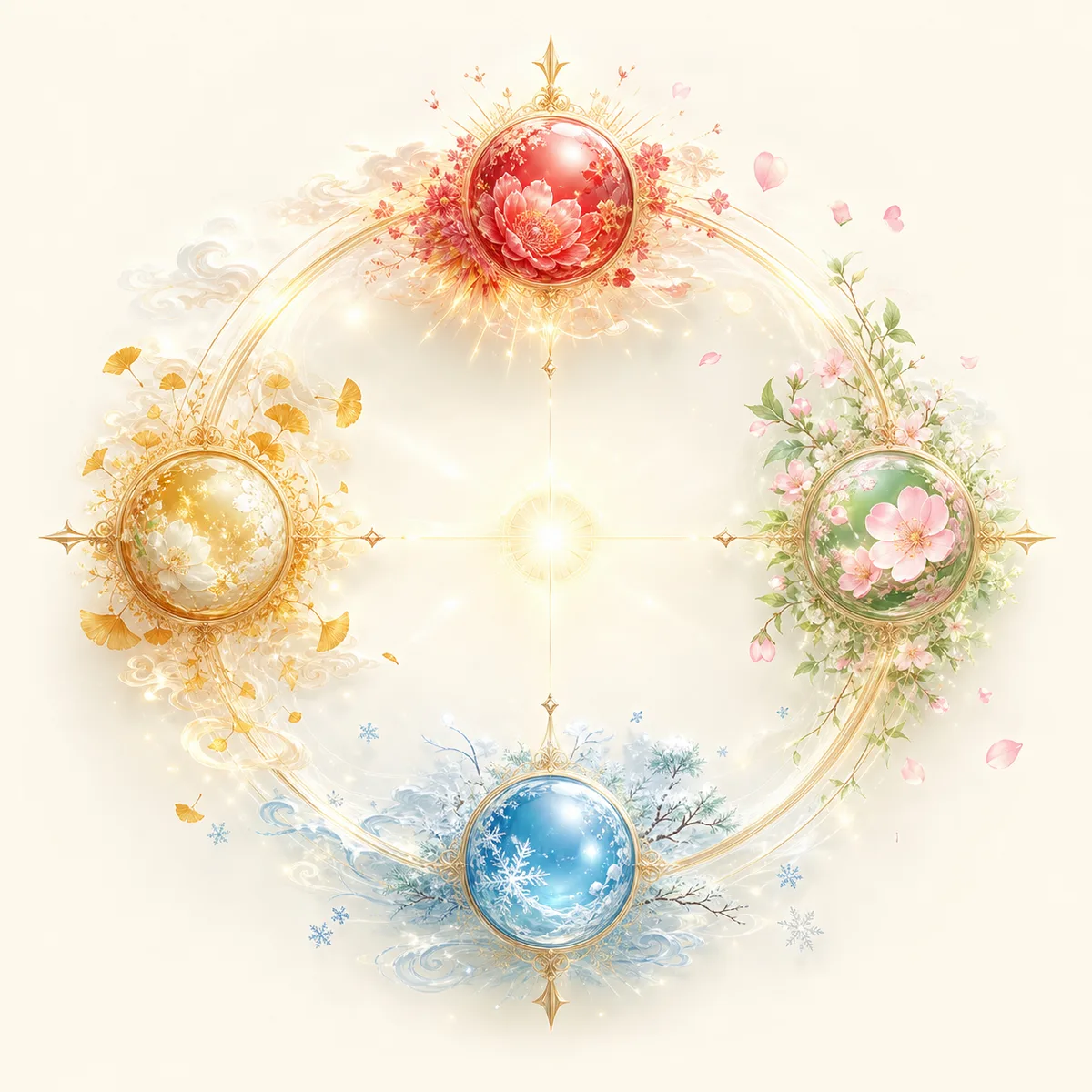
- 午
- Summer · S
- 卯
- Spring · E
- 子
- Winter · N
- 酉
- Autumn · W
Traditional Saju treats the eight characters of a chart as given conditions, and reads the special stars as secondary markers that color those conditions. Dohwasal is no different. It does not decide your fate; it simply shows how much “people-pulling energy” your chart carries. If you want the full map of how Dohwa sits among the other stars first, reading the complete Shinsal guide alongside this one makes Dohwa’s place much clearer.
One-line summary
Dohwasal is not an “ominous star of lust” but a “star of charm that pulls attention.” Its classical name is Hamji-sal, and its seats are the seasonal peak branches Ja, O, Myo, Yu — the ripest, most noticed points are the seats of Dohwa.
How to Find Your Dohwasal — via the Three Harmonies (三合)
Dohwa does not attach to just any character. A single branch is fixed as your Dohwa based on your chart’s Three Harmony group (三合局). A Three Harmony is a relationship where three branches gather into one strong elemental force, and Dohwa sits at the “bathing (沐浴)” position of that force — the point where the energy has just bloomed into full color. The reference character is usually the branch of your birth year (year branch) or birth day (day branch).
| My Three Harmony group | Dohwa branch | Force it forms |
|---|---|---|
| Sin-Ja-Jin (申子辰) | Yu (酉) | Water (水) |
| In-O-Sul (寅午戌) | Myo (卯) | Fire (火) |
| Sa-Yu-Chuk (巳酉丑) | O (午) | Metal (金) |
| Hae-Myo-Mi (亥卯未) | Ja (子) | Wood (木) |
Reading it is simple. If your year or day branch is one of Sin, Ja, or Jin, Dohwa is present when Yu (酉) appears somewhere in your chart. For In-O-Sul it is Myo (卯), for Sa-Yu-Chuk it is O (午), and for Hae-Myo-Mi it is Ja (子). Just remember that each of the four harmony groups carries a different peak branch as its Dohwa, and you can roughly gauge your own Dohwa without a full almanac.
The fact that Dohwa emerges from the “bathing” position connects it to the twelve life stages. Bathing is the stage where a newborn energy first dresses and shows itself to the world — a phase that holds brightness and charm, but also instability, at once. That is why Dohwa’s glamour and its fickleness are two sides of one coin. To follow that thread, read the bathing stage in the Twelve Life Stages guide and the texture of Dohwa comes into focus.
Dohwasal vs Hongyeom-sal — Two Textures of Charm
Talk about Dohwasal and Hongyeom-sal (紅艶殺) almost always follows. Both are stars of “charm,” but their texture differs. If Dohwa is the dazzling popularity that pulls every eye on a stage, Hongyeom is the quiet charm that soaks deeply into one particular person. If Dohwa is a pink that catches the eye at first glance, Hongyeom is closer to a red you fall into the more you come to know it.
| Aspect | Dohwasal (桃花) | Hongyeom-sal (紅艶) |
|---|---|---|
| Direction of charm | Toward everyone — wide | Toward one person — deep |
| First impression | Dazzling and immediate | Plain but long-lasting |
| Metaphor | A star on stage | A quietly alluring partner |
| Color image | Pink — bright and eye-catching | Red — deep and soaking in |
Add Cheoneul Gwiin (天乙貴人), the star that summons the help of benefactors, and you complete the three stars traditionally read together as “relationship luck and charm.” In actual Saju analysis, Dohwa, Hongyeom, and Cheoneul Gwiin are grouped as the power to draw people in and widen one’s circle. The key point is this: having these stars does not guarantee popularity — the outcome turns on “where you point that energy.”
Three Things Everyone Gets Wrong
What makes Dohwasal hard is not the concept but the misconceptions hardened around it. Correct these three, and the character for Dohwa will no longer make you flinch.
1. Dohwasal means you’ll cheat?
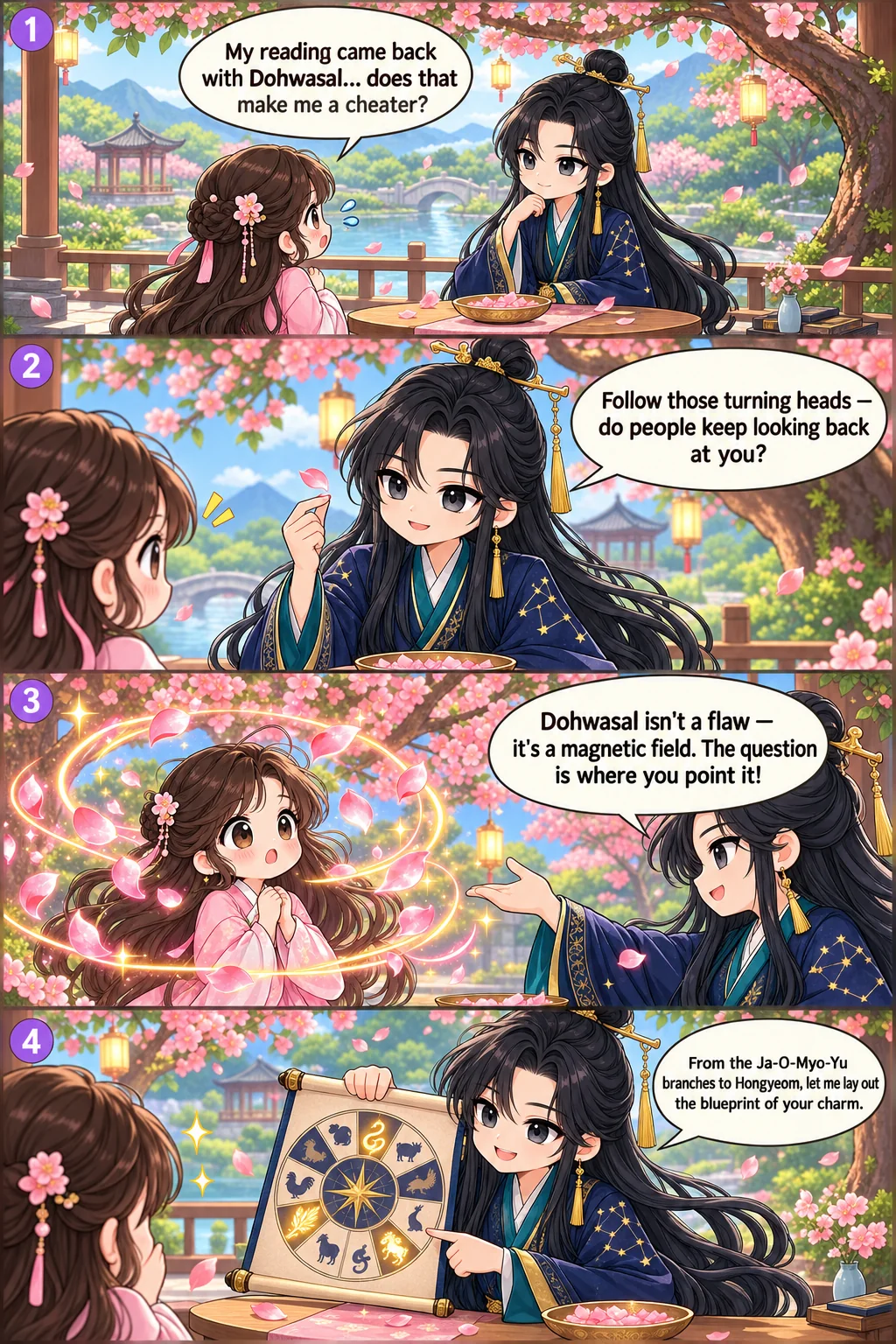
The most common myth. Dohwasal is not “a wandering heart” but “the power to draw people in.” It is true that greater charm brings more opportunities and temptations — but the outcome for someone who channels that power into stage, expression, and relationships is nothing like the outcome for someone who lets it run loose. The star only tells you the size of the energy; what it is used for is up to the person.
2. It carries “sal (煞),” so it must be bad?
The character “sal (煞)” makes it easy to assume the worst, but the special stars mix ominous and auspicious, and Dohwa is a classic “two-sided star.” Modern Saju actively uses Dohwa as a talent for charm, popularity, and artistry. A scary-sounding name does not make the content harmful.
3. Dohwa acts the same wherever it sits?
The same Dohwa acts differently depending on which pillar (year, month, day, hour) it occupies. Whether it shows up as visible popularity, as charm tangled with a spouse relationship, or as appeal in social activity depends on the seat. Don’t stop at “Dohwa present or absent” — read “where it sits” to read it properly.
What remains once the myths are corrected
Dohwa is not a wandering heart but the size of your charm; a “sal” is not automatically bad; and the same Dohwa acts differently by seat. Remember just these three and most of Dohwa interpretation falls into place.
Using Dohwasal — Translating Charm Into Talent
If you have Dohwa, the key is to channel that charm into popularity, expression, and profession rather than scandal. Because Dohwa’s energy rides on dealing with people and presenting yourself, it shines especially in face-to-face, expressive, and artistic work. The cheat sheet below is organized so you can find the single row for your Three Harmony group. Save it and read only your own row when you need it.
| My group | Dohwa branch | Charm keywords | Used well = gain |
|---|---|---|---|
| Sin-Ja-Jin | Yu (酉) | Refined · sensory · expressive | Presenting, planning, branding — 'showing' work |
| In-O-Sul | Myo (卯) | Bright · friendly · social | Sales, broadcasting, face-to-face service |
| Sa-Yu-Chuk | O (午) | Passion · spotlight · stage | Art, marketing, performance |
| Hae-Myo-Mi | Ja (子) | Gentle · empathetic · connecting | Counseling, teaching, community |
Move Dohwa’s charm out of “spending it only on relationships” and into “work that presents you,” and the same energy turns into popularity and achievement. Let it run without restraint and it returns as gossip and waste. If you want to see how Dohwa plays out in romance and compatibility, read on in the Saju compatibility guide for the attraction and friction two people‘s branches create. And if you’re curious about the other charm-and-talent stars, the talent and charm stars guide is worth reading alongside.
Dohwa by Position — the Seat Changes the Effect
The real subtlety of Dohwa lies in “which pillar it sits on.” Because the four pillars each symbolize a different stage of life, the same Dohwa tells an entirely different story depending on its seat. The table below summarizes the texture of Dohwa by position.
| Seat of Dohwa | Stage it symbolizes | Texture of the effect |
|---|---|---|
| Year branch | Early years · ancestry · background | Noticed from a young age; people gather early |
| Month branch | Youth · social activity | Charm in relationships and social popularity |
| Day branch | Spouse · home | Charm tangled with a partner relationship |
| Hour branch | Later years · children · expression | Charm and a drive to express lasting into later life |
Still, this table is a tool for orientation, not determinism. One Dohwa does not fix your life; the flow of the whole chart, its relationships with other characters, and your own choices all act together. If you’re curious about cautions when Dohwa overlaps other ominous stars, the Combination, Clash, Punishment, Break, and Harm guide shows how relationships between branches shake Dohwa’s effect.
Conclusion — Dohwa Is Not a Flaw but a Direction
Now back to the opening question. If two people both carry Dohwasal, why does one end in scandal and the other on stage? The answer is clear. Dohwa is not misfortune but “strong energy without a direction.” What splits good from bad is not the presence of Dohwa but where you aim that magnetic field. Flow it into stage and expression and it becomes popularity and talent; let it pour into relationships alone, unchecked, and it becomes gossip.
So the order of studying Dohwa is always the same. First find your Dohwa branch by your Three Harmony group, then distinguish the textures of Dohwa and Hongyeom, then read which pillar the charm sits on, and finally translate that power into “work that presents you.” Keep this order and Dohwa stops being a frightening label and becomes a compass for handling the pull inside you. If you want to know whether your chart carries Dohwasal — and how Hongyeom and Cheoneul Gwiin are placed — check your special stars and charm points at once in a free Saju analysis, and apply today’s order to your own chart.
References · author note
This guide organizes the traditional Dohwasal (桃花煞) doctrine around its Hamji-sal (咸池殺) and Nyeon-sal names, the Ja-O-Myo-Yu peak branches, and the Three Harmony calculation, drawing on secondary compilations of the shinsal theory in the Yeonhae Japyeong (淵海子平) and Sammyeong Tonghoe (三命通會) lineage, the shinsal entry of the Encyclopedia of Korean Culture (Academy of Korean Studies), and our own shinsal knowledge dataset (Dohwa, Hongyeom, and Cheoneul Gwiin mapped to relationship luck and charm). Handling of Dohwa’s types and effects varies by school; this is a pen-name editorial review that impersonates no real fortune-teller or credential. This content is for reference and entertainment and does not replace medical, legal, or major life decisions.
Related Guides
- Complete Shinsal guide — the full map of the special stars Dohwa belongs to, 40 at a glance
- Talent and charm stars guide — the charm-and-talent stars read alongside Dohwa
- Twelve Life Stages guide — why “bathing,” the root of Dohwa, is both dazzling and unstable
- Saju compatibility guide — the attraction Dohwa’s charm creates between two people
- Combination, Clash, Punishment, Break, Harm guide — how branch relationships shake Dohwa’s effect
Mystic Universe Editorial
Authorship & review
This guide organizes traditional Dohwasal (桃花煞) doctrine around its Hamji-sal and Nyeon-sal names, the Ja-O-Myo-Yu peak branches, and the Three Harmony calculation, drawing on secondary compilations of shinsal theory in the Yeonhae Japyeong and Sammyeong Tonghoe lineage, the Encyclopedia of Korean Culture, and our own shinsal dataset (Dohwa, Hongyeom, and Cheoneul Gwiin mapped to relationship luck and charm). Handling varies by school; this is a pen-name editorial review that impersonates no real fortune-teller or credential.
Frequently Asked Questions
Q.Does having Dohwasal really mean you'll cheat?▾
No. Dohwasal is not 'a wandering heart' but a star of 'charm that draws people in.' Greater charm does bring more opportunities and temptations, but the outcome for someone who channels that power into stage, expression, and healthy relationships is nothing like that of someone who lets it run loose. The star shows the size of the energy; what it is used for is the person's choice.
Q.What is the difference between Dohwasal and Hongyeom-sal?▾
Both are stars of charm, but their texture differs. Dohwasal is the dazzling popularity that pulls every eye on a stage; Hongyeom-sal is the quiet charm that soaks deeply into one particular person. If Dohwa is a pink that catches the eye at first glance, Hongyeom is a red you fall into the more you know it. Add Cheoneul Gwiin and you get the three stars traditionally read as relationship luck and charm.
Q.Is Dohwasal only bad for women?▾
No. Viewing Dohwasal as ominous only for women is a remnant of an old mindset wary of female sensuality. Dohwa means 'people-pulling charm' for men and women alike. Today it is read, regardless of gender, as a talent for popularity, expressiveness, and artistry — a strength in people-facing work like face-to-face service, broadcasting, and the arts.
Q.Does Dohwasal act differently if there are several or it sits in different places?▾
Yes. The same Dohwa acts differently depending on which pillar (year, month, day, hour) it occupies. Year-branch Dohwa reads as popularity from a young age, month-branch as social charm, day-branch as charm tangled with a spouse relationship, and hour-branch as a drive to express lasting into later life. Several Dohwa strengthen the energy, but an accurate reading folds in combinations and clashes with other characters.
Related Articles
Curious about your Day Master?
Enter your birth details and AI will show your Day Master and Five Elements analysis.
Check My Saju for FreeThis content is for entertainment purposes only and does not replace professional advice.