
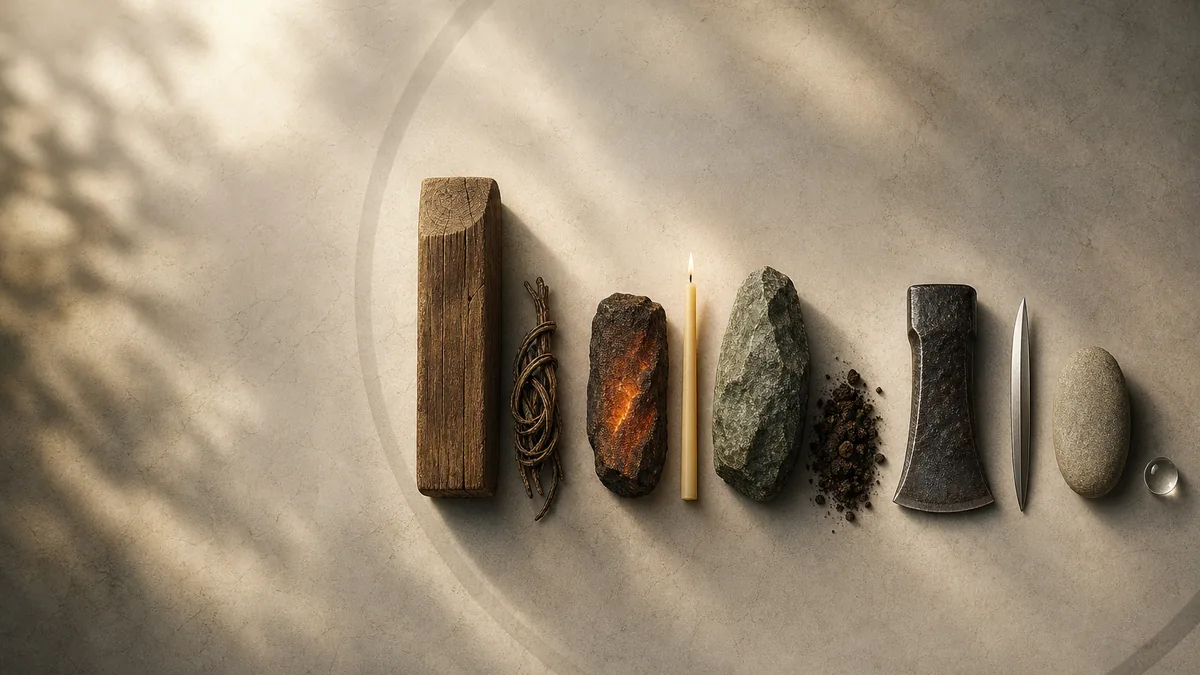
You looked up your Day Master, read the description, and half of it fit while the other half described a stranger. Is the table wrong, or are you the exception?
This guide asks one question: why is one Gap wood person all forward drive and another cautious? The answer comes at the end. First, what the Day Master actually does in a chart.
Today's question
Why does a Day Master description only half fit?
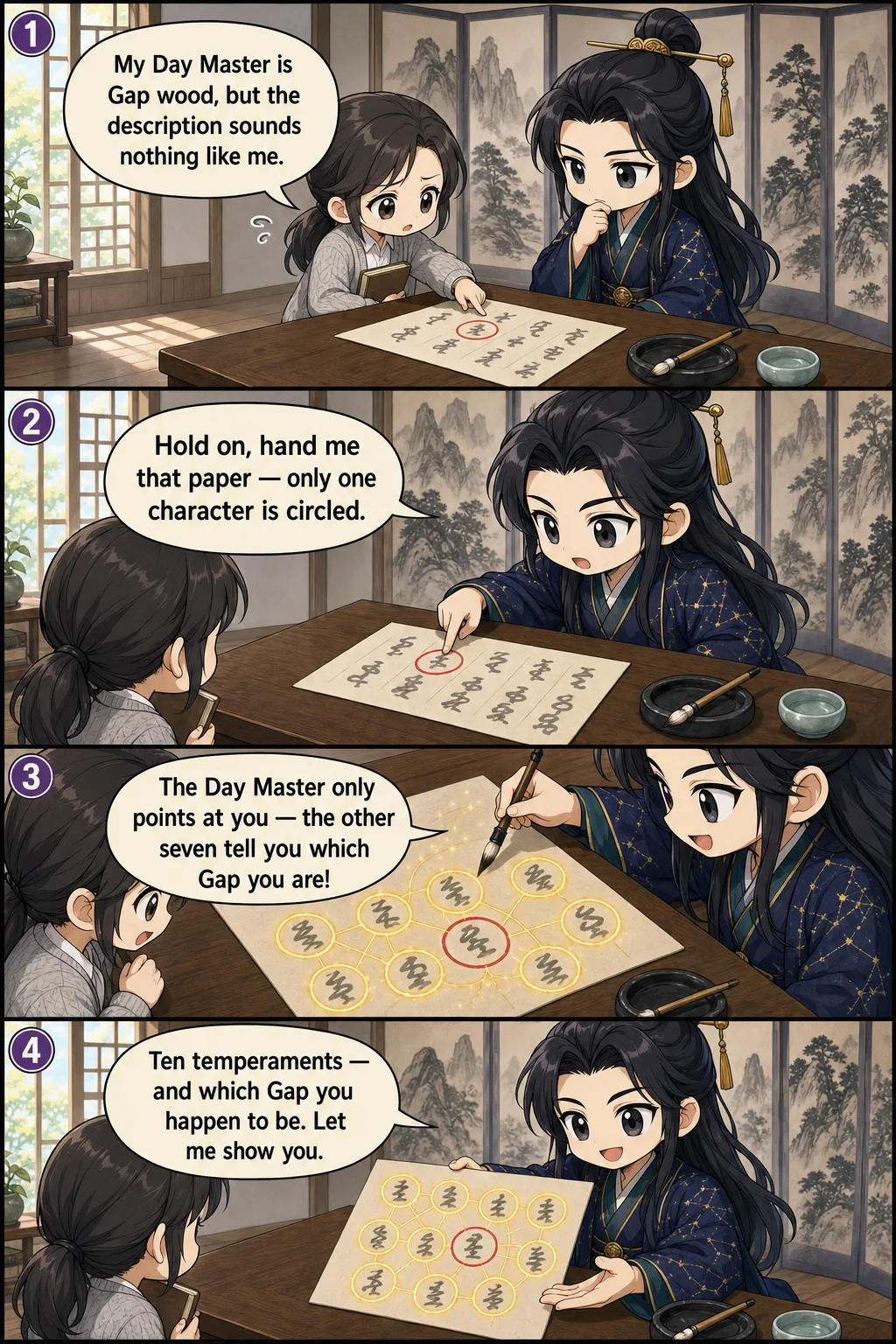
The Day Master is the one character in a Saju chart that stands for you. It points at you. It does not describe all of you. Where the other half lives is what this guide is about.
The Short Answer First
The Day Master is a reference point, not a personality type. It is one coordinate among the eight characters of a chart, and the other seven are the conditions that coordinate sits in. So a description fitting you halfway is exactly what you should expect. The table is not wrong. It is half of the sentence.
The other half comes down to three things — root, season, and the characters standing next to it — which we will get to. First, make sure you have the right character.
One Character Out of Eight Means You
A Saju chart writes your birth year, month, day and hour as two characters each: eight characters in four pillars. In every pillar the upper character is a Heavenly Stem and the lower one is an Earthly Branch. The upper character of the Day Pillar is your Day Master.
The other seven describe your surroundings — parents, siblings, partner, children, work, money. That single character is the only one that means you. It is why every reading starts there.
Do not count columns
You may have seen an instruction like "the third pillar from the left". Counting is not reliable: calculators lay the pillars out in different orders — some start at the Year Pillar, some at the Hour Pillar (getsaju starts at the Hour). One method works regardless of order. Find the pillar labelled Day, and take the character on top.In getsaju that cell is the one outlined in violet. Where the Ten Gods row is shown, it is labelled "Self".
Do Not Memorise Ten. Multiply Five by Two.
There are ten Heavenly Stems, and they are not ten separate inventions. They are five elements multiplied by two polarities. Wood, Fire, Earth, Metal and Water each come in a yang (陽) and a yin (陰) form: five times two is ten.
Polarity is the part that gets misread. Yang is not the good one and yin is not the bad one. They are two ways of using the same force. Gap wood and Eul wood are both Wood reaching outward; one pushes straight up, the other climbs by winding. The difference is method, not direction.
| Element | Yang (陽) | Yin (陰) | In one line |
|---|---|---|---|
| Wood | Gap (甲) | Eul (乙) | Reaching — pushing straight, or climbing by winding |
| Fire | Byeong (丙) | Jeong (丁) | Lighting — covering a field, or burning one point |
| Earth | Mu (戊) | Gi (己) | Holding — standing like a mountain, or growing like a field |
| Metal | Gyeong (庚) | Sin (辛) | Separating — cutting in one stroke, or finishing an edge |
| Water | Im (壬) | Gye (癸) | Soaking — running like a river, or settling like dew |
Ten Temperaments — Read Them in Pairs
Trying to memorise ten cards one at a time does not survive the week. Instead, put the yang and yin of the same element side by side and watch what separates them. Keep the contrast and the ten come along for free.
Wood — the force that extends
A tall tree growing straight up
Once the goal is set, this one pushes in a single direction. Strength shows in first attempts and in front-of-the-room positions. There is a grain here that would rather break than bend.
Pioneering · drive · pride · Fits well with: Founding a business, sport, military and police, politics
A vine climbing by winding
Same Wood, different method. Blocked, it changes direction instead of snapping. It looks soft and outlasts almost everything, and it reads a room carefully.
Flexibility · tenacity · taste · Fits well with: Design, counselling, teaching, horticulture and interiors
Fire — the force that lights
The sun over an open field
Presence is unmistakable wherever this one stands, and people are drawn in. It moves fast and enjoys widening things. Gathering that energy into one place is the standing homework.
Charisma · expansion · heat · Fits well with: Broadcast and entertainment, sales, leadership roles
A candle burning one point
It lights a narrower circle, and goes correspondingly deeper. This is the grain of the specialist who keeps digging, and it picks up the feelings of people nearby with unusual accuracy.
Focus · expertise · sensitivity · Fits well with: Research, art, counselling, medicine
Earth — the force that holds
A mountain that keeps its place
This one does not move quickly. It roots first and acts second, and once committed it stays committed. People end up leaning on it as the fixed point of a group.
Trust · stability · staying power · Fits well with: Management, finance, construction, public institutions
A field that grows a crop
Same Earth, but growing rather than withstanding. It has a good practical sense of what actually pays off, misses very little detail, and looks after the people beside it.
Care · practicality · thoroughness · Fits well with: Healthcare and welfare, accounting, food, education
Metal — the force that separates
An axe that cuts in one stroke
Decisions come fast and principles do not get negotiated away. Right and wrong are drawn sharply, which can look blunt, and which is also why its word carries weight.
Decisiveness · justice · principle · Fits well with: Law, military and police, surgery, trading
A blade edge being finished
It refines rather than cuts. Sensitive to the last percent of finish, unable to walk past a small flaw, and carrying a clear aesthetic standard of its own.
Precision · aesthetic eye · sensitivity · Fits well with: Fashion and beauty, precision engineering, criticism, curation
Water — the force that soaks in
A wide river taking its bends
It dislikes being boxed in and finds the route by moving. What it takes in is broad, so a varied life turns directly into working capital.
Breadth · strategy · freedom · Fits well with: Strategy, investment, diplomacy, travel and tourism
Fine rain that soaks without a sound
Quiet, and yet everything ends up damp. It senses what has not been said out loud yet, and the inner world runs deep.
Intuition · empathy · inwardness · Fits well with: Psychology, writing, medicine, research and planning
So Why Are Two Gap Woods Different?
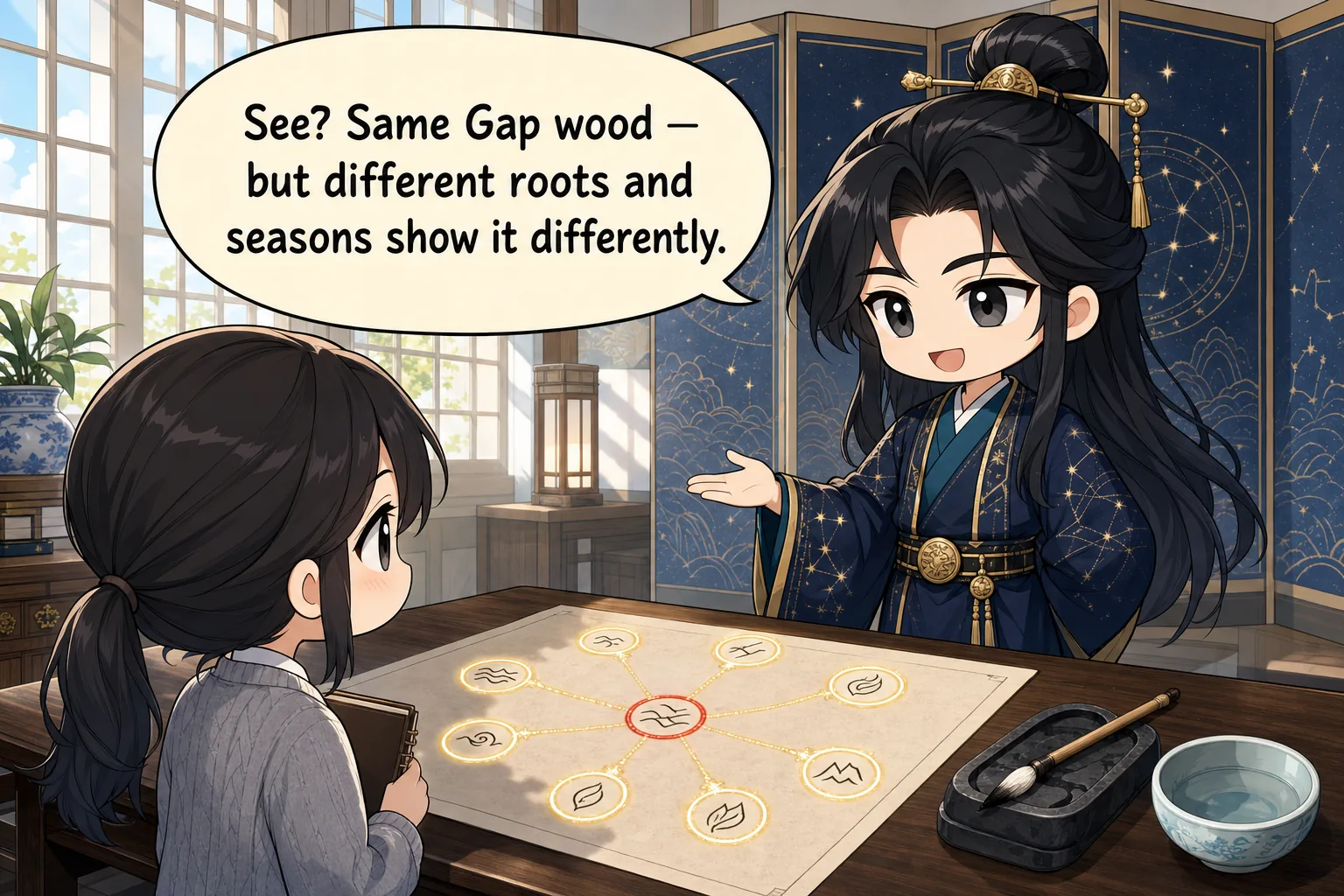
Back to the opening question. Reading all ten does not explain why your description only half fits, because the other half is not in the Day Master at all. It is in where that Day Master stands. Three things do most of the separating.
- Root — is there anywhere among the Branches to root? A Stem meeting its own energy among the Branches and taking hold there is called tonggeun (通根). Do not read only a Branch's surface element: every Branch also conceals Stems inside it, so Hae (亥), Water on the surface, and Jin (辰), Earth, both hold Wood. Rooted, it holds. Without a root, the same character is far more easily moved.
- Season — which month were you born in? A Gap wood born in a spring month, when Wood is at its strongest, and a Gap wood born in autumn, when Metal is, are not the same character carrying the same weight.
- Neighbours — do they feed it or trim it? Water beside Wood grows it. Metal beside Wood cuts it back.
A Gap standing in spring
Born in the In (寅) month · In (寅) and Myo (卯) among the Branches
The Branches hold seats of the same Wood, so this Gap is rooted. The season favours Wood as well, and the straight-ahead grain of Gap wood tends to show up much as the description says.
A Gap standing in autumn
Born in the Yu (酉) month · nothing to root in among the Branches, several Metal
There is nowhere to put down a root, and the Metal that trims Wood has the season behind it. The same Gap wood is read as measuring and refining rather than pushing.
Both people have Gap wood as their Day Master and land on the same card in the table above. They still read differently. The two examples are simplified for illustration — a real reading also weighs strength and the Stems hidden inside the Branches. The direction, though, is clear: the Day Master tells you which temperament, and the rest of the chart changes how it shows up.
A grammatical analogy
This is an aid to understanding, not a term of the tradition. The Day Master behaves something like the subjectof a sentence. Keep the subject and change what follows, and you have a different sentence. Everyone here gets as far as "is Gap wood". What comes after that is where people diverge.
Checking Your Own Chart
Once you have your Day Master, the order of the next steps is settled. Look at whether it is strong or weak, then read it together with the Branch directly beneath it, and then go into the Stems hidden inside the Branches.
- What Saju is — how the eight characters are produced in the first place
- Finding your Yongsin — what to balance a strong or weak Day Master with (schools differ considerably on method here)
- The 60 Day Pillars — reading the Day Master together with the Branch under it
- Hidden Stems — the Stems concealed inside each Branch
- Combinations and clashes — what happens when your Day Master combines with another Stem
Enter a birth date and time and your eight characters come back with the Day Master marked. Check yours free on getsaju.
Conclusion — In One Sentence
The Day Master table is not wrong; it is half. The other half is decided by where that character is rooted and which season it stands in. That is why one Gap wood pushes and another measures. Rather than memorising ten, find out which Gap wood yours is.
Sources and Production Note
Classical — the method of reading a chart from the Day Master takes its name from Yuanhai Ziping (淵海子平). Judging that Day Master through its relations with the remaining characters, rather than in isolation, is treated in the Ditian Sui(滴天髓) lineage. (The "subject" analogy above is a modern explanatory device, not a classical term.)
Modern scholarship— the idea of a Stem taking root in the Branches (通根), and the supporting and controlling relations between Stems and Branches, are examined in Woo Yeon-hwa and Kim Man-tae, "A Study on the Mutual Assistance and Mutual Restraint of Heavenly Stems and Earthly Branches", Journal of Daesoon Thought 42 (2022), 109–141. That paper is the basis for the section above on why two Gap woods differ. For a modern proposal of a distinct Day Master reading method, see So Jae-hak, "A Study on the Interpretation Method of the Day Master in Seokha Myeongni", Journal of Sundo Culture 19 (2015).
Production note
while writing the instruction for finding your Day Master, we opened the getsaju chart screen and checked the pillar order. It draws the Hour Pillar first, so the Day Pillar sits second from the left; counting to the third, as the old instruction said, lands on the Month Pillar. That is why counting was dropped altogether. For tonggeun we checked against the table of Stems hidden inside each Branch, so a root is never judged from a Branch's surface element alone. Where schools diverge — when a combination transforms, how a Yongsin is chosen — we did not pick a side. The ten temperament descriptions were rewritten rather than lifted, so that what separates the yang and yin of an element is what shows.
Frequently Asked Questions
Q.What is the Day Master (Ilgan)?▾
The Day Master is the upper character of the Day Pillar among the eight characters of a Saju chart. The other seven describe your surroundings — parents, partner, work, money — while that single character means you. There are ten, and they are not ten separate inventions: they are the five elements multiplied by two polarities, yang and yin.
Q.How do I find my Day Master?▾
Do not count columns. Calculators order the pillars differently (some start at the Year Pillar, some at the Hour Pillar), so an instruction like "the third from the left" can land you on the wrong character. The reliable method is to find the pillar labelled Day and take the character on top. On getsaju.com that cell is the one outlined in violet, and where the Ten Gods row is shown it is labelled "Self".
Q.Does the same Day Master mean the same personality?▾
No. The Day Master is a reference point for temperament, not the whole personality. Two people with Gap wood can read very differently depending on whether that Wood has anywhere to root among the Branches (tonggeun, which counts the Stems hidden inside a Branch), which season they were born in, and whether the neighbouring characters feed it or trim it. A description fitting you halfway is exactly what you should expect.
Q.Is the Day Master the same as the Day Pillar?▾
No. The Day Pillar is the whole column: the Day Master (upper character) plus the Day Branch (lower character). If your Day Pillar is Gapja (甲子), the Day Master is Gap (甲) and the Day Branch is Ja (子). The Day Master stands for you; the Day Branch points to your inner life and your partner. Combining the two gives the sexagenary cycle, the 60 Day Pillars.
Related Articles
Curious about your Day Master?
Enter your birth details and AI will show your Day Master and Five Elements analysis.
Check My Saju for FreeThis content is for entertainment purposes only and does not replace professional advice.