

Does a Saju chart contain your entire future in advance? The phrase “eight characters reveal a life” sounds compelling, but it hides two different operations: calculation and interpretation. The eight characters are not a list of future events. They are coordinates produced by translating a birth time into a traditional calendrical system.
This article asks one question: if Saju is not a sealed box of destiny, what do the Four Pillars and Eight Characters let us read?We will open the calculation, the main interpretive layers, and the boundaries that keep the framework useful rather than deterministic.
Today’s question
Can eight birth characters determine my future?
Saju is a traditional relationship map that writes birth information as four Stem-Branch pairs. A map can help you inspect conditions and directions, but it does not decide every event of the journey.
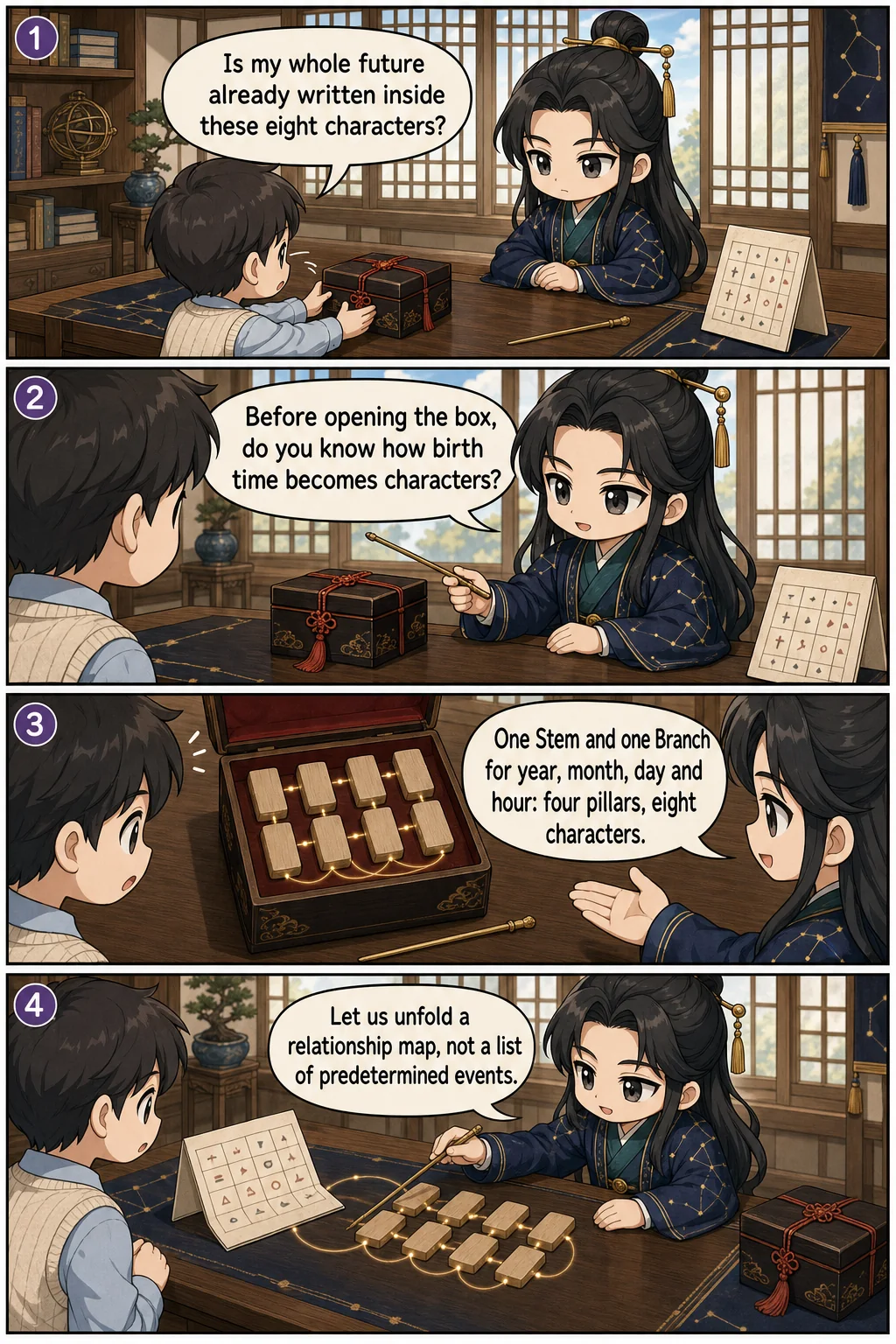
The short answer: Saju is a relationship map of birth time
Sa means four and ju means pillars. Palja means eight characters. Birth year, month, day, and hour are each expressed as a pair: one Heavenly Stem above and one Earthly Branch below. Those pairs are the Year, Month, Day, and Hour Pillars. Stacked vertically, the four pairs resemble structural columns, which is where the name comes from.
Up to this point, we are describing calendar conversion. Interpretation begins afterward. A character changes meaning according to season, neighboring characters, roots, combinations, clashes, and timing. Pulling out one symbol and translating it directly into a personality, occupation, or event discards the relationships the chart was built to compare. TheHeavenly Stems and Earthly Branches guide explains the basic alphabet in greater depth.
| Pillar | What it records | A useful question | Conclusion to avoid |
|---|---|---|---|
| Year Pillar | Stem-Branch pair for the birth year | Wider era, lineage, and outer setting | Your zodiac animal is not a complete personality |
| Month Pillar | Stem-Branch pair for the seasonal month | Season, formative environment, and social role | It is not assigned from the lunar month number alone |
| Day Pillar | Stem-Branch pair for the birth day | The Day Master as reference and close relationships | One Day-Pillar slogan cannot define a person |
| Hour Pillar | Stem-Branch pair for the birth time block | Later interests, expression, and plans | An unknown hour should not be presented as certain |
Why eight characters? Every pillar has an upper and lower sign
The upper character of each pillar is a Heavenly Stem; the lower one is an Earthly Branch. Stems are often used to inspect visible action, while Branches hold seasonal context and roots. Two characters multiplied by four pillars produce eight. The model does not stop at eight visible boxes, however. Each Branch can contain Hidden Stems, making the chart more layered than a flat grid. Continue to the Hidden Stems guide when you want to examine that interior layer.
The word “month” can also mislead beginners. A Saju Month Pillar is not assigned simply by copying a modern calendar or lunar month number. Traditional systems use seasonal solar-term boundaries. Year and month boundaries, the treatment of births near midnight, local time zones, and true-solar-time adjustments can differ by school or calculator settings. Input verification matters more than an elaborate reading built on an uncertain pillar.
If the birth hour is unknown
Do not invent precision. Confirm the Year, Month, and Day Pillars, then mark every Hour-Pillar claim as unresolved. Family records or a birth certificate may narrow the range. Choosing a convenient hour afterward because it matches remembered events is reverse fitting, not independent confirmation.
Five layers turn the grid into a reading
Beginners often begin by counting elements. A count can be a useful inventory, but it is not the interpretation. First identify the Day Master, the Heavenly Stem of the Day Pillar, as the reference point. Then ask how the Five Phases behave in the birth season and how the other characters support, drain, produce, or regulate the Day Master. Translate those relations through the Ten Stars, test their connections through roots and interactions, and only then consider changing time cycles.
| Reading layer | What to inspect | Core question |
|---|---|---|
| Day Master | Reference point of the reading | How the other seven characters relate to it |
| Five Phases | Wood, Fire, Earth, Metal, Water in season | Condition and flow, not a raw count alone |
| Ten Stars | Ten relationships measured from the Day Master | How peers, output, wealth, authority, and resource function |
| Roots and relations | Support in Branches plus combinations and clashes | Whether an isolated keyword connects to the chart |
| Timing | Changing conditions in major and annual cycles | Which layer becomes more visible without erasing the natal chart |
The Five Phases are not five literal substances hidden in the body. They are a traditional vocabulary for phases of change. An element absent from the visible grid is not automatically bad, and “missing” does not automatically mean that element is your Yongsin. TheFive Phases introduction andYongsin guide separate those two questions.
What Saju can ask, and what it cannot decide
| Area | A question Saju may support | What it cannot replace |
|---|---|---|
| Disposition | Which modes of response and expression recur? | A fixed personality or moral judgment |
| Conditions | Under what conditions does energy gather or scatter? | The real effects of family, education, class, and health |
| Timing | Which themes may become relatively prominent? | A guaranteed event, win, admission, or diagnosis on a date |
| Choice | What perspective helps compare options? | Medical, legal, financial, or relationship decisions |
Saju becomes more useful when it sharpens questions instead of promising prediction. Replace “Will I succeed?” with “When pressure rises, do I isolate myself or ask for support?” Replace “Will this be my lucky year?” with “If expression becomes more available, what artifact will I finish and show?” These are observable questions. The chart and a life record can be compared, while agency and responsibility stay with the person.
This distinction also prevents a common circular argument. If every result is declared proof after it occurs, the reading cannot learn from error. Write down a specific interpretation before the period, include what would count against it, and review both matches and misses. You are using a cultural framework for reflection, not conducting a scientific forecast.
A safe order for reading your first chart
- Verify input: birthplace, local time, solar or lunar notation, and leap-month status.
- Read the four pairs: record the Stems and Branches of Year, Month, Day, and Hour without interpreting yet.
- Locate the reference: identify the Day Master and the seasonal environment.
- Inspect relationships: look for directions repeated across phases, Ten Stars, roots, combinations, and clashes.
- Compare with life: keep both confirming and conflicting examples from actual decisions and behavior.
Do not settle on the first sentence that feels flattering or frightening. Ask whether several layers repeat the theme, whether contrary evidence exists, and whether the claim describes an observable action. For a neighboring example, the10 Day Masters guide shows why a Day Master describes one reference layer rather than an entire personality.
How Saju differs from Western astrology
Both systems use birth information, but their calculation languages differ. Saju reads relationships among calendrical Stems and Branches, Five Phases, Ten Stars, and major and annual cycles. Western astrology reads symbolic relationships among the Sun, Moon, planets, zodiac signs, and houses. They may produce similar descriptions, but a Saju character cannot be converted one-to-one into a planet. The Saju, astrology, and MBTI guidekeeps each system's calculations and questions separate when comparison is useful.
A small practice: turn eight boxes into connected questions
Print or sketch your chart without interpretations. Circle the Day Master. Mark the birth season. Draw one line to each character that directly supports it, one different line to each character it produces, and another to each character that regulates it. Then write one lived example beside every relation. If you cannot find an example, leave a question mark instead of inventing a trait.
The result should look less like a personality score and more like a network. Some paths reinforce one another; others pull in opposite directions. Contradiction is not an error to erase. A person may seek stability in one setting and exploration in another. The chart is most honest when it helps name conditional patterns without pretending those patterns are compulsory.
Set a date to revisit the page after a week or a month. Add not only confirming examples but also misses and newly learned behavior. If the interpretation narrows your choices, stop and rewrite it as a more concrete, changeable question. A map is a tool for updating observation, not a label that traps a person inside one story.
One-sentence summary
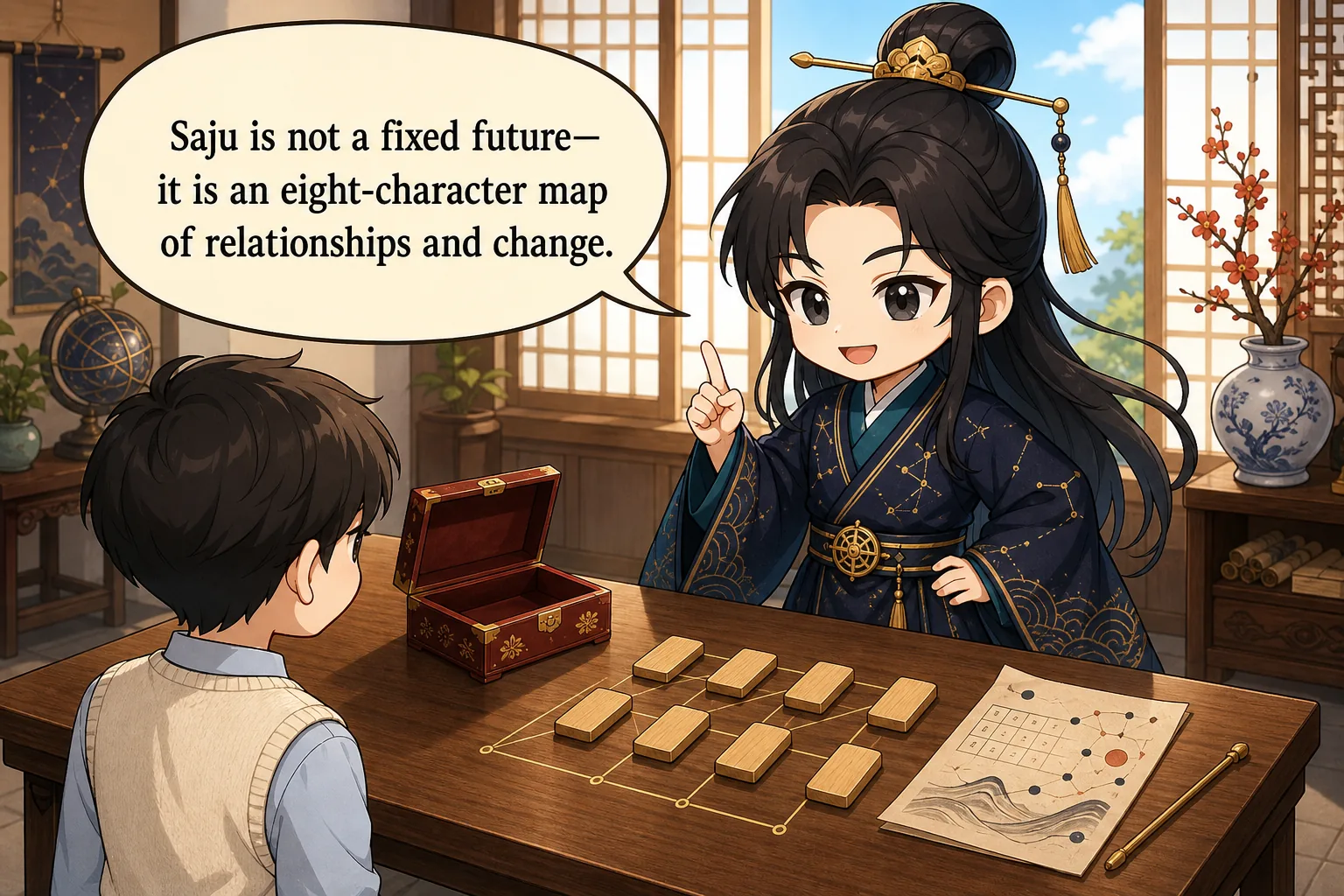
Saju Palja is not a verdict containing fixed events; it is an eight-character map for asking how relationships and change operate.
Sources and editorial note
The classical enumeration and qualities of the Five Phases were checked against the “Great Plan” section of the Book of Documents. The historical context of Four-Pillars narrative was reviewed through Sanming Tonghui and Shin Jeong-won’s 2024 study on destiny narratives in Myeongri. Product explanations of Stems, the Day Master, and timing were checked against the calculation paths that actually power the displayed chart.
This page explains a traditional self-reflection framework. It is not a scientific forecasting tool, psychometric personality test, or substitute for medical, legal, or financial advice. The legacy claim that eight characters reveal personality, wealth, and life path was not preserved; calculation, interpretation, uncertainty, and personal agency are separated explicitly.
Mystic Universe Editorial
Authorship & review
This article explains Saju as a traditional relational framework for reflection. It is not scientific forecasting, psychometric testing, or medical, legal, or financial advice.
Frequently Asked Questions
Q.Why does Saju use eight characters?▾
Birth year, month, day, and hour are each expressed by one Heavenly Stem and one Earthly Branch. Four pillars with two characters each produce the Eight Characters.
Q.Does Saju determine the future?▾
No. Saju is a traditional framework for interpreting relationships and changing conditions, not a verdict fixing events in advance. Environment, choice, practice, and chance still matter.
Q.Can I read Saju without a birth hour?▾
The Year, Month, and Day Pillars can still be calculated, but the Hour Pillar is unresolved. Do not invent an hour or present Hour-Pillar interpretations as certain.
Q.Is a missing element automatically my Yongsin?▾
No. A phase absent from the visible grid is not automatically the helpful one. Season, Day-Master condition, flow, roots, and the selected Yongsin method must be evaluated together.
Q.How is Saju different from Western astrology?▾
Saju reads calendrical Stems and Branches, Five Phases, Ten Stars, and luck cycles. Western astrology reads symbolic relationships among the Sun, Moon, planets, zodiac signs, and houses. Both use birth information, but their calculations are not interchangeable.
Related Articles
Curious about your Day Master?
Enter your birth details and AI will show your Day Master and Five Elements analysis.
Check My Saju for FreeThis content is for entertainment purposes only and does not replace professional advice.