
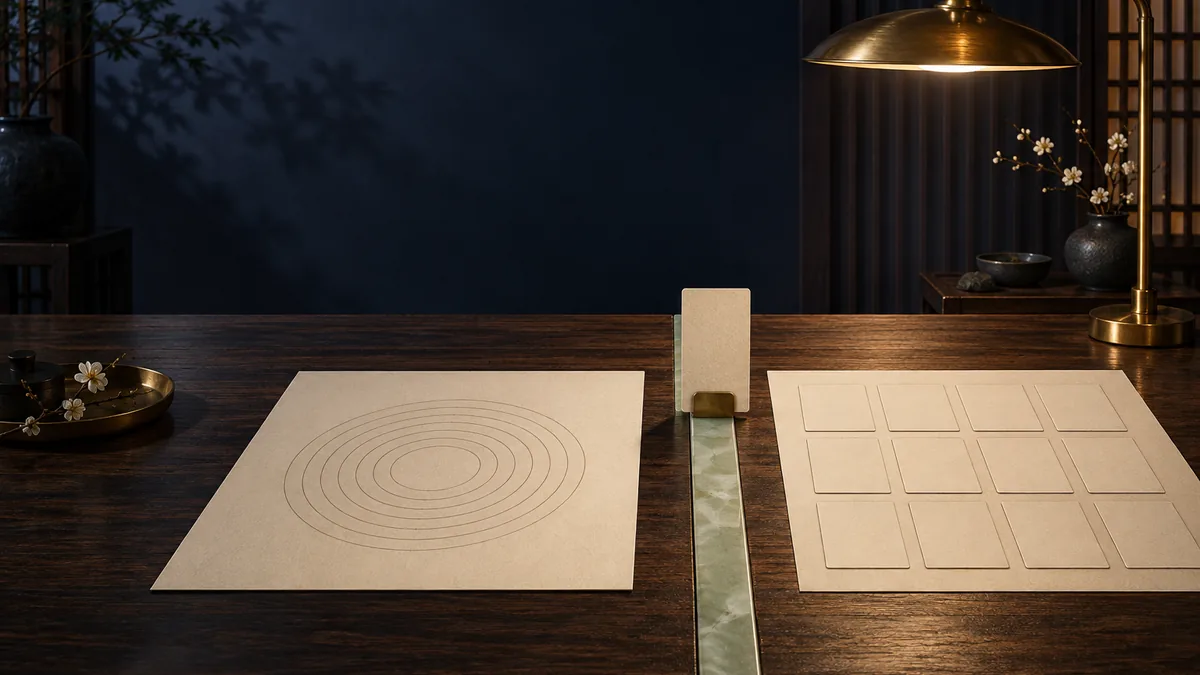
When a Saju reading and a tarot reading disagree, most people ask which one is right. That question is itself a sign the two were stacked incorrectly, because neither was built to hit the same target as the other.
So this guide opens with a question. If you consult two different systems, does the answer become twice as accurate? Rather than selling the combination, this article draws the line between where overlapping them is useful and where it turns into a stretch.
Today's question
Two systems, twice the accuracy?
Saju and tarot differ in what they take as input and in how they can be checked. What rises when you overlap them is not accuracy but the resolution of your question. Use one as evidence for the other and both collapse.
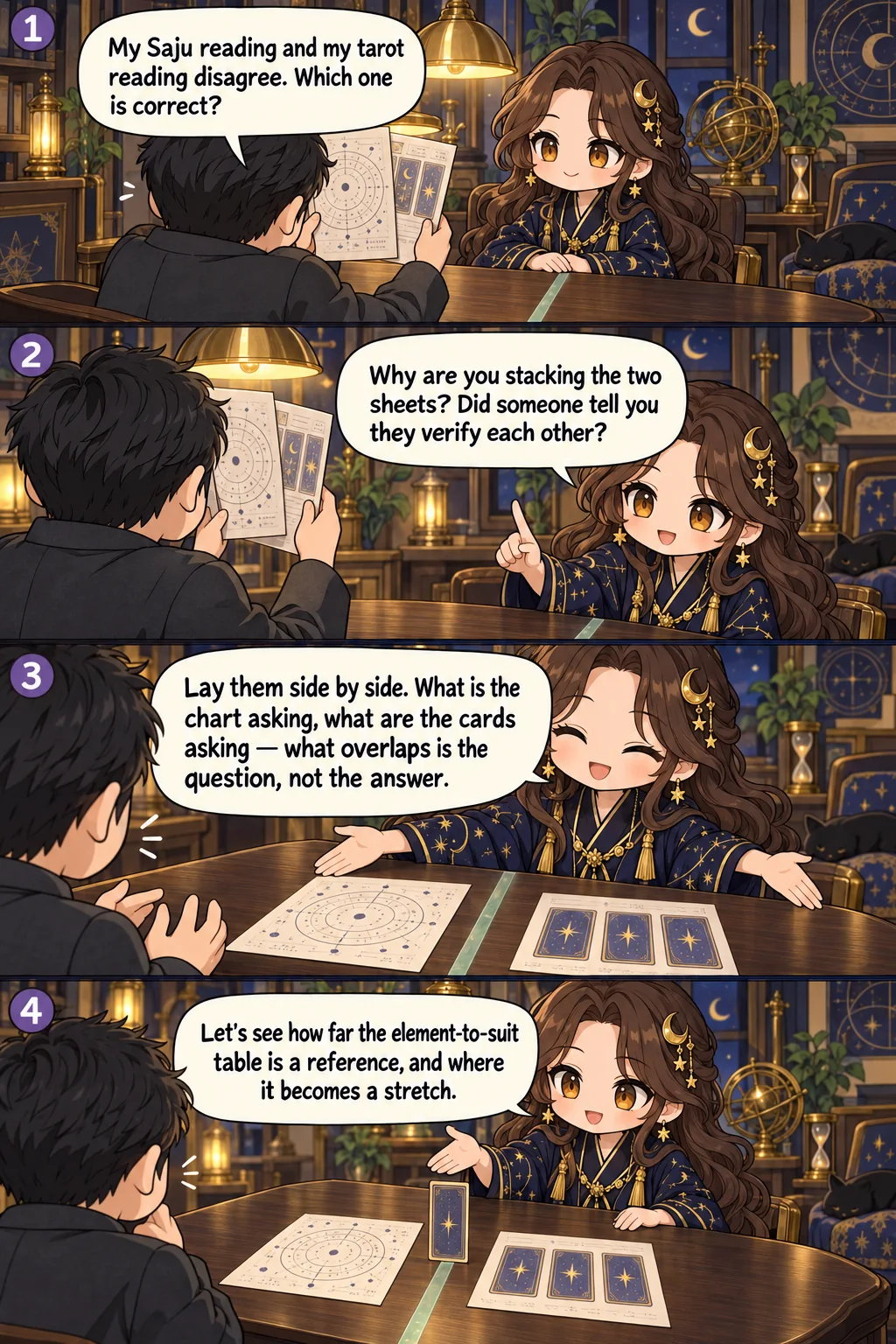
The short answer: what overlaps is the question
None of this means consulting both is pointless. It means expecting something different from it. Saju asks “what conditions is this person standing on?” Tarot asks “what is at stake in this question right now?” When both point at the same subject, what overlaps is not a conclusion but what is worth asking.
Say your chart shows markers associated with movement, and the cards also show a scene of relocating. Reading that as “it said move, twice” is wrong. Read correctly, it says “I keep circling the idea of moving; that deserves a proper think.” The decision is still settled by real conditions.
How the two differ
| Saju | Tarot | |
|---|---|---|
| Input | Birth date and hour — fixed once and never changes | Cards shuffled and drawn on the spot |
| Time span | A lifetime of structure and long cycles | This question now, at most the near future |
| What changes the result | Nothing — same input, same chart, any day | Drawing again gives you different cards |
| How it is read | Following generation and control among the elements | Reading image, position, and the story between cards |
The third row matters most. Put the same birth details in and Saju produces the same chart whenever you calculate it, because the rules of calculation are fixed. Tarot, for the same person asking the same question, gives different cards today and tomorrow, because shuffling is part of the method.
Which is why neither can verify the other
That opposite relationship to repetition forces one conclusion. Neither result can serve as evidence for the other. A good card does not alter the structure of a chart, and a chart does not determine the next card you will draw. If they point the same way, that is coincidence, or it is the same worry asked twice.
Holding this line is also the practical choice. The moment you believe they confirm each other, an unwelcome result gets erased by citing the other one — and then you are consulting two systems while actually reading neither. If the Saju side is unfamiliar, start with what Saju is; if the tarot side is, start with what tarot is.
The element-to-suit table — how far the resemblance goes
The usual bridge between the two is a mapping of the Five Elements onto the tarot suits. The four rows below are places where the symbols genuinely overlap, so they work as a reference frame.
| Mapping | Shared image | How strong the basis is |
|---|---|---|
| Wood ↔ Wands | Reaching outward, beginnings | Genuine overlap — both handle growth |
| Water ↔ Cups | Flow, feeling | They share the same image of water |
| Metal ↔ Swords | Hardness, the cut of a decision | Metal and blade overlap as material |
| Earth ↔ Pentacles | Ground, accumulation | Soil and coin both handle what piles up |
What this table is not is a historical lineage. Tarot’s four elements come from the Western scheme; the Five Elements grew separately in East Asia. There is no record of the two traditions meeting. So when the table lines up, the accurate reading is not “they really do connect” but “the symbols resemble each other enough to lay side by side.”
Where does the fifth element go?
Here the decisive limit appears. There are five elements and four suits. Assign Wood, Water, Metal and Earth to the four suits and Fire is left over.
A common practice assigns that leftover Fire to the Major Arcana, and the earlier version of this article did exactly that. It creates a contradiction inside the table, because in the Rider-Waite-Smith standard Fire is already assigned to Wands. Fire ends up in two places at once.
So we leave it empty
The fifth slot is more honest left empty. Forcing five into four means straining somewhere, and hiding the strain costs the whole table its credibility. If you want to read Fire, read it directly in the chart rather than routing it through a suit.
There is a second limit. The Five Elements carry a cycle — wood feeds fire, fire makes earth, and so on — along with a controlling relationship, and the tarot suits have no such cycle. No rule says Wands generate Cups or Swords overcome Pentacles. So use the mapping for individual correspondences only; the moment you try to carry the relationships across, it becomes a stretch. The element relationships themselves are better checked in the Five Elements guide.
If you do overlap them — three steps
Once the boundaries are clear, overlapping gets easier. Three steps.
- Use Saju to pick candidate questions. Areas, not conclusions. Just decide whether the axis standing out in the chart is relationships, work, or movement.
- Pick one and split it with tarot. Build an open question about that area and divide it into positions. How to build those is in the tarot spread guide.
- Write the conclusions separately, in their own layers. Do not merge what the chart said with what the cards said into one sentence. Kept side by side, you can later check for yourself which held up.
Ways of overlapping to avoid
| Pattern | How it sounds | What is wrong with it |
|---|---|---|
| Correcting one with the other | "The cards were bad but my chart is good, so it's fine" | They do not verify each other; this is just dismissal |
| Adding the two into a score | "Saju 70 plus tarot 80, so 75" | Adding different units produces a number that means nothing |
| Verdicts on health, lifespan, money | "Your fire is weak, so watch your heart" | Turning traditional symbols into medical or financial rulings |
| Drawing until it comes out right | Reshuffling until the wanted card appears | At that point it stops being a reading and becomes picking |
All four are variants of one mistake: trying to merge two systems into a single verdict machine. Merge what does not merge and what you are left with is not a verdict but the answer you already wanted.
Try it yourself — a two-layer sheet
One sheet of paper is enough. Fold it down the middle, write what you read in the chart on the left and what you read in the cards on the right. Then write one line of question along the fold. Both layers stay visible, and the crease keeps them from blending.
Collect a month of these and something interesting shows up. The left barely changes while the right keeps changing. That is correct: the left is where structure is recorded, the right is where now is recorded. Once that feels natural, the question of which one is right quietly disappears.
Once the sheets accumulate, you can check yourself. Beside the question written along the fold, add one line later saying what actually happened. Read those lines back after a few months and it becomes visible which layer you actually acted on and which you merely read past. Usually what emerges is that the thing that changed a decision was neither system, but the question written between them. That is the real yield of keeping the sheet.
In one sentence
Overlap Saju and tarot and the answers do not merge; what each was asking simply becomes clearer.
The app has no feature that merges the two. Start with your Saju resultto see the element balance, draw today’s card separately in the Fortune tab, and lay them side by side using the two-layer sheet above. The button below takes you to that second step.
Sources and production notes
Suit-to-element assignments follow the Rider-Waite-Smith standard, with a note that Wands and Swords are divided across traditions. The generating and controlling relations of the Five Elements presuppose five terms in a cycle, and the four-term suit system has no counterpart. Saju output is calculated deterministically from fixed birth details; the app draws tarot at random each time in the Fortune tab.
Four things are deliberately left unasserted. First, that the element-to-suit mapping is correct; it is symbolic association, not lineage. Second, where the fifth element belongs — this article leaves it empty. Third, that consulting both improves accuracy; no accuracy claim is made. Fourth, that a chart determines personality, health, or wealth; no element imbalance is tied to an organ or an income.
While checking this, the earlier version turned out to carry several problems. The mapping table assigned Fire to the Major Arcana, putting Fire in the table twice. It compared Saju to diagnosis and tarot to prescription, and stated that a fire constitution may mean a weak heart. It presented a wealth-reading case built without an actual chart. And it advertised an automated cross-reading feature the app does not have. The table is reduced to four rows, the rest is removed, and the invented case is replaced by a description of procedure rather than a new case. This article introduces a traditional symbolic system and does not offer scientifically validated prediction.
Mystic Universe Editorial
Authorship & review
This article explains how two traditional symbolic systems can be used together and where that stops. It is not scientifically validated prediction, and the app has no feature that merges the two results.
Frequently Asked Questions
Q.If Saju and tarot disagree, which should I believe?▾
Neither can serve as evidence for the other. Saju gives the same result whenever you calculate it from the same fixed birth details; tarot gives different cards each time because shuffling is part of the method. Their relationship to repetition is opposite, so they cannot verify one another. A disagreement means they were asking different things — write down what each was asking, side by side.
Q.Is the element-to-suit mapping an official standard?▾
No. Tarot's four elements come from the Western scheme and the Five Elements grew separately in East Asia, with no record of the two traditions meeting. Pairings like Wood with Wands or Water with Cups connect places where the symbols genuinely resemble each other, and they are accurate only as a reference frame.
Q.There are five elements and four suits. Where does the leftover go?▾
A common practice assigns the leftover Fire to the Major Arcana, and this article does not. In the Rider-Waite-Smith standard Fire is already assigned to Wands, so that puts Fire in the table twice. The fifth slot is left empty; if you want to read Fire, read it in the chart directly rather than routing it through a suit.
Q.Can I do a cross reading on my own?▾
Yes. Fold a sheet of paper down the middle, write what you read in the chart on the left and what you read in the cards on the right, and write one line of question along the fold. Use Saju to pick a candidate area, split one of them with tarot, and record each conclusion in its own layer. Not merging them into a single sentence is the whole point.
Q.Does GetSaju have a cross-reading feature?▾
No. The app offers a Saju result and tarot in the Fortune tab — one card for today, three for the week — as separate things, and does not provide a combined interpretation. Check each result and lay them side by side yourself, using the two-layer sheet described above.
Related Articles
Start with one card today?
The Fortune tab draws one card for today and three for the week.
Draw Today's CardThis content is for entertainment purposes only and does not replace professional advice.